Table of Contents
- The New Rules for Serious Injury Replacements
- Why is the BCCI Making This Change?
- Demerit Points Now Follow You Across All Formats
- What This Means for Players and Teams
The New Rules for Serious Injury Replacements
The Board of Control for Cricket in India (BCCI) has rolled out a significant update to its domestic cricket regulations, directly impacting the prestigious Ranji Trophy and Duleep Trophy. At the heart of this change is a new, stringent protocol for replacing players who suffer a ‘serious injury’ during a match .
Under the revised playing conditions, a player deemed ‘seriously injured’ is now officially ineligible to play for a full seven days. But that’s not all. Before they can even think about stepping back onto the field, they must receive explicit fitness clearance from the BCCI’s Centre of Excellence (COE) . This two-pronged approach—a mandatory stand-down period followed by a medical green light—is designed to add a serious layer of scrutiny to the injury replacement process.
The replacement player must also be a ‘like-for-like’ substitute, chosen from the list of nominated players at the time of the toss. This prevents teams from making tactical swaps under the guise of an injury .
Why is the BCCI Making This Change?
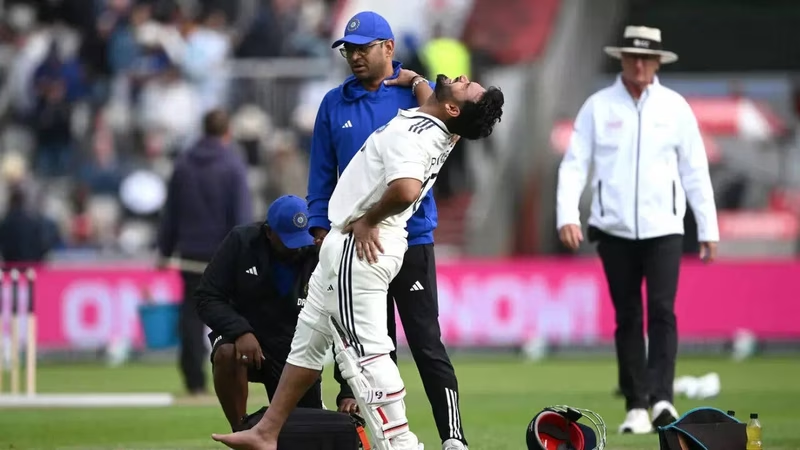
This move isn’t happening in a vacuum. The BCCI’s new rule is part of a wider, global pilot project sanctioned by the International Cricket Council (ICC) . The ICC has been exploring ways to allow like-for-like injury substitutions in international cricket, largely driven by high-profile incidents like Rishabh Pant’s career-threatening accident, which highlighted the need for better player welfare protocols .
The primary goal is to prevent the misuse of injury replacements. In the past, there have been whispers and concerns that teams might exploit vague injury definitions to gain a tactical advantage by bringing in a fresh, more suitable player for the current match situation. By mandating a seven-day stand-down and requiring COE clearance, the BCCI is sending a clear message: this rule is for genuine, serious injuries only .
Demerit Points Now Follow You Across All Formats
In a related but equally important update, the BCCI has announced that demerit points and associated sanctions will now carry over seamlessly across all formats of the game. This means a player who accumulates demerit points in a T20 league like the IPL will have that record follow them into domestic first-class cricket like the Ranji Trophy, and vice versa .
This unified code of conduct creates a more consistent disciplinary framework. It ensures that a player cannot escape the consequences of their actions by simply switching formats. The demerit points will remain on a player’s record for 24 months, or two full domestic seasons, before being cleared—provided there are no further transgressions .
What This Means for Players and Teams
For players, this new rule means their health and recovery will be under the microscope. A quick return from an injury is no longer an option without official medical approval. It places a greater emphasis on long-term player welfare over short-term team gains.
For team management, it demands greater caution and transparency. The process now requires a formal ‘Serious Injury Replacement Request’ to be submitted to the BCCI Match Referee immediately after the incident . Any attempt to game the system could lead to severe penalties and damage to the team’s reputation.
Overall, these changes signal a more professional, accountable, and player-centric era for Indian domestic cricket, aligning it more closely with evolving international standards.