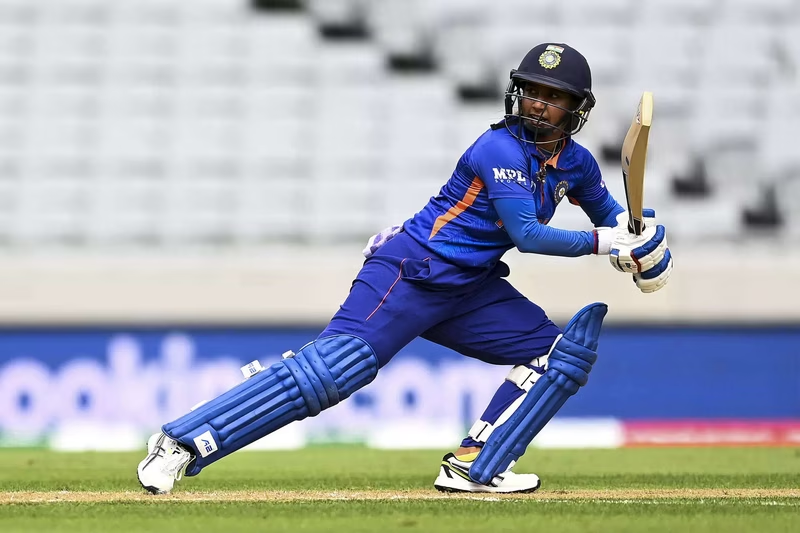
Just as India celebrates its historic ICC Women’s Cricket World Cup 2025 triumph, a powerful reminder of how far the game has come has resurfaced—thanks to none other than Mithali Raj herself. In a now-viral clip from a past interview, the legendary batter revealed a jaw-dropping truth: in the early 2000s, she and her teammates were paid just ₹1,000 per match to represent India. That’s less than the cost of a decent dinner in Mumbai today.
“We got just ₹1,000 a game,” Mithali said with quiet dignity, her words echoing across social media as fans grappled with the stark contrast between then and now. Fast forward to 2025, and Indian women cricketers earn the exact same match fees as their male counterparts—a landmark decision by the BCCI that has rewritten the narrative of gender equity in Indian sport.
From ₹1,000 to Parity: The Long Road to Equality
Mithali Raj’s career spans over two decades, beginning in 1999. She led India to their first Women’s World Cup final in 2005—a feat that should’ve been met with celebration and support. Instead, the team often traveled in economy class, stayed in modest lodgings, and received little media coverage. Their passion, not paychecks, kept them going.
Compare that to today: the 2025 World Cup-winning squad flew business class, had dedicated coaching and analytics staff, and each player earned ₹15 lakh per Test, ₹6 lakh per ODI, and ₹3 lakh per T20I—the same as the men. This parity, announced by the BCCI in 2023, was the result of years of advocacy by players like Mithali, Jhulan Goswami, and Harmanpreet Kaur.
Why Mithali’s Story Still Matters
Her revelation isn’t just about money—it’s about recognition. For years, women’s cricket was treated as a sideshow. Players juggled day jobs, relied on family support, and trained without proper facilities. Mithali once practiced in empty maidans at dawn because there were no evening slots for women at local grounds.
Now, with sold-out stadiums, prime-time broadcasts, and brand endorsements, the game has transformed. But Mithali’s ₹1,000 reminder ensures we never forget the pioneers who built this foundation with sweat, sacrifice, and sheer love for cricket.
Women’s Cricket Pay: Then vs Now
| Era | Match Fee (ODI) | Support & Infrastructure |
|---|---|---|
| Early 2000s | ₹1,000 | No dedicated coaches, minimal travel support, sparse media coverage |
| 2017–2022 | ₹1–2 lakh | Improved contracts, but still 30–50% less than men |
| 2023–2025 | ₹6 lakh (equal to men) | Full-time staff, analytics, equal travel, centralized contracts |
The Legacy of Sacrifice
Mithali retired in 2022, but her impact endures. She played 232 ODIs—the most by any woman cricketer—and scored over 7,000 runs. Yet, her greatest contribution may be the path she cleared for the current generation. Players like Yastika Bhatia, Richa Ghosh, and Shreyanka Patil now dream without limits, knowing their talent will be valued equally.
As fans cheer for the 2025 champions, Mithali’s old interview serves as a poignant tribute—not just to what was lost, but to what was won through quiet resilience.