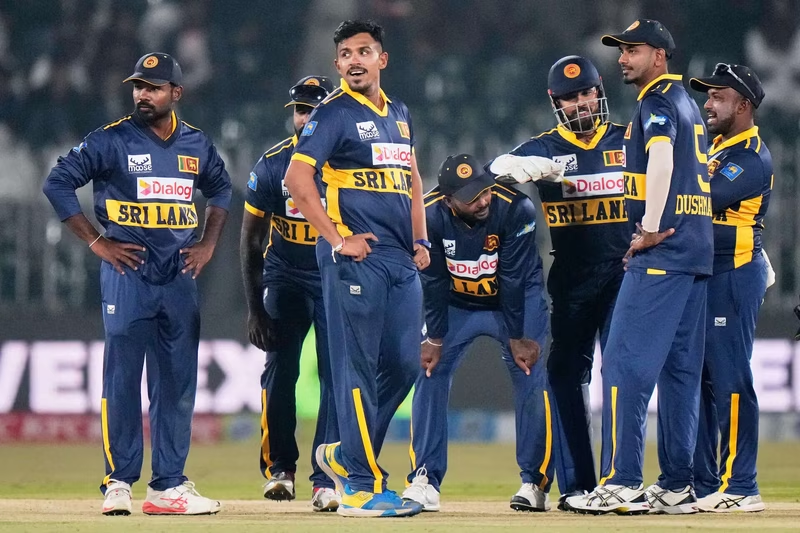
Sri Lanka Team Security Beefed Up After Islamabad Blast
In a tense and rapidly evolving situation, Pakistan has rolled out extraordinary security measures for the visiting Sri Lankan cricket team following a deadly suicide bombing in Islamabad. The attack, which claimed multiple lives and sent shockwaves across the capital, has thrown cricket diplomacy into sharp focus. In response, the Pakistan Cricket Board (PCB) has activated its highest-level protocols, with the army and paramilitary forces now directly involved in safeguarding the Sri Lankan contingent. The PCB chairman has personally reassured Colombo that the Sri Lanka team security Pakistan arrangements are “fool-proof” and non-negotiable .
But what exactly triggered this emergency response? How is security being restructured on the ground? And can cricket survive in a region grappling with escalating geopolitical tensions? Let’s break it all down.
Table of Contents
- Islamabad Blast: What Happened?
- Immediate Security Response for Sri Lankan Team
- PCB Chairman’s Personal Reassurance
- Broader Geopolitical Context: Afghanistan Tensions
- History of Security for International Teams in Pakistan
- What This Means for the Ongoing Series
- Conclusion: Cricket Amidst Crisis
- Sources
Islamabad Blast: What Happened?
On a quiet Tuesday in November 2025, a suicide bomber targeted a high-security zone in Islamabad, resulting in multiple fatalities and injuries . While no international cricketers were near the site, the attack occurred just days before a crucial bilateral series between Pakistan and Sri Lanka was set to continue.
The bombing has been widely attributed to militant groups operating from Afghanistan, with Pakistani authorities citing increased cross-border activity as a major concern . This incident has reignited fears about Pakistan’s internal security—especially for high-profile foreign visitors like international sports teams.
Immediate Security Response for Sri Lankan Team
Within hours of the blast, Pakistan’s National Security Committee convened an emergency meeting. The result? A massive security overhaul for the Sri Lankan squad:
- Military Deployment: Elite army and paramilitary units now provide 24/7 perimeter and convoy security.
- Restricted Movement: The team is confined to a highly secure hotel with biometric access and drone surveillance.
- Dedicated Escorts: Armored vehicles and armed commandos accompany every trip to the stadium or training ground.
- Intelligence Coordination: Real-time threat monitoring by ISI and local police intelligence wings.
These measures mirror those used during England’s historic 2023 tour and the 2025 ICC Champions Trophy, both of which were executed without incident thanks to similarly rigorous protocols.
PCB Chairman’s Personal Reassurance
In a show of diplomatic urgency, PCB Chairman Mohsin Naqvi held a direct video call with Sri Lanka Cricket (SLC) officials and team management . He personally guaranteed their safety, stating: “The security of the Sri Lankan team is our absolute top priority. We have deployed fool-proof measures involving the highest echelons of our security apparatus.”
Naqvi’s involvement underscores how seriously Pakistan is taking this situation—not just as a sporting matter, but as a test of its credibility on the global stage. A security lapse could set back Pakistan’s hard-won progress in hosting international cricket by years.
Broader Geopolitical Context: Afghanistan Tensions
The Islamabad blast didn’t occur in a vacuum. It comes amid a sharp escalation in tensions between Pakistan and Afghanistan over alleged safe havens for militant groups like the TTP (Tehreek-e-Taliban Pakistan). Pakistan has recently conducted cross-border airstrikes, and Afghanistan’s caretaker government has condemned them as violations of sovereignty .
This regional instability directly impacts cricket. Foreign teams have long cited security concerns as the primary reason for avoiding Pakistan. The current situation, therefore, is not just about one attack—it’s about whether Pakistan can maintain a safe environment in an increasingly volatile neighborhood.
For authoritative context on regional security dynamics, the International Crisis Group’s Pakistan reports provide invaluable analysis.
History of Security for International Teams in Pakistan
Since the 2009 attack on the Sri Lankan team bus in Lahore, Pakistan has treated international team security with near-military precision. Every visiting squad since the return of cricket in 2019—from West Indies to New Zealand—has been protected under “Fortress Cricket” protocols.
These efforts have largely succeeded. No foreign team has faced a security incident in Pakistan in over six years. The current measures for the Sri Lankan team are an extension of this proven model, now intensified due to the immediate threat environment.
What This Means for the Ongoing Series
As of now, both boards have confirmed the series will continue as scheduled . However, the atmosphere is undeniably tense. Sri Lankan players have been advised to avoid personal outings, and all public interactions have been canceled.
From a fan perspective, this could mean reduced crowd sizes or even closed-door matches if the threat level rises further. For fantasy cricket managers and bettors, staying updated via official channels like [INTERNAL_LINK:live-cricket-updates] is crucial.
Conclusion: Cricket Amidst Crisis
The heightened Sri Lanka team security Pakistan measures are a stark reminder that sport and geopolitics are often intertwined. While the PCB’s swift action and military-grade protection offer reassurance, the underlying tensions with Afghanistan pose an ongoing challenge. Cricket in Pakistan has come a long way since 2009—but as this crisis shows, its return remains fragile, requiring constant vigilance, trust, and above all, safety. For now, the game goes on—but under the watchful eyes of soldiers, not just spectators.
Sources
- Times of India: Security beefed up for SL team after Islamabad blast; PCB assures safety
- International Crisis Group: Pakistan Reports
- PCB Official Statement (as reported by media): Security protocols for international teams