Table of Contents
- Eden Gardens Pitch Sparks Controversy
- Player Reactions: “Dangerous” and “Unplayable”?
- Coaching Staff Weigh In on Pitch Conditions
- How Bowlers Exploited the Conditions
- Historical Context: Is This the Worst Indian Pitch?
- ICC Guidelines and Pitch Monitoring
- Conclusion
- Sources
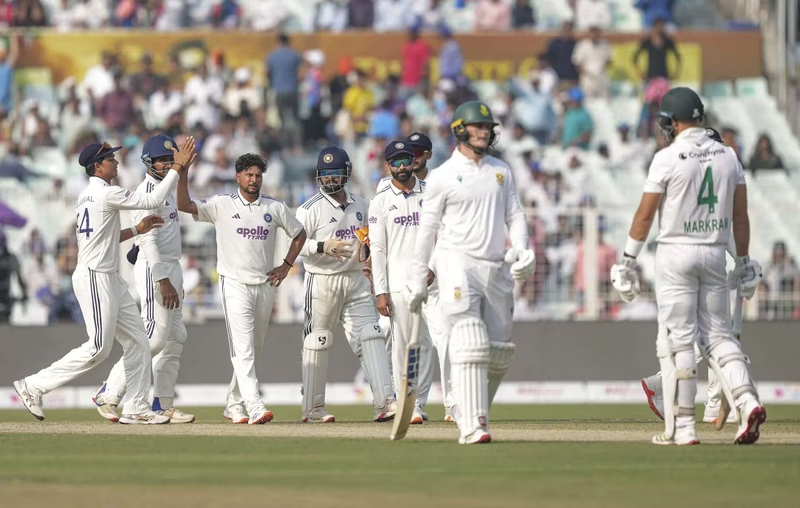
The opening India vs South Africa Test at Eden Gardens has turned into a high-stakes survival contest—not just for wickets, but for player safety. By the end of Day 2, a shocking 26 wickets had fallen, and the central figure in this drama wasn’t a bowler or batter, but the Eden Gardens pitch itself .
South African batsmen were visibly unsettled by erratic bounce, with deliveries from Jasprit Bumrah and Ravindra Jadeja leaping unpredictably from a length. Coaches from both teams expressed surprise at how quickly the surface deteriorated, describing it as “unusually variable” and, in some cases, “potentially hazardous.”
Eden Gardens Pitch Sparks Controversy
Traditionally, Eden Gardens is known for offering balanced contests—especially in the early stages of a Test. But this time, the pitch began misbehaving from Session 1 of Day 1. Balls were shooting low from one end while rearing up chest-high from the other, creating a minefield for batters.
What’s more alarming is the speed of deterioration. By Day 2, cracks had widened, and moisture loss led to inconsistent seam movement and exaggerated spin. This isn’t just “turn”—it’s unpredictability that borders on danger, especially when fast bowlers like Bumrah are extracting steep, sharp bounce from good lengths.
Player Reactions: “Dangerous” and “Unplayable”?
While no player used the word “dangerous” publicly, body language told the story. South African opener Tony de Zorzi flinched multiple times, and Aiden Markram was struck painfully on the glove by a Bumrah delivery that kept unusually low .
Behind the scenes, sources reported frustration among the Proteas camp. “You can’t trust your technique when you don’t know if the next ball will hit your shoe or your throat,” said one team insider .
Even Indian players acknowledged the extremity. One senior batter, off the record, admitted: “It’s not just tough—it’s unfair at times.”
Coaching Staff Weigh In on Pitch Conditions
South Africa’s batting coach Dale Benkenstein called the variable bounce “extreme for a pitch so young,” adding that such conditions usually appear only in Day 4 or 5 of a Test .
Interestingly, India’s coaching staff also seemed taken aback. Fielding coach Abhay Sharma was seen discussing pitch behavior with ground staff multiple times, suggesting even the home team hadn’t anticipated this level of inconsistency.
That said, not all were critical. A visiting spinner (believed to be Keshav Maharaj) noted that while challenging, the pitch “wasn’t the worst I’ve faced in India”—a nod to more notorious tracks like Nagpur 2023 or Chennai 2016 .
How Bowlers Exploited the Conditions
Jasprit Bumrah was the chief beneficiary, using his pinpoint yorkers and steep bouncers to devastating effect. His ability to seam the ball both ways, combined with unpredictable bounce, made him nearly unplayable.
Key moments included:
- Bumrah trapping David Bedingham lbw with a delivery that skidded through
- Ravindra Jadeja trapping Marco Jansen plumb in front after a sharp turn from a crack
- Mohammed Siraj getting Travis Head caught behind off a lifter that rose sharply
While skill played a part, the pitch magnified every minor error in judgment or footwork—a luxury bowlers rarely get on Day 2.
Historical Context: Is This the Worst Indian Pitch?
India has hosted several pitches criticized for excessive turn or uneven bounce. Notable examples include:
- Nagpur 2023 (IND vs AUS): Turn from ball one, 10 wickets in a session
- Chennai 2016 (IND vs AUS): 20 wickets in two days
- Mumbai 2012 (IND vs ENG): Cracked surface, heavy spin
Yet the Eden Gardens pitch in 2025 stands out not for turn, but for extreme variable bounce—a rarer and arguably more dangerous trait, especially for fast bowling.
ICC Guidelines and Pitch Monitoring
According to the ICC Pitch and Outfield Monitoring Process, a pitch can be rated “poor” if it shows “excessive seam movement, variable bounce, or early deterioration that compromises player safety.”
If match officials file a negative report, the venue could face sanctions, including loss of future international fixtures. Eden Gardens last received a “below average” rating in 2011—but never a full “poor” classification.
Fans can track pitch ratings and historical data on our pitch reports page for deeper insights.
Conclusion
The Eden Gardens pitch in the IND vs SA Test has reignited the debate over player safety versus “traditional” spin-friendly conditions. While it has produced a thrilling, low-scoring contest, the unpredictable bounce—particularly from fast bowlers—crosses a line for many players and coaches. As the match heads into its final days, all eyes will be on the ICC’s post-match assessment. One thing is certain: this pitch will be remembered not just for the cricket it produced, but for the questions it raised about the fine line between challenge and hazard.
Sources
- Times of India: IND vs SA: Eden pitch under fire as players question dangerous variable bounce
- International Cricket Council (ICC): ICC Pitch and Outfield Monitoring Process Guidelines
- ESPNcricinfo: Eden Gardens pitch history and ICC ratings