Table of Contents
- A Day to Forget for Indian Cricket
- India vs South Africa Test: The Numbers Behind the Collapse
- South Africa’s Disciplined Bowling Masterclass
- Unwanted Records India Now Owns
- Why Low Targets Are Dangerous in India
- Historical Context: SA Wins in India
- What Next for Team India?
- Conclusion
- Sources
A Day to Forget for Indian Cricket
November 15, 2025, will go down as one of the darkest days in recent Indian Test history. At Eden Gardens, a venue long considered a fortress for the home side, India imploded in spectacular fashion—bowled out for a mere 93 runs while chasing a modest target of 124 against South Africa .
The result wasn’t just a loss. It was a historic low that exposed deep cracks in India’s batting resilience and mental fortitude. The India vs South Africa Test ended with the Proteas celebrating their first victory on Indian soil since 2009—a gap of 15 years . For a team that has prided itself on home dominance, this defeat is both shocking and symbolic of a larger trend: the vulnerability of chasing small totals on deteriorating subcontinental pitches.
India vs South Africa Test: The Numbers Behind the Collapse
Cricket is a game of stats—and this innings was a statistical nightmare:
- Target: 124 (lowest 4th-innings target in a losing cause for India at home since 2001)
- All out for: 93 (India’s 3rd-lowest total in a 4th-innings chase in home Tests)
- Top scorer: Shreyas Iyer (29 runs)
- Run rate: 2.76 (indicating extreme caution that quickly turned into panic)
- Wickets lost to spin: 8 out of 10
Every batter from 1 to 9 scored less than 30. No partnerships crossed 25 runs. The scoreboard told the story of a side paralyzed by pressure, not pitch.
South Africa’s Disciplined Bowling Masterclass
While India faltered, South Africa executed a near-perfect bowling plan. On a wearing Eden Gardens track, they deployed relentless line-and-length discipline:
- Simon Harmer (off-spin): 5/33 – targeted rough outside off, used loop and turn to trap batters LBW or caught at slip.
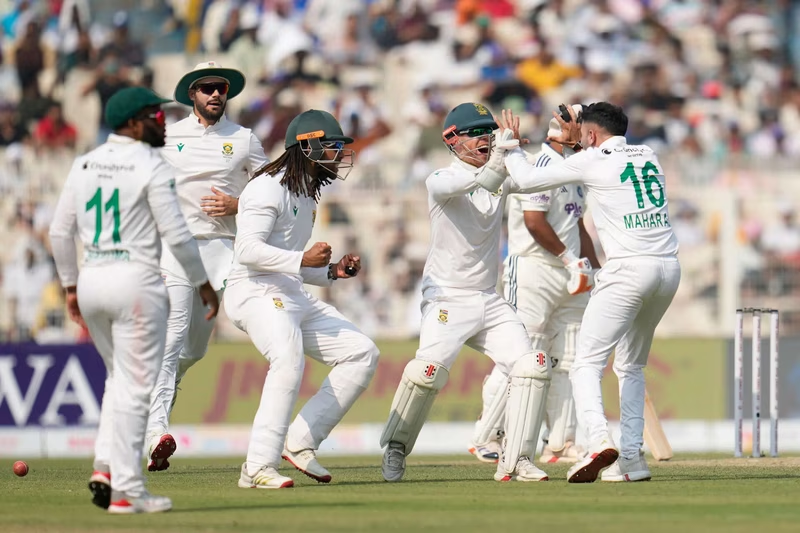
- Keshav Maharaj (left-arm spin): 3/27 – bowled tight, dried up singles, and built pressure from the other end.
- Aiden Markram & Marco Jansen: Combined for 2 wickets and crucial overs that prevented run flow.
There were no loose deliveries, no freebies. Just intelligent, patient, and clinical cricket—the kind India has often used to dominate visitors, now turned against them.
Unwanted Records India Now Owns
This collapse has dragged India into several undesirable statistical zones:
- Largest margin of defeat while chasing under 130 at home in the last two decades.
- First time since 2008 that India has lost a home Test after setting the opposition a target.
- Only the second instance in 35 years where India lost a home Test after bowling the opposition out twice for under 200.
- Joined the list of teams with the most sub-100 collapses in 4th-innings chases since 2020 (alongside Pakistan and West Indies) .
These aren’t just numbers—they reflect a recurring pattern of mental fragility in “must-win” or “low-pressure” chases.
Why Low Targets Are Dangerous in India
Paradoxically, chasing small totals in India can be more perilous than big ones. Here’s why:
- Fifth-day pitch deterioration: By Day 4 or 5, cracks widen, bounce becomes unpredictable, and spinners dominate.
- Psychological pressure: Batters feel they “must not lose,” leading to tentative shots and risk aversion.
- No time to rebuild: With a small target, there’s little room for error or recovery after early wickets.
In fact, since 2015, India has lost 3 home Tests
Historical Context: SA Wins in India
South Africa’s victory is monumental. Before this match, their last Test win in India was in 2009 in Kolkata—also at Eden Gardens . That series was led by Graeme Smith and featured Jacques Kallis in prime form.
Since then, South Africa had played 9 Tests in India and lost 7, drawing 2. Their inability to adapt to Indian conditions was a long-standing narrative. But under new leadership and with a matured spin attack, they’ve finally cracked the code—by embracing the conditions, not fighting them.
What Next for Team India?
With the series now 1-0 to South Africa, India faces immense pressure heading into the second Test [INTERNAL_LINK:india-vs-south-africa-test-collapse-without-gill]. Captain Shubman Gill’s fitness will be critical—if he returns, stability may return to the top order. But deeper fixes are needed:
- Reevaluate middle-order technique against quality spin on Day 5.
- Develop a clearer game plan for low chases—aggression early, not panic late.
- Consider benching batters who consistently crumble under pressure.
Conclusion
The India vs South Africa Test collapse isn’t just about one bad innings—it’s a symptom of a larger issue in Indian cricket’s home dominance narrative. When even Eden Gardens becomes a graveyard for the home side, it’s time for serious introspection. South Africa didn’t just win a match; they exposed a vulnerability. And for India, that’s a historic low that demands urgent correction.