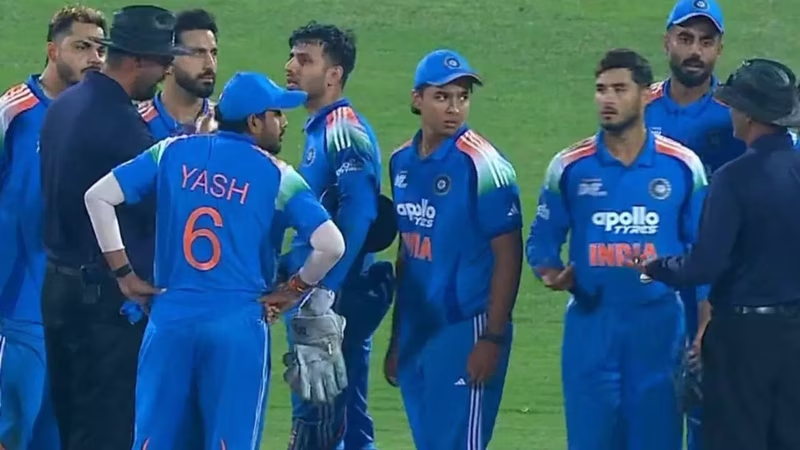
Cricket fans were left stunned during a high-stakes encounter at the Rising Stars Asia Cup when a dramatic relay catch attempt by India A was waved away by the on-field umpire—allowing Pakistan Shaheens’ star batter Maaz Sadaqat to continue his match-winning innings. What looked like a textbook dismissal turned into a major talking point, all thanks to a subtle but critical update in the MCC’s Laws of Cricket .
Table of Contents
- The Controversial Moment Explained
- The MCC Rule That Changed Everything
- Why This Matters in the Rising Stars Asia Cup
- Historical Context of Relay Catches in Cricket
- Fan and Expert Reactions
- Conclusion
- Sources
The Controversial Moment Explained
During the Group B clash between India A and Pakistan Shaheens in Doha, Maaz Sadaqat—already in scintillating form—skied a delivery towards the deep mid-wicket boundary. India A’s Nehal Wadhera sprinted from the boundary, leaped spectacularly, and managed to get a hand to the ball while airborne .
However, instead of holding on, Wadhera instinctively flicked the ball back into the field while still in mid-air. His teammate Naman Dhir, alert and nearby, cleanly caught the relayed ball. The Indian players erupted in celebration, believing they had dismissed the dangerous Sadaqat.
But the umpire immediately signaled ‘not out.’ Why? Because Wadhera, during his initial leap, had stepped beyond the boundary rope before flicking the ball back. This technicality made all the difference—and kept Sadaqat at the crease.
The MCC Rule That Changed Everything
The decision hinged on **Law 19.5.2** of the MCC’s Laws of Cricket, which governs catches near or over the boundary. According to this rule:
“A fielder who is not in contact with the ground is considered to be grounded beyond the boundary if his/her final contact with the ground before his/her first contact with the ball was not entirely within the boundary.”
In simpler terms: if a fielder’s last step before jumping was outside the rope, they are deemed to be outside the field of play—even if they catch or touch the ball while airborne over the playing area.
Because Wadhera’s last point of contact with the ground was beyond the boundary rope, his touch on the ball was treated as a boundary six—not a legal fielding act. Thus, the subsequent catch by Dhir was invalid. This rule was clarified and reinforced by the MCC in recent years to eliminate ambiguity around boundary-line catches .
Why This Matters in the Rising Stars Asia Cup
This ruling had massive consequences for the outcome of the match. Maaz Sadaqat, who was on 28 at the time of the incident, went on to smash an unbeaten 79 off just 47 balls, powering Pakistan Shaheens to a commanding eight-wicket victory in under 14 overs .
That win secured Pakistan’s place in the semifinals of the Rising Stars Asia Cup, while India A was left to rue what might have been. Had the catch been ruled legal, the momentum could have swung dramatically. Instead, the match became a showcase of how technical knowledge of the laws can be as crucial as skill on the field.
Historical Context of Relay Catches in Cricket
Relay catches—where a fielder near the boundary throws or flicks the ball back to a teammate before stepping out—have long been a gray area. In the past, such efforts were often celebrated as brilliant teamwork. However, inconsistent interpretations led the MCC to tighten the rules.
Notable instances include:
- 2019 IPL: A similar relay attempt by Mumbai Indians was ruled a six because the fielder’s foot was on the rope.
- 2023 World Test Championship Final: Umpires consulted extensively on a boundary-line catch, highlighting the complexity.
Today, the law is clear: the fielder must be grounded *entirely within* the boundary at the moment of their last contact with the ground before touching the ball. Anything else defaults to a boundary—no exceptions.
Fan and Expert Reactions
The decision sparked heated debate online. Many fans argued the spirit of the game was ignored, while others defended the umpire for correctly applying the letter of the law. Cricket analysts pointed out that fielders are now trained to stay *well inside* the boundary when attempting such heroics—a nuance that’s become part of elite fielding education.
As one former international umpire noted on social media: “It’s not an error—it’s modern cricket. Players must adapt to the laws, not the other way around.” This incident is now likely to be used in coaching manuals for [INTERNAL_LINK:Players] development programs across Asia.
Conclusion
While it may have felt like a missed opportunity for India A, the controversial not-out call in the Rising Stars Asia Cup was a textbook application of current cricket law. It underscores a critical truth in modern cricket: understanding the rules is just as important as mastering the cover drive. For young talents in this tournament, it’s a hard but valuable lesson in the fine margins that define elite sport.