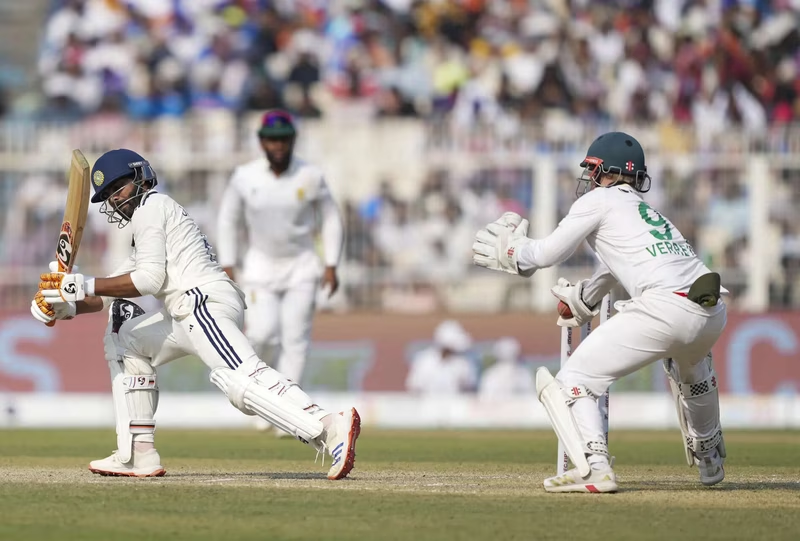
After India’s humiliating three-day Test collapse against South Africa at Eden Gardens, the cricketing world isn’t just questioning the pitch—it’s questioning the very foundation of Indian batting. And no voice has been more incisive than that of former Test batter and respected commentator Sanjay Manjrekar. In a brutally honest assessment, he declared: “Defence has become the last priority” for modern Indian batters—a statement that cuts to the heart of India’s Test batting crisis .
Table of Contents
- The Eden’s Collapse: A Symptom, Not the Disease
- Manjrekar’s Blunt Diagnosis
- How T20 Cricket Eroded Defensive Technique
- The Case for English-Style Pitches in India
- Can Indian Batters Relearn Defense?
- What This Means for India’s Test Future
- Conclusion
- Sources
The Eden’s Collapse: A Symptom, Not the Disease
India’s 30-run loss wasn’t just about a turning pitch or poor shot selection. It was the inevitable result of a deeper, systemic flaw: the inability to play long innings under pressure. Batters like Virat Kohli and Shreyas Iyer—normally rock-solid—were dismissed playing expansive drives to good-length balls that kept low or spun sharply .
But as Manjrekar points out, you can’t blame the pitch alone when your top order averages under 25 in home Tests over the past 12 months. The problem isn’t the surface—it’s the skill set of the players facing it.
Manjrekar’s Blunt Diagnosis
In a candid post-match analysis, Manjrekar didn’t hold back: “Today’s players are trained to score, not to survive. Defence is the last thing on their mind. They see a ball on off-stump and think, ‘Can I hit this?’—not ‘Can I leave this?’” .
He attributes this shift to the overwhelming dominance of white-ball cricket, especially franchise T20 leagues like the IPL, where aggression is rewarded and patience is penalized. “Test cricket has become the least favoured format in a player’s calendar,” he added. “Why would they invest in a skill that doesn’t get them contracts or fame?”
How T20 Cricket Eroded Defensive Technique
The data backs Manjrekar’s argument. Consider these trends:
- Reduced red-ball exposure: Most Indian domestic players now play fewer than 6 first-class matches a season, compared to 10–12 a decade ago.
- Technique drift: The “V” between bat and pad—once sacrosanct—has widened as batters adopt open stances optimized for sweeps and reverse-sweeps.
- Mental wiring: Young players spend more time analyzing T20 powerplay data than studying how to leave balls or play with a straight bat.
This has created a generation of batters who thrive in chaos but crumble under sustained pressure—a fatal flaw in Test cricket.
The Case for English-Style Pitches in India
Manjrekar’s proposed solution is radical: India should prepare more English-style pitches—green, seaming tracks that reward line, length, and patience over the first three days before offering spin later.
“If you give batters a surface where they have to play straight, leave well, and value their wicket, they’ll relearn those skills,” he argues. “You can’t teach defence on a pitch that turns square from ball one. It’s impossible.”
This approach would also better prepare India for overseas tours, where seaming conditions in England, Australia, and South Africa have repeatedly exposed their technical fragility—a key insight from our [INTERNAL_LINK:International] series on India’s away record.
Can Indian Batters Relearn Defense?
It’s not impossible—but it requires structural change:
- Domestic overhaul: Mandate more four-day games with points for survival (e.g., bonus points for partnerships over 50 runs).
- Academy focus: National and state academies must reintroduce “defensive drills” as core curriculum.
- Selector incentives: Reward consistent first-class performers over T20 stars for Test selection.
Players like Yashasvi Jaiswal and Dhruv Jurel show promise, but without systemic support, their natural talent may succumb to the same T20 conditioning.
What This Means for India’s Test Future
India sits at a crossroads. They can continue banking on extreme turners for short-term home wins—while watching their batting crumble under pressure. Or, they can heed Manjrekar’s warning and invest in a sustainable Test culture that values resilience as much as runs.
As the World Test Championship cycle intensifies, and away series become more critical, the cost of neglecting defensive technique will only grow. The Eden Gardens loss may be a painful wake-up call—but it could also be the catalyst for renewal.
Conclusion
Sanjay Manjrekar’s warning about India’s Test batting crisis is not just about one match—it’s a plea for the soul of red-ball cricket. In an era where every ball must be attacked, the art of defense is vanishing. If India wants to remain a true Test powerhouse, not just a home bully, it must rediscover the discipline, patience, and respect for the game that once defined its greatest batters. The pitch isn’t the problem; the mindset is.