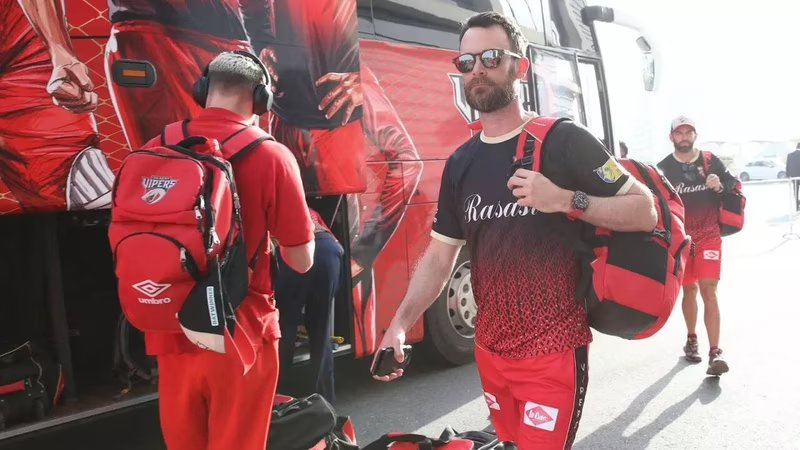
Desert Vipers’ ILT20 Season 4 Blueprint: Culture, Power Hitters, and a Title Quest
Two-time runners-up. Consistently competitive. But still chasing that elusive trophy. The Desert Vipers ILT20 franchise knows the sting of coming oh-so-close. But ahead of the fourth season of the International League T20, head coach James Foster isn’t just talking redemption—he’s unveiling a meticulously crafted plan built on three pillars: **team culture**, **strategic recruitment**, and **aggressive cricket**.
In an exclusive conversation with Times of India, Foster pulled back the curtain on how the Vipers intend to convert near-misses into championship glory—starting with a relaxed, player-centric environment and key signings like West Indian powerhouse Shimron Hetmyer and Afghan sensation Noor Ahmad .
Table of Contents
- The Runner-Up Curse and the Mindset Shift
- James Foster’s Player-First Philosophy
- Desert Vipers ILT20 Key Signings: Hetmyer and Noor
- The Retained Core: Continuity as a Competitive Edge
- Aggressive Cricket: Not Just a Slogan
- How the ILT20 Landscape Has Evolved
- Conclusion: Can the Vipers Finally Break Through?
- Sources
The Runner-Up Curse and the Mindset Shift
Finishing second in both ILT20 Season 1 and Season 2 is a double-edged sword. It proves consistency—but also breeds frustration. “We’ve been at the summit, just not on top of it,” Foster admitted. “This season isn’t about being competitive. It’s about winning.”
That clarity of intent has driven every decision—from retention to recruitment. The Vipers aren’t just assembling a team; they’re engineering a winner’s mindset.
James Foster’s Player-First Philosophy
Perhaps the most striking aspect of Foster’s approach is his emphasis on **psychological safety**. “When players feel valued, trusted, and relaxed, their performance soars,” he explained . This isn’t fluff—it’s neuroscience-backed coaching.
Gone are the days of fear-driven environments. At the Vipers’ camp, open communication, mutual respect, and fun are non-negotiable. Foster believes this culture unlocks creativity and resilience—critical in a high-pressure, short-format league like the ILT20.
“We don’t shout. We solve,” he said. “Mistakes are learning moments, not failures.”
Desert Vipers ILT20 Key Signings: Hetmyer and Noor
On the field, the Vipers have made two pivotal additions:
- Shimron Hetmyer: The West Indian left-hander is a proven finisher with a strike rate north of 140 in T20s. His ability to clear boundaries from ball one makes him the perfect lower-order enforcer—exactly what the Vipers lacked in tight chases.
- Noor Ahmad: The 19-year-old Afghan left-arm wristspinner is one of the most exciting young talents in world cricket. With mystery spin, control, and nerve in death overs, he adds a new dimension to the Vipers’ attack.
These aren’t just star signings—they’re tactical solutions to past weaknesses.
The Retained Core: Continuity as a Competitive Edge
While other franchises undergo major overhauls, the Vipers have wisely **retained a strong core**—including captain Colin Munro, pace spearhead Tom Curran, and wicketkeeper-batter Paul Stirling.
This continuity offers immense value:
- Chemistry: Players understand each other’s games intuitively.
- Leadership stability: Munro’s calm demeanor balances the team’s aggression.
- Tactical cohesion: Less time learning, more time executing.
In a league where team dynamics can make or break a campaign, this is a massive advantage.
Aggressive Cricket: Not Just a Slogan
“Aggressive cricket” is a phrase every T20 team uses. But for the Vipers, it’s operational doctrine. Foster revealed they’ve analyzed every innings from Seasons 1 and 2 and identified a key trend: **they often played too conservatively in the middle overs**.
This season, the mandate is clear: take risks early, back your skills, and never let the opposition dictate terms. With batters like Hetmyer, Stirling, and Johnson Charles in the lineup, the firepower is there to back it up.
How the ILT20 Landscape Has Evolved
The ILT20 is no longer the “new kid on the block.” As noted by the ICC’s global T20 league analysis, franchise leagues in the UAE now attract top-tier international talent year-round—raising the competitive bar significantly.
Teams like MI Emirates and Dubai Capitals have invested heavily. To stay ahead, the Vipers’ blend of culture, continuity, and calculated aggression may be their ultimate differentiator.
For more on the league’s growth, see our [INTERNAL_LINK:ilt20-season-4-preview].
Conclusion: Can the Vipers Finally Break Through?
The Desert Vipers ILT20 have all the pieces: a stable core, explosive new signings, and a head coach who prioritizes human connection as much as run rates. If their relaxed-yet-focused culture translates into fearless performances under pressure, 2026 could finally be their year.
As Foster put it: “We’re not chasing second place. We’re building a legacy.” And legacies are made by champions—not runners-up.
Sources
- Times of India: “EXCLUSIVE | Hetmyer, Noor and retained core: Foster reveals plans for ILT20 Season 4.” https://timesofindia.indiatimes.com/…/125405412.cms
- ICC Cricket: “The Rise of UAE-Based T20 Leagues.” https://www.icc-cricket.com/news
- ESPNCricinfo Player Profiles: Shimron Hetmyer, Noor Ahmad, Tom Curran.