India’s Bold Batting Drill After 1st Test Loss: Why No Front Pad?
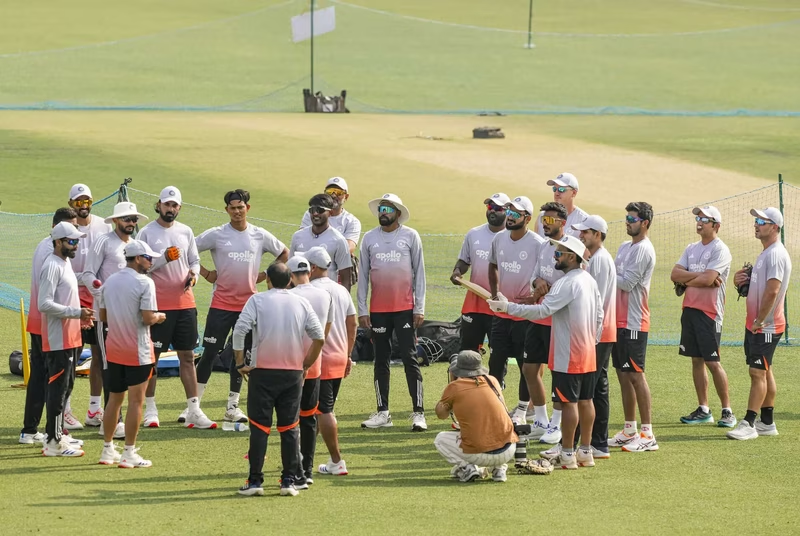
Following a humbling defeat in the first Test against South Africa, the Indian camp didn’t waste time sulking—they hit the nets with a purpose. And what caught everyone’s attention wasn’t just the intensity, but a throwback technique: batters **Sai Sudharsan** and **Dhruv Jurel** were seen training *without their front pads* during the optional practice session in Cape Town .
This unconventional **India batting drill** isn’t just for show. It’s a time-tested method designed to retrain muscle memory, force batters onto the front foot, and eliminate the dangerous habit of falling onto the back foot when facing quality spin—especially on turning tracks. With India’s top order looking shaky and Shubman Gill’s participation in the second Test hanging in the balance, this drill signals a serious course correction .
Table of Contents
- What Is the No-Front-Pad Batting Drill?
- Why India Needed This Drill After the 1st Test
- Sai Sudharsan and Dhruv Jurel Take the Lead
- Shubman Gill’s Uncertain Future in the Series
- Historical Roots of the Drill and Modern Relevance
- How This Drill Addresses India’s Spin Woes
- Conclusion: Can a Simple Drill Turn the Series Around?
- Sources
What Is the No-Front-Pad Batting Drill?
The “no front pad” drill is a classic technique used by coaches across generations. By removing the protective pad on the front leg, batters are forced to rely solely on their bat and footwork for defense. If they hang back or fail to commit to the front foot, they risk a painful blow to the shin—making the lesson unforgettable.
This method sharpens:
- Forward press timing against slower deliveries.
- Head position and balance when driving through the line.
- Discipline in playing with a straight bat, reducing edges.
As legendary batting coach Ramakrishnan Sridhar once noted, “Comfort breeds complacency. Sometimes, you need discomfort to learn.”
Why India Needed This Drill After the 1st Test
India’s batting collapse in Centurion exposed a recurring flaw: batters repeatedly falling onto the back foot against slow bowlers, even on pitches that offered minimal turn. South Africa’s Keshav Maharaj and veteran spinner Simon Harmer exploited this hesitation ruthlessly.
Multiple dismissals came from tentative prods, half-cocked defenses, and misjudged lengths—all symptoms of poor front-foot commitment. Head coach Gautam Gambhir and batting consultant Vikram Rathour clearly identified this as a priority fix before the second Test in Cape Town.
Sai Sudharsan and Dhruv Jurel Take the Lead
While senior players like Virat Kohli and Rohit Sharma focused on standard nets, it was the younger contingent—Sai Sudharsan and Dhruv Jurel—who embraced the challenging drill head-on.
Sudharsan, known for his elegant cover drives, has occasionally been criticized for getting tied down against spin in overseas conditions. Jurel, the wicketkeeper-batter with a solid technique, is likely being groomed as a potential No. 6 or 7 in the absence of an all-rounder.
Their willingness to undergo this discomfort shows a hunger to adapt—a trait India desperately needs right now.
Shubman Gill’s Uncertain Future in the Series
Compounding India’s batting concerns is the injury cloud over **Shubman Gill**. The opener missed the final day of the first Test and was absent from the main training group, only doing light fielding on the sidelines .
If Gill is ruled out of the second Test, Yashasvi Jaiswal could open with Sudharsan, or Ruturaj Gaikwad might get his chance. Either way, India’s top order is in flux—and that makes mastering fundamentals through drills like this even more critical.
Historical Roots of the Drill and Modern Relevance
This technique isn’t new. Indian batting greats like Sunil Gavaskar and Rahul Dravid reportedly used similar methods during their formative years. Gavaskar’s mastery against West Indies pace came from relentless net sessions that prioritized discipline over comfort.
In the modern era, players often rely on advanced gear and impact training. But as this **India batting drill** shows, sometimes the old ways are the best ways—especially when facing high-stakes, pressure-cooker situations like an away Ashes or a must-win Test in South Africa.
For further reading on traditional batting techniques, the ECB’s coaching manuals offer excellent insights into such drills [EXTERNAL_LINK:https://www.ecb.co.uk/].
How This Drill Addresses India’s Spin Woes
South Africa may not have a fearsome spin attack like India or Sri Lanka, but their spinners are accurate, patient, and backed by sharp close-in fielders. On slow, low tracks, hesitation is punished instantly.
By forcing batters to commit forward, the drill directly counters:
- Indecision on length (front-foot vs back-foot judgment).
- Soft dismissals like LBWs and bat-pad catches.
- Mental passivity when facing dot-ball pressure.
If even 20% of the squad internalizes this adjustment, it could change the complexion of the second Test.
Conclusion: Can a Simple Drill Turn the Series Around?
One net session won’t fix all of India’s problems—but it’s a powerful symbol of intent. The **India batting drill** without front pads is more than a technical exercise; it’s a mindset shift. It says: “We’re going back to basics. We’re willing to feel pain to avoid failure.”
With the series poised at 0–1, and pride on the line, such humility and adaptability might just be the spark India needs. As fans, we’ll be watching closely to see if this old-school remedy translates into runs on the board in Cape Town.
For more on India’s tour of South Africa, check out our [INTERNAL_LINK:ind-vs-sa-test-series-preview].
Sources
- Times of India: “IND vs SA: Who did what in first training session post India’s 1st Test loss?” https://timesofindia.indiatimes.com/…/125406381.cms
- ECB Coaching Resources: https://www.ecb.co.uk/play-cricket/coaching