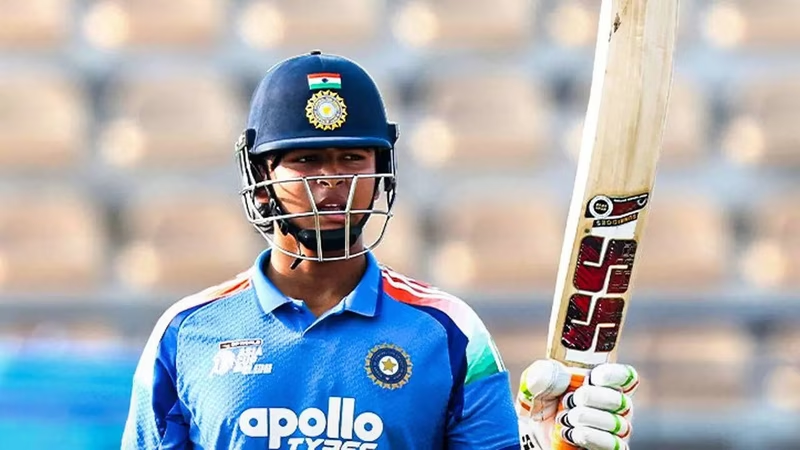
At just 14 years old, Vaibhav Suryavanshi isn’t just making runs—he’s rewriting expectations. The Indian batting prodigy has become the talk of the junior cricket circuit across Asia, and now, even rival players from Oman are left scratching their heads in disbelief. “14 saal ke ho, kaise maarte ho ye chakke?” (You’re 14 years old—how do you hit these sixes?) was the stunned reaction from Oman’s Samay Shrivastava after watching Suryavanshi dismantle top bowling attacks with jaw-dropping ease.
This isn’t hyperbole. In recent matches at the Rising Stars Asia Cup, Vaibhav Suryavanshi smashed a record-breaking 144 against the UAE and followed it up with a fearless 45 against the formidable Pakistan Shaheens—proving his talent isn’t a one-off. His clean striking, mature shot selection, and fearless intent have captured the imagination of fans, coaches, and even opponents. But perhaps no reaction has been as heartfelt—or as personal—as that of Oman’s emerging cricketers, many of whom share deep Indian roots.
Table of Contents
- Who Is Vaibhav Suryavanshi?
- Oman Players in Awe: “How Does He Do It?”
- Samay and Aryan: From India to Oman
- Why Suryavanshi’s Rise Matters for Asian Cricket
- The Future of Youth Cricket in Asia
- Conclusion: A New Benchmark for Teen Talent
- Sources
Who Is Vaibhav Suryavanshi?
Hailing from Ranchi—the same city that produced MS Dhoni—Vaibhav Suryavanshi has been on the radar of Indian selectors for years. Trained at the prestigious Ranchi Cricket Academy, he combines elegant strokeplay with explosive power, a rare blend in someone so young. His recent performances in the Rising Stars Asia Cup, a tournament featuring U-19 and A-level teams from across Asia, have elevated him from promising youngster to genuine phenom.
His 144 against UAE wasn’t just big—it was dominant. He cleared the ropes with nonchalant ease, often launching good-length deliveries over mid-wicket and long-off. Against Pakistan Shaheens, a team stacked with pace and spin, he showed adaptability, rotating strike and picking boundaries at will. For a 14-year-old to display such composure under pressure is what has left seasoned observers—and rival players—speechless.
Oman Players in Awe: “How Does He Do It?”
Samay Shrivastava and Aryan Bisht, two key members of Oman’s junior setup, didn’t just watch Suryavanshi—they studied him. Both, having moved from India to Oman during their childhood, understand the Indian cricket system intimately. That’s what makes their admiration so telling.
“We’ve played age-group cricket in India. We know how tough it is to score big, let alone hit sixes at will,” said Shrivastava in an exclusive conversation. “But Vaibhav… he’s operating on a different level. We genuinely want to meet him and learn from his technique.”
Bisht echoed the sentiment: “It’s not just power—it’s timing, footwork, and fearlessness. At 14, most of us were still scared of fast bowlers. He’s taking them on like a seasoned pro.”
Why Their Reaction Matters
- They’re not just fans—they’re competitors in the same tournament.
- As former Indian residents, they bring a nuanced perspective on grassroots talent.
- Their desire to “meet and learn” shows Suryavanshi’s impact transcends borders.
Samay and Aryan: From India to Oman
Both Shrivastava and Bisht were born in India—Shrivastava in Delhi and Bisht in Uttarakhand—before their families relocated to Oman for work. Like many expatriate families, cricket became their cultural anchor. Oman’s investment in youth cricket over the past decade has allowed talents like them to flourish under the ICC’s Associate pathway.
Shrivastava, a top-order batter, and Bisht, an all-rounder, now represent Oman in international junior competitions. Their journey mirrors that of hundreds of Indian-origin players across the Gulf who’ve found opportunity through Oman’s inclusive cricket policy. Ironically, it’s this shared heritage that makes Suryavanshi’s rise feel both inspiring and bittersweet to them.
Why Suryavanshi’s Rise Matters for Asian Cricket
Vaibhav Suryavanshi’s emergence signals a new era in youth development. In an age where T20 leagues dominate, his ability to anchor an innings while still clearing boundaries shows that classical technique and modern power can coexist.
For Associate nations like Oman, watching a 14-year-old from a Full Member nation dominate so effortlessly is both a benchmark and a motivator. It highlights the gap in resources, coaching, and exposure—but also proves that raw talent, when nurtured early, can accelerate faster than ever before.
According to the ICC’s Global Development Report, early specialization and access to high-quality domestic tournaments are key predictors of future international success—a model India is now executing with precision in its age-group system .
The Future of Youth Cricket in Asia
Tournaments like the Rising Stars Asia Cup are becoming critical talent incubators. They don’t just showcase future stars—they foster cross-border respect and learning. The fact that Oman players are actively seeking mentorship from an Indian prodigy like Suryavanshi speaks volumes about the collaborative spirit emerging in Asian cricket.
For India, Suryavanshi represents the next frontier: a generation that may debut in international cricket before even finishing school. For Oman and other Associates, his story is a blueprint—a reminder that while resources matter, vision, discipline, and early opportunity matter more.
Conclusion: A New Benchmark for Teen Talent
Vaibhav Suryavanshi is more than a prodigy—he’s a phenomenon redefining what’s possible at 14. His sixes aren’t just clearing boundaries; they’re shattering perceptions. And when even rival players from Oman pause to marvel and ask, “How?”, you know something special is unfolding.
As youth cricket in Asia grows more competitive and connected, talents like Suryavanshi won’t just carry India forward—they’ll inspire an entire continent to dream bigger, swing harder, and believe that age is just a number. The future of cricket isn’t coming. It’s already here—and it’s 14 years old.