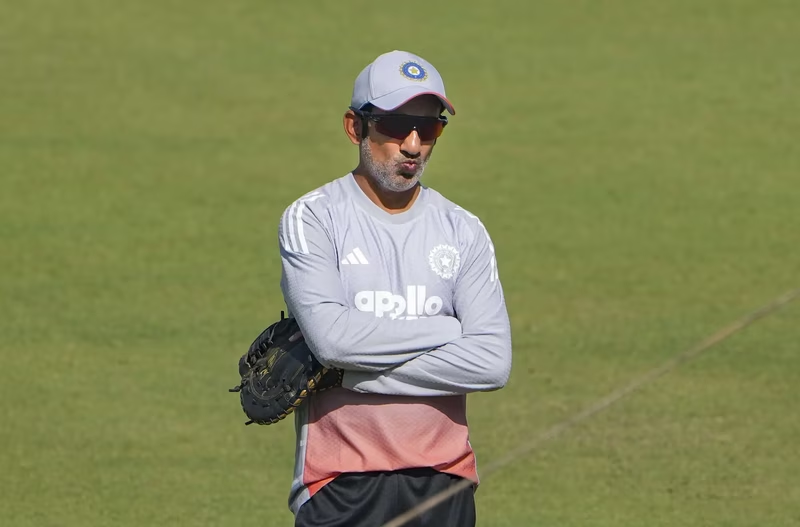
Ex-Cricketer Robin Uthappa Defends Gautam Gambhir
Following India’s shocking 30-run loss to South Africa in the opening Test at Eden Gardens—a match defined by a dramatic batting collapse on a turning track—new head coach Gautam Gambhir found himself at the center of a growing storm. Critics blamed the pitch, questioned team selection, and even targeted Gambhir’s coaching philosophy. But now, a prominent voice has stepped in to set the record straight: former India all-rounder Robin Uthappa.
Table of Contents
- Eden Gardens Backlash: The Root of Controversy
- Gautam Gambhir Responds to Pitch Criticism
- Robin Uthappa Slams “Double Standards”
- The Bigger Debate: Indian Pitches and Expectations
- What This Means for Gambhir’s Coaching Tenure
- Conclusion
- Sources
Eden Gardens Backlash: The Root of Controversy
India’s top order was dismantled twice on a pitch that offered sharp turn and variable bounce. The home side managed just 156 and 141 in their two innings, while South Africa’s spinners—led by Simon Harmer—ran rampant . Almost immediately, social media and expert panels lit up with accusations: the pitch was “too extreme,” “unplayable,” and “a betrayal of home advantage.”
Many pointed fingers at the new coaching setup, implying that Gautam Gambhir and captain Rohit Sharma had endorsed a surface designed to overcompensate for India’s perceived weakness against spin—a strategy that spectacularly backfired.
Gautam Gambhir Responds to Pitch Criticism
In his post-match press conference, Gambhir stood firm. “The pitch was exactly what we asked for,” he stated calmly. “It was playable. The ball spun, yes, but it didn’t do anything outrageous. You have to give credit to the opposition bowlers” .
He emphasized that pitches offering assistance to spinners are part of India’s home identity—a legacy that helped the team dominate for years under previous regimes. Gambhir’s stance was clear: this wasn’t a case of poor pitch preparation, but a failure of execution by the batters.
Robin Uthappa Slams “Double Standards”
Former India star Robin Uthappa echoed Gambhir’s sentiment with even sharper clarity. In a candid interview, he quipped, “Coach thodi jaake khel raha hai?” (“Is the coach going out there to bat?”)—highlighting the misplaced blame .
Uthappa argued that the same pitches lauded when India wins are condemned when they lose. “When we beat Australia or England on turning tracks, everyone celebrates ‘home advantage.’ But when we lose on a similar surface, suddenly the pitch is ‘criminal.’ That’s double standards,” he said .
He also pointed out a critical disparity: domestic pitches in India’s Ranji Trophy often offer far more assistance—yet rarely attract the same level of scrutiny. “If this pitch was in a Ranji match, no one would blink. But because it’s an international game and we lost, it becomes a scandal,” Uthappa noted .
The Bigger Debate: Indian Pitches and Expectations
This controversy taps into a long-standing tension in Indian cricket:
- Legacy vs. Evolution: India built its Test dominance on spin-friendly tracks, but modern batting demands more balance.
- Home Advantage: Should pitches be tailored to exploit opponent weaknesses, or offer a fair contest?
- Accountability: When results go south, is it the pitch, the players, or the coaching staff?
According to a report from the ICC, pitch neutrality has become a growing focus in recent years, with panels assessing home conditions to prevent excessive bias . Yet India has consistently defended its right to prepare pitches suited to its strengths—a position respected under ICC guidelines as long as they remain playable.
What This Means for Gambhir’s Coaching Tenure
As India’s first full-time head coach with no prior international coaching experience, Gautam Gambhir knew his appointment would be under a microscope. This early setback has amplified that scrutiny—but Uthappa’s public backing signals that not everyone in the cricketing fraternity is ready to pass judgment after one loss.
For Gambhir, the real test begins in Guwahati. If India bounces back—especially if they adapt quickly to varying conditions—it could silence critics and validate his tough-love approach. His philosophy aligns closely with what we explore in our [INTERNAL_LINK:Analysis] section on modern coaching transitions.
Conclusion
The uproar over the Eden Gardens pitch says more about fan expectations than pitch quality. Robin Uthappa’s defense of Gautam Gambhir cuts through the noise with a simple truth: coaches don’t bat, players do. While the surface certainly played a role, the onus remains on India’s batters to execute under pressure. As the series moves to Guwahati, all eyes will be on whether this team—and its new coach—can turn criticism into conviction.