Guwahati’s Historic Test & a Looming Strategic Dilemma
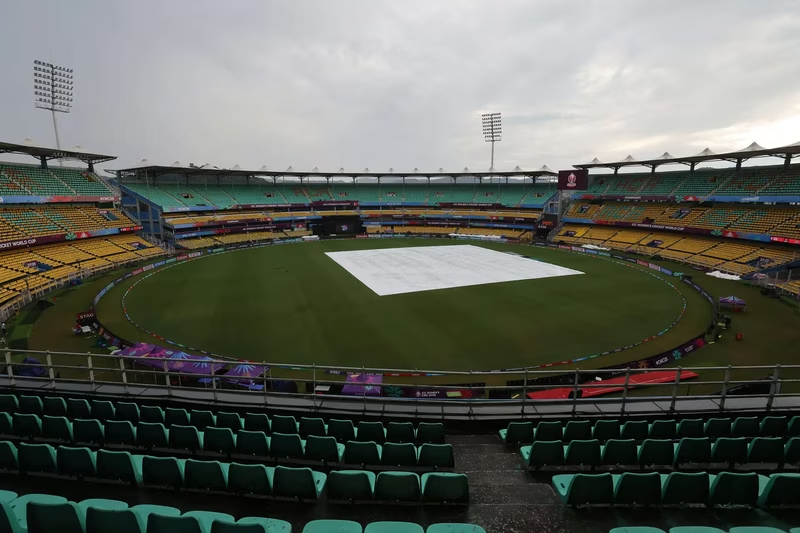
When the red cherry rolls onto the pitch at Guwahati’s Barsapara Stadium for the first time in a Test match, it will mark a historic moment for Assam and northeastern Indian cricket. The venue, India’s 28th Test ground, is a symbol of the BCCI’s successful mission to take top-tier cricket to every corner of the nation . Yet, this very policy of constant venue rotation has sparked a serious strategic debate, led by two of India’s modern greats: Virat Kohli and R Ashwin. Their central question is a provocative one: is India, in its quest for geographic inclusivity, inadvertently squandering its most potent weapon in Test cricket—its home advantage?
Table of Contents
- The Guwahati Factor
- The Home Advantage Paradox
- Kohli and Ashwin’s Crusade for Fixed Centers
- The Global Comparison
- The Path Forward
- Conclusion: A Delicate Balance
- Sources
The Guwahati Factor
The Barsapara Stadium, also known as the Assam Cricket Association Stadium, has hosted a handful of white-ball internationals, all of which have been high-scoring affairs on a surface described as “highly batting-friendly” with “good bounce” and a “fast outfield” . Early reports for the upcoming Test suggest a red-soil pitch that may offer initial seam movement for pacers before settling down . The big question is whether this pitch, in a venue with no prior Test history, can be prepared to the specific, challenging standards that have defined India’s home fortress in the past. The team has no historical data or ingrained familiarity with the conditions, which is the very opposite of a traditional home-ground advantage.
The Home Advantage Paradox
Historically, India’s home advantage was built on a simple, powerful formula: spin-friendly pitches at familiar venues. From 1990 to 2024, India won a staggering 87 of its 144 home Tests, turning its stadiums into formidable fortresses . However, the core of this strategy was consistency. Teams played at established grounds like Chennai, Mumbai, and Kolkata, where the pitches were known entities and the Indian team had a proven strategy for dominating them.
The current model of playing at a new venue almost every series disrupts this. As one expert analysis puts it, “fix the venues first, then fix the pitches. Do that, and India’s home advantage stops feeling like a guessing game” . When the home team itself is uncertain about the pitch behavior, that uncertainty dilutes the advantage.
Kohli and Ashwin’s Crusade for Fixed Centers
Both Virat Kohli and R Ashwin have been vocal advocates for a more focused approach. Years ago, Kohli proposed that India should limit its home Tests to a maximum of five premier venues to build a true legacy and advantage . He believed this would ensure only the best pitches were used and that the team could master them .
Ashwin has recently doubled down on this idea, stating bluntly, “Don’t call it a home Test just because the venue is on the Indian map” . He argues that a genuine home advantage comes from playing on the best pitches at venues where the team is acclimatized and has a clear strategic plan . For Ashwin, the constant rotation means India is often playing on sub-par surfaces that don’t challenge the opposition enough, thereby neutralizing their biggest strength .
The Global Comparison
The criticism gains weight when you look at other major Test-playing nations. Countries like England, Australia, and South Africa rely on a core group of 6-11 established Test venues . This provides a clear, consistent home environment. English teams know the Dukes ball will swing at Lord’s and seam at Headingley. Australian sides are masters of the pace and bounce at the Gabba and the WACA. This predictability for the home team, and unpredictability for the visitor, is the essence of a true home advantage—a system India seems to be moving away from.
The Path Forward
The BCCI faces a delicate balancing act. On one hand, the policy of venue rotation is a fantastic way to grow the sport’s popularity and discover new talent in untapped regions—a social and developmental win. On the other hand, from a pure, elite-level competitive standpoint, the calls from its most experienced players have merit.
A potential middle ground could be a two-tier system:
- Premier Test Circuit: A fixed set of 5-6 top-tier venues known for their challenging, high-quality pitches, reserved for marquee series against top-ranked opponents like Australia, England, and South Africa. This would preserve the competitive home advantage for the biggest battles.
- Developmental Venues: Newer stadiums like Guwahati could host matches against lower-ranked or visiting teams, serving the dual purpose of promoting cricket in new areas and giving the main team a chance to experiment in a lower-stakes environment.
Conclusion: A Delicate Balance
The inaugural Test in Guwahati is a landmark event for Indian cricket, but it also serves as a perfect case study for a much larger strategic question. While expanding the game’s footprint is noble, Kohli and Ashwin’s concerns are valid: a true home advantage in Test cricket is not just about geography, but about consistency, pitch quality, and team familiarity. To remain a dominant force at home, India must find a way to harmonize its developmental goals with its competitive ambitions. For more on team strategy, see our piece on [INTERNAL_LINK:india_test_team_management].
Sources
[1] Cricbuzz. “Barsapara Stadium, Guwahati Pitch Report”.
[8] Cricket.com. “India vs South Africa 2nd Test Match 2025”.
[9] ESPNcricinfo. “Should India have fixed Test centers? A deep dive…”.
[14] Times of India. “As Test cricket reaches Guwahati, are India squandering home advantage?”.
[16] The Cricket Monthly. “Off-side: India’s Test fortress is crumbling…”.
[17] CricTracker. “Don’t call it a home Test just because the venue is on Indian map: R Ashwin”.
[18] Hindustan Times. “India should have 5 fixed Test venues: Virat Kohli”.
[20] Sportstar. “India should have only five Test centres – Virat Kohli”.
[21] India Today. “Don’t call it a home Test just because the venue is on Indian map: R Ashwin”.
[24] Times Now. “R Ashwin calls for permanent Test centres in India”.