BCCI U-23 Tournament Shift: Pollution Forces Relocation to Mumbai
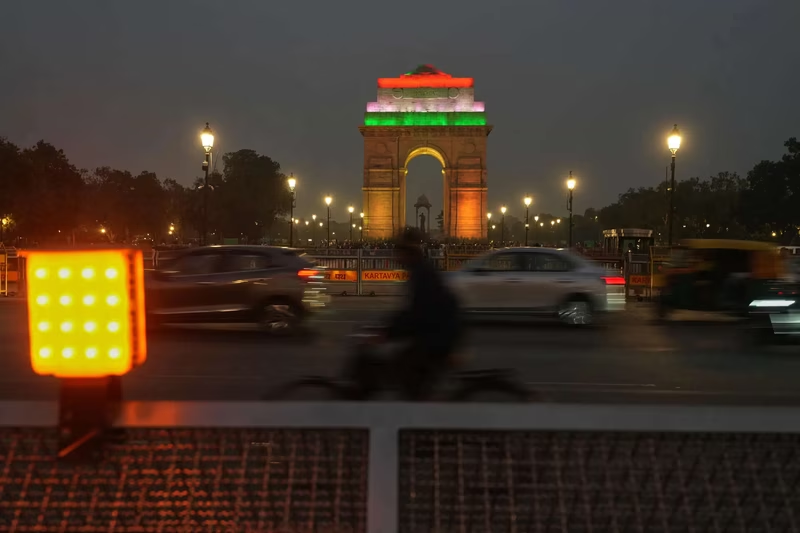
In a decisive move prioritizing athlete welfare over logistics, the Board of Control for Cricket in India (BCCI) is set to shift the knockout stage of the Under-23 State A One-Day tournament from Delhi to Mumbai due to dangerously high air pollution levels in the national capital. The decision, confirmed through internal communications on Friday, November 21, 2025, comes as Delhi’s Air Quality Index (AQI) remains in the “severe” category—exceeding 450 in several districts .
The BCCI has verbally requested the Mumbai Cricket Association (MCA) to prepare for hosting the crucial knockout matches, scheduled from November 25 to December 1. Venues like the Wankhede Stadium and the Brabourne Stadium are under consideration, with final confirmation expected within 48 hours.
Table of Contents
- Why Delhi Was Deemed Unsafe
- BCCI U-23 Tournament Shift: Logistics and Timeline
- Player Health and Pollution Risks
- Mumbai Cricket Association’s Readiness
- Precedents and Future Implications
- Conclusion
- Sources
Why Delhi Was Deemed Unsafe
Delhi’s air quality has deteriorated sharply in late November due to a combination of factors:
- Stubble burning in neighboring Punjab and Haryana
- Drop in temperature trapping pollutants near ground level
- Festive firecracker use post-Diwali
- High vehicular and industrial emissions
The Central Pollution Control Board (CPCB) has issued “public health emergency” warnings, advising all outdoor physical activity be minimized—especially for children and young adults . With U-23 players aged 20–23, the BCCI’s medical committee flagged the risk of respiratory distress, reduced lung function, and long-term health impact.
“We cannot ask future stars to train or compete in conditions that may harm their careers before they even begin,” said a senior BCCI official, requesting anonymity.
BCCI U-23 Tournament Shift: Logistics and Timeline
The relocation, though last-minute, is feasible due to Mumbai’s robust cricket infrastructure:
- November 22–24: Travel and accommodation arrangements for 12 qualifying state teams.
- November 25: Quarterfinals begin at Wankhede or Brabourne.
- November 29: Semifinals.
- December 1: Final and award ceremony.
The MCA has confirmed availability of practice facilities at the MCA Centre in Kandivli and match-day medical support, including on-ground pulmonologists and air quality monitors. Teams will be housed in centralized hotels to streamline movement.
For updates on domestic cricket disruptions, check our [INTERNAL_LINK:bcci-domestic-tournament-updates].
Player Health and Pollution Risks
Medical experts have long warned about the dangers of high-intensity exertion in polluted air:
- Reduced Oxygen Uptake: Particulate matter (PM2.5) impairs lung function, lowering stamina.
- Increased Asthma Risk: Even healthy athletes can experience bronchial inflammation.
- Long-Term Damage: Repeated exposure may lead to chronic respiratory conditions.
A 2023 study by the All India Institute of Medical Sciences (AIIMS) found that cricketers training in Delhi during November showed a 12–15% drop in peak expiratory flow rate (PEFR)—a key lung function metric . The BCCI’s decision aligns with global sports bodies like FIFA and the IOC, which now mandate air quality thresholds for youth competitions.
Mumbai Cricket Association’s Readiness
The MCA, led by chairman Amol Vaidya, has a strong track record of hosting last-minute events. In 2023, it seamlessly absorbed Ranji Trophy matches shifted from flood-affected regions. This time, the association is leveraging its experience:
- All venues equipped with LED lighting for day-night matches.
- Practice pitches pre-prepared for white-ball conditions.
- Coordination with Mumbai Police for smooth team transit amid city traffic.
“Mumbai has always stood ready to support Indian cricket in times of need,” Vaidya stated. “Our priority is ensuring these young talents get a safe, competitive platform.”
Precedents and Future Implications
This isn’t the first time pollution has disrupted Indian cricket:
- 2017: The India vs Sri Lanka ODI in Delhi was nearly called off due to AQI > 400.
- 2022: Junior National Championships were moved from Delhi to Indore.
- 2024: BCCI introduced a formal “Air Quality Protocol” for all domestic tournaments.
Going forward, the board may consider seasonal adjustments—scheduling northern India’s winter tournaments in southern or western zones where air quality remains stable. Climate-resilient planning is no longer optional; it’s essential for athlete safety and event integrity.
Conclusion
The BCCI U-23 tournament shift from Delhi to Mumbai is a responsible, health-first decision that reflects the growing intersection of sports and environmental awareness. While logistical challenges remain, the move protects the well-being of India’s next-generation cricketers—many of whom could soon don the national jersey. As climate volatility increases, such adaptive responses will become the norm, not the exception. For now, all eyes turn to Mumbai, where the future of Indian cricket will compete not just for trophies, but for a safe and sustainable playing environment.
Sources
- Times of India: BCCI likely to shift U-23 One-Day knockouts from Delhi to Mumbai due to severe pollution
- Central Pollution Control Board: Delhi Air Quality Index (AQI) Dashboard
- AIIMS Study (2023): Impact of Urban Air Pollution on Young Athletes’ Respiratory Health
- BCCI Domestic Handbook 2025: BCCI Air Quality and Player Safety Protocols