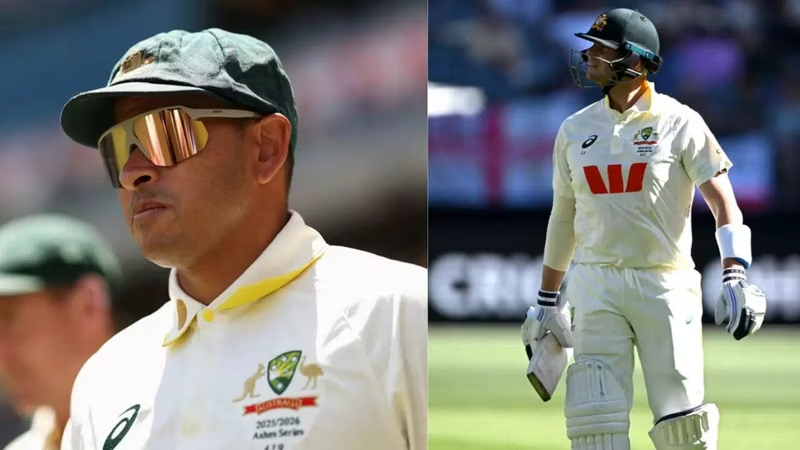
Khawaja Barred from Opening: The Ashes Chaos Explained
The opening day of the 2025 Ashes in Perth delivered a plot twist no one saw coming. Instead of the familiar sight of Usman Khawaja walking out to face the new ball, it was debutant Jake Weatherald who partnered with Marnus Labuschagne at the top. The reason? Khawaja was officially barred from opening—not due to a failed fitness test or a tactical gamble, but because of a little-known, yet strict, ICC playing condition regarding time spent off the field .
This unusual turn of events not only disrupted Australia’s carefully laid plans but also forced captain Steve Smith into the unaccustomed role of a No. 3 batsman, adding another layer of complexity to an already tense contest.
Table of Contents
- The Bizarre ICC Rule That Changed Everything
- What Happened on Day One in Perth?
- Steve Smith’s Unexpected Role at No. 3
- Impact on Australia’s Ashes Campaign
- Conclusion
- Sources
The Bizarre ICC Rule That Changed Everything
The heart of this controversy lies in the ICC’s standard playing conditions, specifically a rule designed to prevent time-wasting and ensure fairness. According to these regulations, if a player is off the field of play for longer than eight minutes during the opposition’s innings, they face restrictions on their own participation when their team comes to bat .
Reports indicate that Khawaja left the field for what was described as “toilet breaks and stretching” to manage back spasms . His absence lasted for approximately 23 minutes . This triggered the penalty clause in the ICC rules. The consequence was that Khawaja was not permitted to bat until he had served an equivalent amount of “penalty time” on the field during Australia’s innings—time that simply didn’t exist at the start of their batting order .
This rule, while logical in its intent to prevent gamesmanship, created a bizarre situation where a fully fit and selected opening batsman was rendered ineligible to perform his primary role at the start of the innings.
What Happened on Day One in Perth?
England won the toss and elected to bat first, but their innings was cut short as they were bowled out for just 117 runs. Australian pacers provided an excellent start for the hosts .
However, the drama was just beginning for Australia. With Khawaja unable to take the field as an opener, selectors had to scramble. The solution was to promote debutant Jake Weatherald to open the batting alongside Marnus Labuschagne, a move that was as unexpected as it was forced.
Despite the disruption, the initial plan seemed to work for a short while. Labuschagne and the incoming Steve Smith managed to weather England’s attack for a brief period. But the makeshift top order was fragile. Australia’s innings quickly unraveled in a dramatic collapse, losing wickets in a flurry to be bowled out for 123, giving England a slender first-innings lead . The day ended with the match perfectly poised, but the shadow of the Khawaja controversy loomed large.
Steve Smith’s Unexpected Role at No. 3
Forced to find a new No. 3, Australia turned to their captain, Steve Smith. While Smith is a world-class batsman, he is not a natural No. 3 in the current setup and hadn’t batted in that position regularly for some time. His move up the order was a direct and immediate consequence of Khawaja being barred from opening .
This shift presented a significant tactical challenge. The No. 3 position is crucial, often tasked with seeing off the new ball if an early wicket falls or stabilizing the innings after the openers have done their job. Smith, known for his unique technique and exceptional skill against the short ball, had to adapt his game to the specific demands of that spot in the order, all while leading the team under immense Ashes pressure.
Impact on Australia’s Ashes Campaign
The implications of this incident stretch far beyond a single, chaotic day of cricket. It raises serious questions about team management and preparation:
- Medical & Tactical Planning: Why was Khawaja’s back issue not managed in a way that kept him within the eight-minute window? This highlights a potential oversight in the team’s medical and tactical planning .
- Squad Depth Test: It immediately tested the depth of Australia’s batting lineup, thrusting a debutant into one of the most high-pressure roles in cricket.
- Psychological Factor: Such an avoidable disruption can be a significant psychological blow to a team at the start of a major series like the Ashes.
For the remainder of the series, Australia will need to ensure that all players, especially those with known niggles like Khawaja, are meticulously managed to avoid a repeat of this scenario. As for Khawaja, he is still a vital part of the team, and fans can expect to see him back in his usual role in the second innings and beyond, provided he serves his penalty time or avoids another lengthy absence . You can check the latest Ashes 2025 schedule to follow his return.
Conclusion
The story of Usman Khawaja being barred from opening in the first Ashes Test is a stark reminder that modern cricket is as much about navigating complex regulations as it is about skill and strategy. A routine break for a minor back issue snowballed into a major tactical headache for Australia, forcing Steve Smith into an unfamiliar spot and throwing their entire batting plan into disarray. While the on-field drama provided thrilling, if chaotic, entertainment for fans, it serves as a crucial lesson for all teams on the importance of understanding and adhering to every nuance of the game’s laws. For an official breakdown of the rules governing player availability, you can refer to the ICC’s official playing conditions.
Sources
- Times of India: Khawaja barred from opening in Ashes! Steve Smith forced to bat at No. 3 – here’s why
- ABC Sport: Reporting on Khawaja’s off-field time for “toilet breaks and stretching”.
- ICC Official Website: ICC Men’s Standard Playing Conditions.