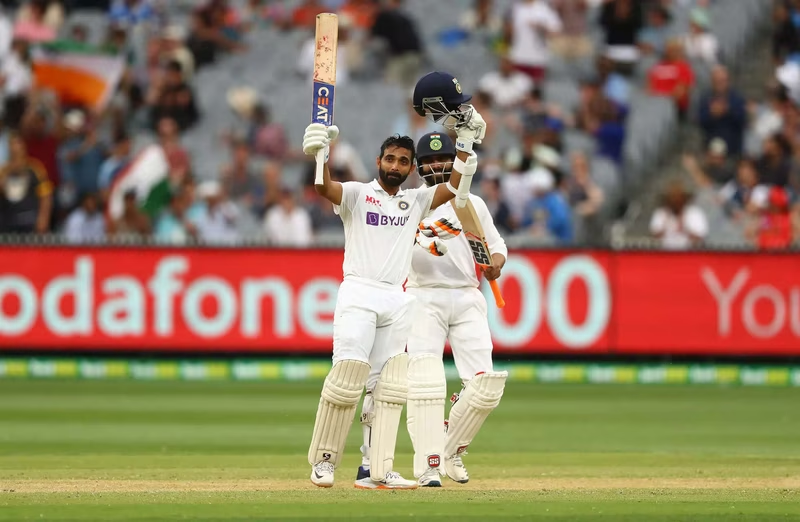
Rahane Slams No.3 Chaos: A Stark Warning to Team Management
In a rare and pointed public critique, former India vice-captain Ajinkya Rahane has fired a warning shot at newly appointed chief selector Gautam Gambhir over the team’s erratic handling of the crucial No.3 batting position. “A player’s career is on the line,” Rahane declared, highlighting the damage caused by India’s recent No.3 chaos—a revolving door that has seen Washington Sundar promoted over established red-ball talent like Sai Sudharsan .
Rahane, who himself anchored India’s middle order for years from that very spot, argued that the No.3 role demands technical stability, mental resilience, and long-term nurturing—not experimental tinkering based on short-term tactics or IPL form. His comments come amid growing concern over India’s lack of a settled batting core ahead of a packed 2025–26 Test calendar, including the World Test Championship final.
Table of Contents
- The No.3 Chaos: What Happened?
- Rahane on Career Implications
- Why No.3 Is Crucial in Test Cricket
- Sai Sudharsan vs Washington Sundar: The Debate
- What India Needs: A Long-Term Vision
- Conclusion
- Sources
The No.3 Chaos: What Happened?
The controversy stems from India’s recent squad decisions for the home Test series against South Africa. Despite Sai Sudharsan’s stellar domestic record—including a 154 on debut for Gujarat and consistent Ranji Trophy performances—he was overlooked in favor of all-rounder Washington Sundar, who was asked to bat at No.3 despite averaging under 30 in first-class cricket .
This move followed earlier experiments with Shreyas Iyer, Hanuma Vihari, and even Cheteshwar Pujara at No.3 in different conditions. The lack of continuity has left fans and experts baffled, especially when compared to historical stability—think Rahul Dravid (1996–2012) or Kumar Sangakkara for Sri Lanka.
Rahane on Career Implications
“You can’t treat the No.3 position like a T20 Powerplay slot,” Rahane told reporters. “This is Test cricket. A young player needs clarity, confidence, and the security of knowing he’ll get 3–4 matches to prove himself. Constant chopping and changing based on one innings? That’s unfair—and it ruins careers.”
He emphasized that players like Sudharsan—who have excelled in India’s premier domestic competition—deserve a proper run. “When you promote a part-time batter over someone with a proven red-ball technique just to ‘balance the side,’ you’re prioritizing theory over reality,” Rahane added .
Why No.3 Is Crucial in Test Cricket
The No.3 batsman is often called the “backbone” of the innings. Their responsibilities include:
- Walking in possibly as early as the 2nd over if an opener falls.
- Handling the new ball with pace and movement.
- Building partnerships that set the platform for the middle order.
- Displaying defensive solidity and run-scoring consistency over long periods.
According to a 2024 ICC batting analysis, teams with a settled No.3 batter win 68% more home Tests than those who rotate the position frequently . India’s recent instability here is a glaring tactical blind spot.
Sai Sudharsan vs Washington Sundar: The Debate
The core of Rahane’s frustration lies in the Sudharsan–Sundar dilemma:
| Player | First-Class Avg | Style | Role Fit |
|---|---|---|---|
| Sai Sudharsan | 52.3 | Classical left-hander, strong on back foot | Ideal No.3 |
| Washington Sundar | 28.7 | Part-time batter, frontline spinner | Better at No.7/8 |
Promoting Sundar to No.3 may offer an extra bowling option, but it weakens the batting spine—a trade-off Rahane calls “short-sighted.” He argues that if balance is needed, select a proper all-rounder like Ravindra Jadeja or Washington lower down, not at the critical No.3 slot .
What India Needs: A Long-Term Vision
Rahane’s message is clear: India must stop treating Test cricket like an extension of the IPL. A sustainable batting order requires investment in red-ball specialists. He urged the selection committee, led by Gambhir, to:
- Identify 2–3 candidates for No.3 and give them a 4–5 match window.
- Prioritize domestic performance over white-ball reputation.
- Involve former Test batters like Dravid, Laxman, or himself in selection discussions.
For fans tracking this issue, our India Test Batting Order Analysis provides deeper insights into historical trends and future options.
Conclusion
Ajinkya Rahane’s critique of the No.3 chaos isn’t just about one position—it’s a plea for philosophy, patience, and respect for the red-ball game. In an era obsessed with versatility and instant results, his reminder that “a player’s career is on the line” cuts deep. If India hopes to dominate Test cricket long-term, they must stop experimenting at No.3 and start building foundations—before more promising careers are sacrificed at the altar of short-term thinking.
Sources
- Times of India: Rahane fires warning shot at Gambhir over No.3 chaos
- ESPNCricinfo Statsguru: Sai Sudharsan & Washington Sundar FC Records
- ICC Cricket: The Impact of Batting Stability in Test Cricket