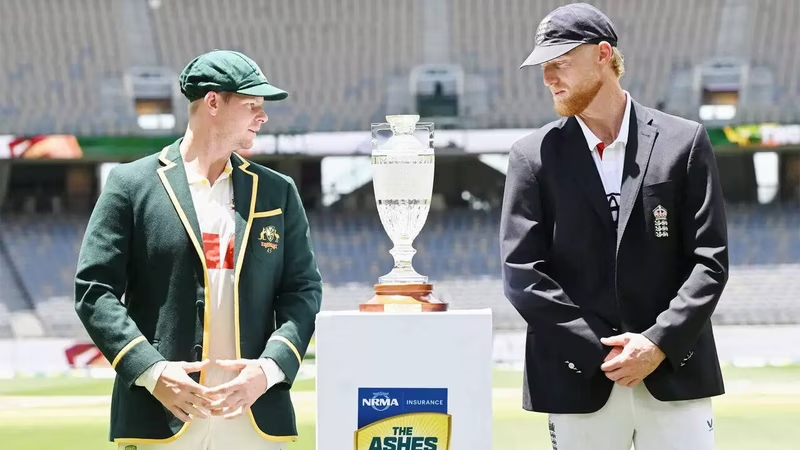
For over a century, the words “The Ashes” have sent a shiver down the spines of cricket fans worldwide. It’s more than a trophy; it’s a symbol of pride, rivalry, and a shared history between England and Australia that’s as dramatic as any novel. But have you ever stopped to wonder why this legendary contest is called The Ashes?
The answer doesn’t lie in a grand ceremony or a royal decree, but in a cheeky piece of satire published in a London newspaper over 140 years ago.
Table of Contents
- The Birth of a Legend: The 1882 Obituary
- From Word to Wood: The Creation of The Ashes Urn
- The Ashes Urn: Its Home and Its Status
- The Ashes Rivalry By The Numbers
- Conclusion: Why The Ashes Endures
- Sources
The Birth of a Legend: The 1882 Obituary
On August 29, 1882, something unthinkable happened at The Oval in London. Australia, then a fledgling cricketing nation, defeated the mighty England on their home soil for the first time. The score was close—the visitors won by just 7 runs—but the shockwave it sent through English society was immense .
Just a few days later, on September 2, the Sporting Times published a now-infamous piece of sporting satire. Written by the English journalist Reginald Shirley Brooks, it was a mock obituary that read:
“In affectionate remembrance of English cricket, which died at the Oval on 29th August, 1882. Deeply lamented by a large circle of sorrowing friends and acquaintances. N.B.—The body will be cremated and the ashes taken to Australia.”
This single, tongue-in-cheek notice was the spark that ignited one of sport’s greatest narratives . The idea of “cremating” English cricket and sending its “ashes” to Australia captured the public’s imagination perfectly. It was a humorous, yet poignant, commentary on a national sporting humiliation that would soon be transformed into a quest for redemption.
From Word to Wood: The Creation of The Ashes Urn
The legend truly took physical form during the 1882-83 England tour of Australia, led by the Hon. Ivo Bligh (later Lord Darnley). Bligh’s explicit mission, fueled by the obituary, was to “recover the Ashes” .
During a social gathering at Rupertswood, the estate of Sir William Clarke in Sunbury, Victoria, a group of women—reportedly including Florence Morphy, who would later become Bligh’s wife—gifted him a small terracotta urn. Inside were the ashes of a burnt cricket bail (or possibly a veil, depending on the account), symbolizing the “ashes” of English cricket that Brooks had written about .
This tiny, unassuming urn, just a few inches tall, became the ultimate symbol of the rivalry. It was a personal gift to Bligh, not an official trophy. For decades, The Ashes series was played for the honour of winning, with the urn remaining in Bligh’s private possession.
The Ashes Urn: Its Home and Its Status
After Ivo Bligh’s death in 1927, his widow, Florence, donated the urn to the Marylebone Cricket Club (MCC). Since then, it has resided in the MCC Museum at Lord’s Cricket Ground in London, where it’s one of the most cherished artifacts in the sport .
Here’s a key point many fans don’t realize: the original urn is not the trophy awarded to the winning team. It’s far too fragile and precious to be handed around. Instead, a larger, Waterford Crystal replica has been presented to the victors since the 1998/99 series .
So, while teams compete to “win The Ashes,” they are technically winning the right to say they hold the Ashes, with the original urn remaining a permanent, sacred fixture at Lord’s.
The Ashes Rivalry By The Numbers
The contest has grown into a biennial event (alternating between England and Australia) that is often considered as prestigious as a Cricket World Cup. The rivalry is incredibly close, a testament to the passion and skill on both sides.
Here’s a quick snapshot of the historic battle:
| Statistic | Record |
|---|---|
| Total Series Played (as of 2025) | 73 |
| Series Won by Australia | 34 (plus 6 retained from draws) |
| Series Won by England | 32 (plus 1 retained from a draw) |
| Drew Series | 6 |
This near-perfect balance has fueled countless dramatic comebacks, infamous controversies, and legendary individual performances, from Sir Don Bradman to Ian Botham and Steve Smith .
Conclusion: Why The Ashes Endures
The story of The Ashes is a perfect blend of history, humour, and sporting drama. It began not with a grand plan, but with a witty newspaper piece that turned a defeat into an enduring legend. The tiny urn, a personal gift from a bygone era, has become the most powerful symbol in Test cricket.
Today, the series remains a pinnacle event, a direct line back to that summer in 1882. It’s a reminder that in sport, a single moment of brilliance—or of failure—can echo through history, creating a legacy that captivates generations. The body of English cricket may have been “cremated,” but from those Ashes rose the world’s greatest cricketing rivalry.