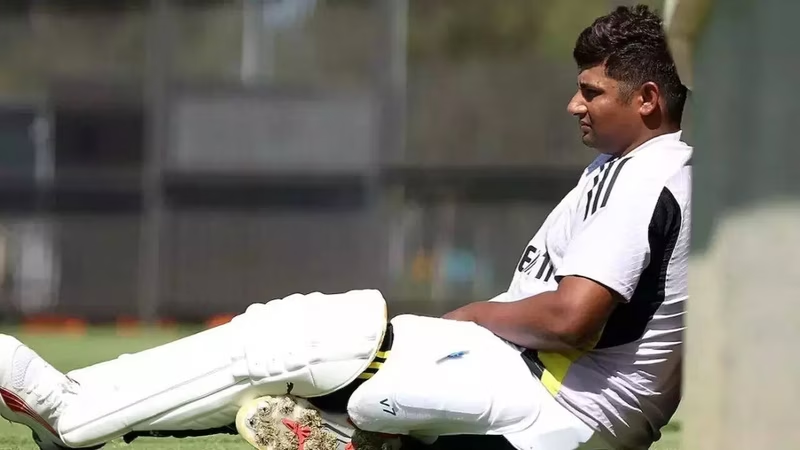
Why Was Sarfaraz Khan Dropped After Just 6 Tests?
The omission of Sarfaraz Khan from India’s playing XI for the second Test against South Africa in Guwahati has sparked a fierce debate—one that goes beyond form, fitness, or even team balance. Despite scoring 371 runs in just six Tests at an average of 37.10, including one century (150) and three fifties, the 27-year-old has been benched. And now, former India opener and respected analyst Aakash Chopra has fired a sharp question at selectors: “Is he not even allowed to fail?” .
Table of Contents
- Sarfaraz Khan’s Test Record: What the Numbers Say
- Aakash Chopra Calls Out ‘Perception Bias’
- Why Sarfaraz Might Be Punished for His Past
- The Future of India’s Middle Order
Sarfaraz Khan’s Test Record: What the Numbers Say
Objectively, Sarfaraz Khan’s start to Test cricket has been promising—especially for a player thrust into the side mid-series:
- Matches: 6
- Runs: 371
- Average: 37.10
- Highest Score: 150 (vs England, 2024)
- Centuries: 1
- Fifties: 3
For context, many established Indian batters—Shreyas Iyer, Hanuma Vihari, even a young Cheteshwar Pujara—had slower or less consistent starts. Sarfaraz’s 150 at Ranchi was a masterclass in counter-attacking under pressure, rescuing India from 100/4 . Yet, after a modest 20 and 1 in Kolkata, he’s been dropped in favor of veterans like Shubman Gill moving down or potential recalls like KS Bharat or even Yashasvi Jaiswal at No. 5.
Aakash Chopra Calls Out ‘Perception Bias’
Speaking on his YouTube channel, Aakash Chopra didn’t mince words. “This isn’t about performance anymore,” he said. “It’s about perception. Sarfaraz carries a baggage—his size, his running between wickets, his domestic strike rate. But in the six Tests he’s played, he’s done nothing wrong” .
Chopra argues that Indian cricket has created a culture where certain players are held to impossible standards, while others are given multiple chances despite prolonged slumps. “If you’re KL Rahul or Shreyas Iyer, you get 15 Tests to find form. Sarfaraz gets six—and one bad game wipes the slate clean?” he questioned .
This “perception bias,” as Chopra calls it, stems from Sarfaraz’s decade-long wait for a Test cap despite piling up runs in the Ranji Trophy (over 5,000 runs at an average above 70). Critics labeled him “overweight” or “not athletic enough,” overshadowing his undeniable batting prowess.
Why Sarfaraz Might Be Punished for His Past
The real issue may lie in selectors’ long memory. Sarfaraz’s delayed Test debut was partly due to concerns about his fielding and fitness. While he’s visibly worked on both—his catching behind square and running have improved significantly—the shadow of past criticism lingers.
Moreover, India now has a glut of middle-order options:
- Shreyas Iyer: Returning from injury, seen as a “proven” No. 5.
- Rishabh Pant: Likely to bat at 5 or 6 in home conditions.
- Yashasvi Jaiswal: Being experimented with in the middle order.
In this crowded landscape, any dip in form—even temporary—gives selectors justification to look elsewhere. But as Chopra points out, that’s not how talent development works. Great players aren’t born consistent; they’re given space to grow through failure.
The Future of India’s Middle Order
India’s Test middle order has been a revolving door since the retirements of Rahane and Pujara. The team needs stability, not just star power. Sarfaraz Khan represents a rare blend: a player who thrives in Indian conditions, plays spin with authority, and isn’t afraid of pace.
Dropping him after one lean game sends a dangerous message: that only flawless performers deserve a place. If India wants to build a resilient batting unit for the World Test Championship and beyond, they must allow room for learning. As former captain Rahul Dravid once said, “You don’t build a wall by rejecting every brick that’s slightly crooked.”
Final Thoughts
Sarfaraz Khan’s omission isn’t just a selection call—it’s a test of Indian cricket’s philosophy. Will it prioritize perfection or potential? Aakash Chopra’s question—“Is he not even allowed to fail?”—resonates because it challenges a system that often confuses potential flaws with actual failure. In a sport where resilience is built through adversity, denying a player like Sarfaraz the chance to bounce back may cost India more than just a series.
Sources
- Times of India: ‘Not even allowed to fail’: Ex-cricketer questions Sarfaraz Khan’s omission
- ESPNCricinfo: Sarfaraz Khan Player Profile & Stats
- Aakash Chopra’s YouTube Analysis (November 20, 2025): “Sarfaraz Khan Deserved More Time”
- The Cricket Monthly: The Sarfaraz Khan Conundrum