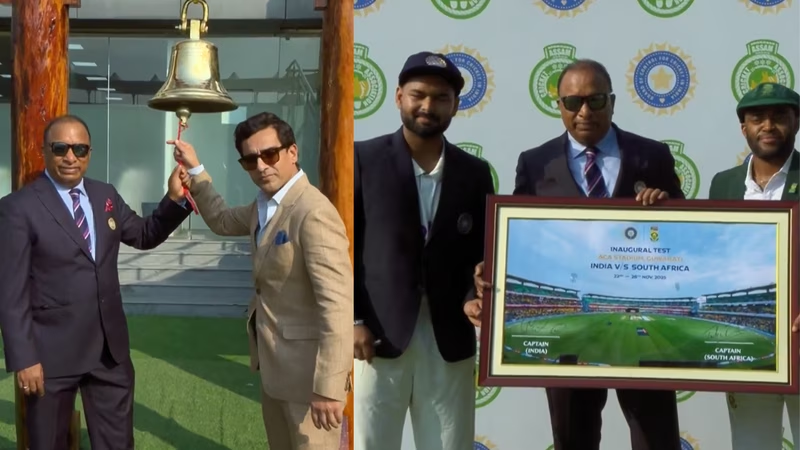
History wasn’t just made on the pitch—it was woven into every moment off it. On Saturday, November 22, 2025, **Guwahati’s Barsapara Cricket Stadium** stepped onto the global stage, hosting its **first-ever Test match** and becoming India’s **30th venue** to do so. But this wasn’t just another addition to the calendar. From the ceremonial ringing of the bell to a revolutionary match schedule shaped by the Northeast’s early sunset, the **Guwahati Test debut** was a celebration of regional pride, logistical innovation, and cricketing legacy.
BCCI President **Roger Binny**, alongside senior officials **Mithun Manhas** and **Devajit Saikia** (the latter a former Assam cricketer and now Honorary Secretary), officially inaugurated the occasion by ringing the match bell and presenting **special memorial toss coins** to captains Rishabh Pant and Temba Bavuma—a symbolic gesture honoring the venue’s long-awaited entry into Test cricket .
And in a first for international cricket in India, the day’s play followed a **tea-before-lunch** schedule to accommodate the region’s early dusk. It was a small adjustment with a big message: Indian cricket is no longer just centered in Mumbai, Kolkata, or Chennai—it’s truly national.
Table of Contents
- Why Guwahati Test Debut Is a Milestone
- The Ceremony: Bell and Memorial Coins
- The Tea-Before-Lunch Revolution
- Barsapara Stadium: A Venue Built for the Future
- Northeast Cricket on the Rise
- Conclusion: More Than Just a Test Match
- Sources
Why Guwahati Test Debut Is a Milestone
The **Guwahati Test debut** marks a significant expansion of India’s cricketing footprint. With this match, India now has **30 official Test venues**—more than any other nation . But beyond the number, it’s about inclusion.
For decades, the Northeast—home to over 50 million people—was overlooked in India’s cricket map. That began changing with the 2018 ODI between India and West Indies at Barsapara, followed by Ranji Trophy and IPL matches. Now, with a full-fledged Test, the region has arrived at the sport’s highest domestic honor.
“This is not just Guwahati’s moment—it’s the Northeast’s moment,” said Devajit Saikia, whose own journey from Assam captain to BCCI leadership embodies the region’s cricketing evolution .
The Ceremony: Bell and Memorial Coins
Before a single ball was bowled, the occasion was sanctified with tradition. BCCI President Roger Binny, accompanied by Mithun Manhas and Devajit Saikia, rang a specially crafted bell to signal the start of play—a ritual inspired by Lord’s but localized for Assamese culture.
Even more poignant were the **memorial toss coins**, featuring the silhouette of the iconic Umananda Temple on the Brahmaputra River on one side and the BCCI logo on the other. These limited-edition coins will be preserved in the stadium’s archives and gifted to players as keepsakes .
Such gestures transform a match into a memory—something fans in Assam, who waited generations for this day, won’t soon forget.
The Tea-Before-Lunch Revolution
In a groundbreaking scheduling shift, the ICC and BCCI approved a **reversed session order** for this Test:
- Session 1: 9:00 AM – 10:30 AM
- Tea Break: 10:30 AM – 11:10 AM
- Session 2: 11:10 AM – 1:10 PM
- Lunch Break: 1:10 PM – 2:10 PM
- Session 3: 2:10 PM – 4:10 PM
Why? Because in late November, **sunset in Guwahati occurs around 4:30 PM**, making traditional 4:30–6:30 PM sessions impractical under natural light. This adaptive approach sets a precedent for future matches in high-latitude or remote regions—showing that cricket can bend without breaking its spirit.
Barsapara Stadium: A Venue Built for the Future
Officially named the **Dr. Bhupen Hazarika Cricket Stadium**, Barsapara boasts a 40,000-seat capacity, floodlights for day-night matches, and a pitch curated by Ranjit Das—the same man behind Eden Gardens’ legendary surfaces.
Key features:
- Pitch: Dry, hard base with slow initial wear—ideal for a 5-day contest
- Outfield: Lush, fast, and well-drained
- Fan Experience: Dedicated Northeast fan zones, local food courts, and Assamese cultural performances at breaks
The stadium isn’t just built for today—it’s designed to host **World Cup matches** and **day-night Tests** in the coming decade.
Northeast Cricket on the Rise
Guwahati’s Test debut is the culmination of a decade-long BCCI initiative to develop cricket in the Northeast. Since Assam and other regional teams were integrated into the Ranji Trophy in the 2010s, talent has surged:
- Riyan Parag: Rajasthan Royals star and India T20I regular
- Abhishek Thakuri: Solid wicketkeeper-batter in domestic circuit
- Gokul Sharma: Veteran who paved the way for younger players
With world-class infrastructure now in place, expect more stars to emerge from this cricket-loving region. For more on this transformation, explore our feature on [INTERNAL_LINK:regional/northeast-cricket-revolution].
Conclusion: More Than Just a Test Match
The **Guwahati Test debut** is far more than a box ticked on a fixture list. It’s a statement—about inclusion, adaptability, and the democratization of Indian cricket. As Rishabh Pant leads a reshuffled Indian side in a do-or-die match against South Africa, the real victory may already be secured: a region, long on the margins, now stands at the heart of the game.
Sources
- Times of India: Guwahati’s Historic Test Debut
- BCCI Official – Barsapara Stadium Profile
- ICC – Guwahati Match Schedule Approval
- Ceremonial and logistical details from BCCI press release and TOI coverage .