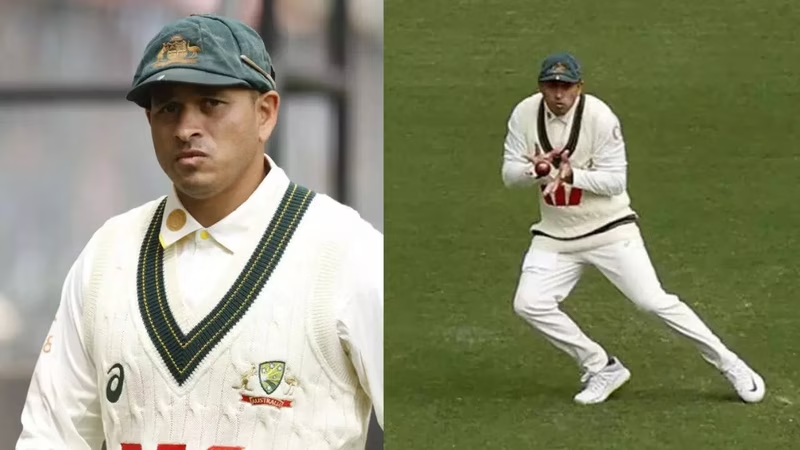
The opening Test of the Ashes 2025-26 series was barely underway when a sudden twist threw Australia’s batting order into chaos. Veteran opener Usman Khawaja, a linchpin of the side, was struck by severe back spasms while fielding, forcing a last-minute reshuffle that prevented him from walking out to open the innings. The timing couldn’t have been worse, and the reason behind it sparked immediate controversy.
Whispers began to circulate that Khawaja had been spotted playing in a golf competition in Perth just a day before the match . For fans and pundits alike, this raised serious questions: was a casual round of golf the culprit behind a star player’s untimely injury on cricket’s biggest stage? The narrative gathered steam, painting a picture of questionable preparation.
However, Cricket Australia’s CEO, Nick Hockley, has categorically shut down this line of speculation. In a firm statement, Hockley and CA clarified that the back spasms had nothing to do with Khawaja’s pre-match golf session . They emphasized that this type of back issue was something Khawaja has dealt with in the past, an unfortunate but known risk for many elite athletes.
Table of Contents
- The Khawaja Ashes Injury Incident
- CA CEO’s Response and the Golf Controversy
- ICC Rules and the Batting Order Chaos
- What This Means for Player Preparation
- Conclusion
- Sources
The Khawaja Ashes Injury Incident
The match-day drama unfolded quickly. Khawaja began the game as part of Australia’s official playing XI. During the first innings, while fielding, he was visibly in discomfort and had to leave the field for treatment . Officially, Cricket Australia described his condition as “back stiffness,” which later developed into more pronounced back spasms .
Despite being named in the initial lineup, these spasms created an impossible situation for the Australian team management. The injury meant Khawaja was physically unable to take the field at the start of their first innings, a critical moment that would have significant procedural consequences.
CA CEO’s Response and the Golf Controversy
The revelation that Khawaja had participated in a golf event before the match was the fuel this fire needed. In the high-pressure cauldron of an Ashes Test, any perceived lapse in professional discipline is magnified. Critics were quick to point fingers, suggesting that the physical demands of golf—particularly the rotational force on the spine—could have triggered the back spasm.
This is where Cricket Australia’s leadership stepped in. CEO Nick Hockley, a key figure in managing the team’s public and operational stance, issued a clear denial. According to CA, the injury was a recurrence of a pre-existing issue and was entirely unrelated to his leisure activity . This statement was crucial in defending Khawaja’s professionalism and shifting the focus back to his recovery rather than a media-fueled scandal.
ICC Rules and the Batting Order Chaos
The real-world impact of the Khawaja Ashes injury wasn’t just about the pain; it was about the rulebook. Under current ICC playing conditions for Test matches, teams are not permitted to make full substitutions for injuries outside of concussions . A substitute can field, but they cannot bat or bowl.
Because Khawaja was part of the original playing XI, Australia was not allowed to simply replace him with another batsman at the top of the order for their first innings. To open, they needed a player who had been named in the original XI. This forced captain Pat Cummins into a tactical reshuffle, with other batters moving up the order to cover the gap . It was a chaotic and sub-optimal start for the home side, all stemming from a sudden physical setback.
Here’s a breakdown of the ICC’s stance on player substitutions:
| Injury Type | Substitution Allowed? | Substitute’s Role |
|---|---|---|
| Concussion | Yes | Full replacement (can bat, bowl, field) |
| Other Injuries (e.g., back spasm) | Partial | Fielding replacement only (cannot bat or bowl) |
This rigid framework is what turned a personal health issue into a team-wide strategic problem.
What This Means for Player Preparation
Beyond the immediate match, this incident has ignited a broader conversation about how elite athletes manage their time and bodies in the lead-up to major events. While CA has dismissed the golf link, the optics remain challenging.
Key questions for the cricketing community include:
- What constitutes appropriate pre-match activity for a professional cricketer?
- How can teams better manage and mitigate the risk of recurring injuries like back spasms?
- Is it time for the ICC to revisit its injury substitution rules for Test cricket to account for serious, non-concussion injuries?
The pressure on players like Khawaja is immense. They are expected to be in peak physical condition while also managing their mental well-being. Activities like golf are often used as a form of mental relaxation. However, this episode serves as a stark reminder of the fine line between personal time and professional obligation at the highest level of the sport.
Conclusion
The Khawaja Ashes injury saga is a complex story of physical vulnerability, media scrutiny, and the inflexible nature of international cricket’s rules. While Cricket Australia’s CEO Nick Hockley has successfully defended his player against claims of poor preparation, the incident highlights the immense pressure on athletes and the urgent need for a more pragmatic approach to in-game injuries. For now, all eyes will be on Khawaja’s recovery and whether he can return to bolster Australia’s lineup in the crucial matches ahead. For more on player fitness and its impact on team strategy, see our analysis on [INTERNAL_LINK:player-fitness-in-modern-cricket].