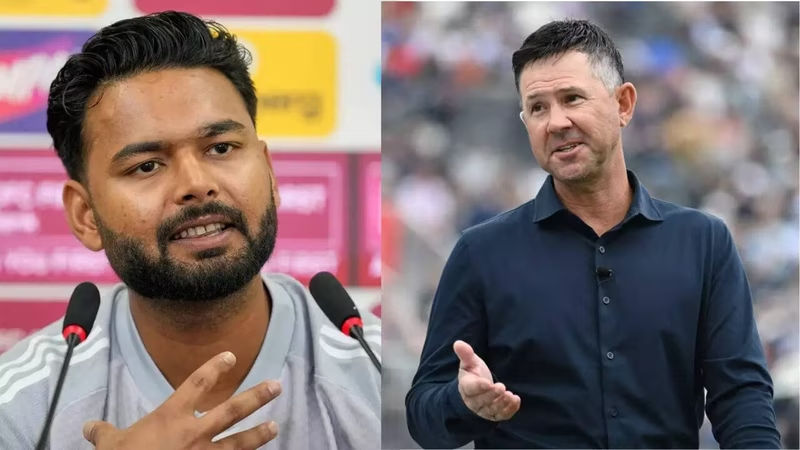
When Ricky Ponting speaks about Test cricket, the world listens. And his latest take on **Rishabh Pant captaincy** isn’t just endorsement—it’s a masterclass in leadership philosophy.
Ahead of India’s do-or-die second Test against South Africa in Guwahati, the Australian legend didn’t hold back: “If he changes his style… it could be a mistake.” Ponting doubled down on his belief that Pant’s natural aggression, tactical instinct, and experience as both a wicketkeeper and IPL skipper make him uniquely suited for the captain’s armband—even in his very first Test as official leader .
With India reeling from a narrow 30-run loss in Kolkata and star opener Shubman Gill ruled out, the pressure on Pant is immense. But Ponting sees this not as a liability, but as an opportunity for the 27-year-old to show the world what authentic, fearless leadership looks like in modern Test cricket.
Table of Contents
- Why Ponting Believes in Pant
- The Wicketkeeper-Captain Advantage
- Pant vs. Traditional Captains: A New Blueprint?
- IPL Experience: A Hidden Asset
- What Pant Must Do in Guwahati
- Conclusion: Trust Your Instincts
- Sources
Why Ponting Believes in Pant
Ricky Ponting’s confidence in **Rishabh Pant captaincy** isn’t blind faith. It’s rooted in decades of observing what makes great leaders tick. “He’s got that instinctive feel for the game,” Ponting noted in a pre-match analysis for a leading broadcaster . “He’s been in high-pressure situations his whole career—whether it’s rescuing India in Australia or finishing games for Delhi in the IPL.”
Crucially, Ponting warned against the temptation to “overthink” or “play safe” just because it’s a Test match. “If he tries to be someone he’s not—someone more conservative—he’ll lose what makes him special,” he said. That raw, unfiltered decision-making is exactly what India needs in a must-win game.
The Wicketkeeper-Captain Advantage
Pant isn’t just any captain—he’s a wicketkeeper-captain, a rare breed in international cricket. Only a handful of players in history, like MS Dhoni and Adam Gilchrist, have successfully combined both roles at the highest level.
As a keeper, Pant sees the game from behind the stumps—the bowler’s rhythm, the batter’s footwork, the subtle shifts in momentum. This 360-degree awareness gives him a tactical edge that traditional captains standing at first slip simply can’t match. Ponting, himself a former captain, recognizes this: “He’s always in the game. That constant engagement is priceless when you’re leading.”
Pant vs. Traditional Captains: A New Blueprint?
Historically, Indian Test captains have leaned toward structured, process-driven leadership—think Rahul Dravid’s meticulous planning or Virat Kohli’s intense discipline. Pant represents a departure from that mold.
His style is intuitive, reactive, and often unpredictable—qualities that can be polarizing but also game-changing. Consider his legendary knocks in Adelaide (2020) and Sydney (2021)—both built on instinct, not instruction. Ponting believes this same instinct will define his **Rishabh Pant captaincy** era:
- Field placements: Expect unconventional angles, like a short mid-wicket for a spinner.
- Bowling changes: He’ll bring on part-timers early if he senses a mismatch.
- Player management: He trusts his teammates to express themselves, not just follow orders.
This isn’t recklessness—it’s calculated boldness. And in a high-stakes match where conventional tactics failed in Kolkata, India might need exactly that.
IPL Experience: A Hidden Asset
Many critics argue that T20 captaincy doesn’t translate to Test cricket. But Ponting disagrees—especially in Pant’s case. As captain of Delhi Capitals, Pant led a diverse squad through high-pressure playoffs, managed egos, and made split-second decisions under floodlights .
That experience, Ponting argues, builds emotional intelligence and adaptability—two traits often overlooked in traditional captaincy evaluations. “Managing 15 international stars in the IPL is harder than managing 11 in Tests,” he quipped. “If Pant can handle Rishabh Pant, Prithvi Shaw, and David Warner in the same dressing room, he can handle anything.”
What Pant Must Do in Guwahati
The pitch at Barsapara Stadium is expected to assist spinners from day two, and with KL Rahul and Yashasvi Jaiswal opening in Gill’s absence, early stability will be crucial. Here’s how Pant can maximize his debut:
- Back his spinners early: Use Ashwin and Jadeja in overlapping spells to build pressure.
- Lead from the front: A big Pant innings—ideally 70+—could shift momentum instantly.
- Stay calm under fire: One bad over doesn’t define a captain; how he responds does.
For more on how Guwahati’s conditions impact strategy, check out our pitch report at [INTERNAL_LINK:analysis/guwahati-pitch-preview].
Conclusion: Trust Your Instincts
Ricky Ponting’s message to Rishabh Pant is simple yet profound: don’t dull your edge to fit a mold. **Rishabh Pant captaincy** works because it’s authentic—fluid, fearless, and full of heart. In a series where India faces a historic whitewash, what the team needs isn’t caution—it’s courage. And if Ponting’s right, Pant has more than enough of that to go around.