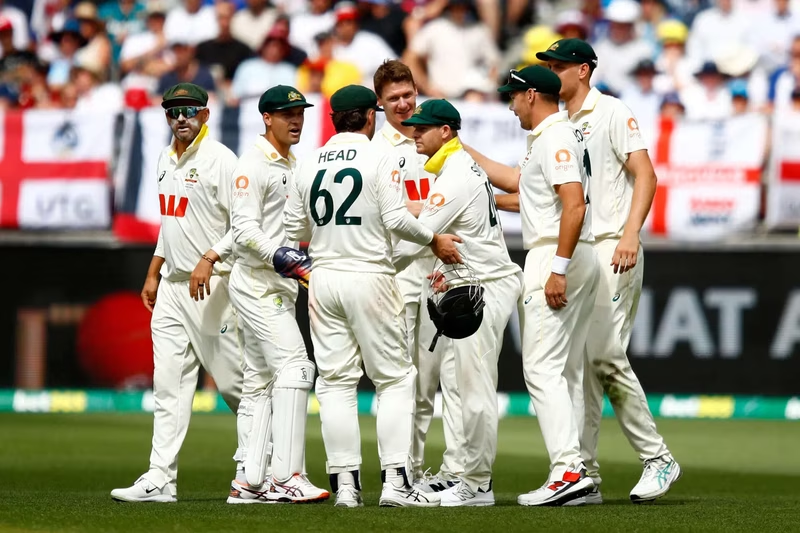
Australia has raced to a 1-0 lead in the 2025-26 Ashes series after a dominant, two-day victory in Perth. On the surface, it’s a dream start for the home side. But behind the scenes, cricket administrators are facing a nightmare: a financial hemorrhage estimated at over AUD $3 million.
This isn’t just a story about a quick win; it’s a stark warning about the modern game’s volatile economics. The very strategy that makes cricket exciting—England’s aggressive ‘Bazball’—might be its biggest financial enemy in the traditional format. Let’s break down why this win feels a lot like a loss.
Table of Contents
- The Perth Disaster: A $3M Revenue Black Hole
- Australia Ashes Financial Loss Explained
- How Bazball Became a Double-Edged Sword
- Cricket Australia’s Revenue Model At Risk
- What’s Next for the Ashes Series?
- Conclusion: Victory at What Cost?
- Sources
The Perth Disaster: A $3M Revenue Black Hole
The first Test at Optus Stadium in Perth, which began on November 21, 2025, was scheduled to run for five days . Instead, it was wrapped up by the end of day two, with a record crowd of 101,514 witnessing a fast-bowling masterclass . While fans got their money’s worth in intensity, Cricket Australia (CA) was left holding an empty bag.
Ticket sales for a marquee event like the Ashes are a primary revenue stream. With tens of thousands of tickets pre-sold for days three, four, and five, the abrupt end of the match meant those sales evaporated instantly. Industry experts and initial reports have pegged this direct loss at a staggering more than AUD $3 million .
Australia Ashes Financial Loss Explained
Cricket Australia’s financial model for international matches is heavily reliant on gate receipts and associated spending on food, merchandise, and hospitality. According to their own financial framework, CA retains all gate and signage revenue from international fixtures .
The Australia Ashes financial loss from this single match is particularly painful given the context. CA just reported an $11.3 million net deficit for the 2024-25 financial year, despite overall revenue growth from a new domestic media deal . This unexpected blow in Perth could significantly delay their path back to profitability. A loss of this magnitude from a single game in a five-match series is a major setback.
How Bazball Became a Double-Edged Sword
England’s radical ‘Bazball’ philosophy, championed by coach Brendon McCullum and captain Ben Stokes, is built on a foundation of fearless, attacking cricket that prioritizes a win-at-all-costs approach . While this has led to thrilling comebacks and a more entertaining brand of Test cricket, its downside in a high-stakes, revenue-critical series like the Ashes is now painfully clear.
In Perth, England’s aggressive batting approach on a lively, fast pitch contributed directly to their rapid collapse in the first innings. Their willingness to take risks, a core tenet of Bazball , played into the hands of Australia’s pace attack and turned a potential five-day grind into a spectacular, but financially disastrous, two-day affair.
This creates a paradox for the sport’s custodians: how do you balance the need for an exciting product that attracts a new audience with the traditional five-day format’s economic necessity?
Cricket Australia’s Revenue Model At Risk
Cricket’s economics are complex, but for a major board like CA, marquee events are non-negotiable profit centers. The Ashes in Australia is their biggest cash cow. CA was projected to earn a significant sum from sponsorships alone—around A$86 million for the cycle .
However, the model is fragile. A single two-day Test can wipe out a massive chunk of the gate revenue that helps subsidize the entire domestic game. CA’s recent sponsorship revenues have already seen a slight dip , making reliable income from ticket sales even more critical. This incident in Perth exposes a fundamental vulnerability in their business plan, which is built on the assumption of full, five-day matches.
What’s Next for the Ashes Series?
With the series moving to the Gabba in Brisbane for a day-night Test on December 4th , all eyes will be on the pitch preparation. Cricket Australia has a vested interest in ensuring the remaining matches last the distance. It’s widely expected that future pitches in the series will be prepared to be less bowler-friendly and more conducive to long, high-scoring battles.
The pressure is now on the match referees and pitch curators to find a balance between a sporting contest and a commercial necessity. For fans, this could mean a return to a more traditional, attritional style of play, at least until the financial books are safer.
Conclusion: Victory at What Cost?
Australia’s victory in the first Ashes Test is a moment of on-field triumph, but it’s overshadowed by a serious off-field crisis. The Australia Ashes financial loss of over $3 million serves as a wake-up call for the entire cricketing world. It highlights the precarious balance between sporting entertainment and economic sustainability in the modern era. For Cricket Australia, the mission is clear: win the series, but for heaven’s sake, make the matches last five days.
Sources
- Times of India. “Why Australia is in huge trouble despite winning the first Ashes Test – Here’s the shocking reason.” Accessed November 23, 2025.
- “Why Aussie cricket bosses will NOT be happy with Ashes result.” News.com.au.
- “Two-day Test could cost Cricket Australia millions.” ESPN Cricinfo.
- “The Ashes 2025/26: Fixtures, dates and venues.” BBC Sport.
- “Venues | Men’s Ashes 2025-26.” Cricket Australia.
- “What is Bazball in Cricket? England’s Aggressive Approach.” Cricket.com.
- “Attack Mode Supply Chain Strategy – The Cricket Bazball Explained.” SportBusiness.
- “Cricket Australia reports sponsorship drop, TV jump.” Inside the Games.
- “Cricket Australia Reports A$11.3 Million Loss for 2024-25.” Reuters.
- “Financial Report.” Cricket Australia. May 2, 2023.