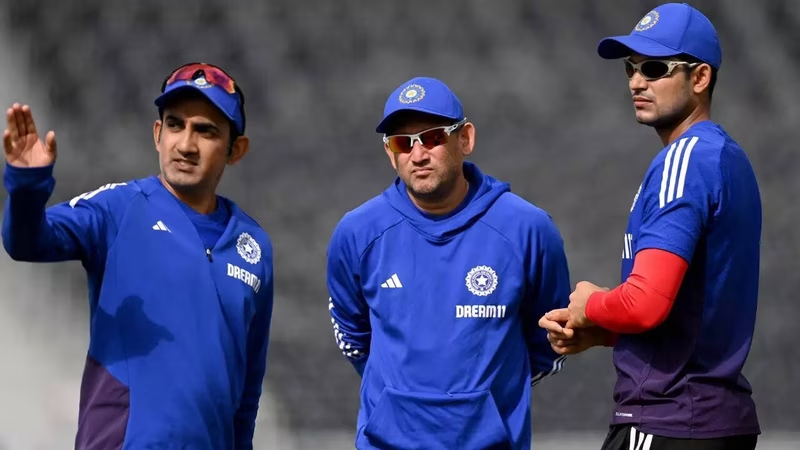
The jet-setting lifestyle of India’s chief selector is impossible to miss. From the sweltering heat of Dubai for the Asia Cup to the green pitches of England and the intense cauldron of an Australian Test series, Ajit Agarkar has been a constant, reassuring presence on the team management’s balcony.
Yet, if you head to the Wankhede Stadium or any other venue for a crucial Ranji Trophy knockout match, you’re unlikely to find him in the stands. This stark contrast has fueled a long-standing debate: Can a selector who’s physically absent from the domestic circuit truly make the best decisions for India’s future?
Table of Contents
- The Global Guru: Agarkar’s Overseas Commitment
- The Domestic Dilemma: Ranji Trophy Absence
- A Recurring Controversy from Mumbai Roots
- What’s at Stake for Indian Cricket?
- Summary
- Sources
The Global Guru: Agarkar’s Overseas Commitment
Over the past year, Ajit Agarkar’s passport has been stamped across the cricketing world. His itinerary reads like a blockbuster tour schedule:
- December 2024 – January 2025: The high-stakes Border-Gavaskar Trophy in Australia .
- June – August 2025: A five-Test series in England, a true examination of a player’s mettle .
- September 2025: The Asia Cup in the familiar surroundings of Dubai .
This constant presence overseas is not a bug; it’s a feature of his role. The BCCI, having extended his contract as chairman of the selection committee until June 2026 , clearly values his on-ground assessment of players in the most pressurized international environments . His partnership with fellow selector S.S. Das on multiple tours underscores a strategy focused on real-time, high-level performance evaluation. This approach is a significant shift from the past, moving towards a more dynamic, reactive selection philosophy that prioritizes how a player copes with the best in the world. It’s a strategy that has coincided with India’s recent successes in ICC tournaments, a fact the BCCI has openly acknowledged .
The Domestic Dilemma: Ajit Agarkar‘s Ranji Trophy Conundrum
While his commitment to the international stage is lauded by some, it casts a long shadow over his connection to India’s domestic bedrock: the Ranji Trophy. His physical absence from domestic games is not a recent phenomenon but a notable and persistent absenteeism that has drawn sharp criticism.
The concern is simple yet profound. The Ranji Trophy is the primary talent pipeline for Team India. It’s where future stars like Yashasvi Jaiswal and Dhruv Jurel announce themselves on the national stage. A selector’s deep, personal knowledge of these players—their temperament in a five-day grind, their technique against seasoned domestic bowlers, and their ability to handle pressure in a low-stakes but long-format game—is considered invaluable.
Without this on-the-ground presence, selectors risk relying too heavily on statistics, reputation, or a single outstanding performance, which can be a flawed approach. This gap in oversight is what fuels the narrative that the selection committee, led by Agarkar, might be overlooking consistent performers from the domestic circuit in favor of players who have already proven themselves on the international or IPL stage .
A Recurring Controversy from Mumbai Roots
This criticism isn’t new for Agarkar. In fact, it’s a ghost from his past that continues to haunt his present role. Back in 2019, during his tenure as the chief selector for the Mumbai senior team, a similar controversy erupted . A Special General Meeting (SGM) of the Mumbai Cricket Association (MCA) passed a resolution to sack the entire selection panel, with a key grievance being their lack of presence at domestic matches .
Feeling “hurt” by the lack of support and the public criticism, Agarkar and his panel resigned en masse . This historical context is crucial. It shows that the tension between a selector’s physical presence in the domestic arena and their decision-making credibility is a long-standing issue for him. His current role at the national level has simply magnified this pre-existing challenge onto a much larger stage.
What’s at Stake for Indian Cricket?
The debate over Agarkar’s focus isn’t just about one man’s schedule. It’s about the very philosophy of talent identification for a cricket-crazy nation of 1.4 billion people.
Two competing visions are at play:
- The Global-First Approach: Championed by Agarkar and the current BCCI regime, this view holds that performance under the brightest lights is the ultimate test. A player who can handle the speed of an Australian quick or the swing of an English seamer is inherently more valuable than one who dominates on a flat Indian pitch. This approach has arguably yielded a more resilient and adaptable Indian team in SENA (South Africa, England, New Zealand, Australia) countries.
- The Grassroots Guardian Approach: This traditional view argues that a strong domestic system is the foundation of a strong national team. Selectors must be the eyes and ears on the ground, spotting raw talent, understanding a player’s development over a season, and ensuring that the pipeline never dries up. Neglecting this can lead to a short-term focus and a potential talent gap in the future.
For fans and aspiring cricketers across the country, this is deeply personal. They want to know that their heroes grinding it out in the Ranji Trophy have a fair shot at donning the blue jersey, and that a selector has seen their fight, not just their highlight reel on a sports channel.
Summary
In conclusion, Ajit Agarkar embodies a modern, overseas-centric selection philosophy that has its merits but also carries significant risks. His constant presence on international tours speaks to a hands-on approach to managing India’s top stars, a strategy the BCCI has endorsed with a contract extension until 2026. However, his continued and notable absence from the Ranji Trophy, a controversy that dates back to his time with the Mumbai selectors, remains a major point of contention. The central question for Indian cricket is whether this global-first vision can be sustained without a deeper, more consistent connection to its vital domestic roots. The answer will shape the team’s future for years to come.
Sources
- Times of India: Ajit Agarkar: A constant on overseas tours, notable absentee from Ranji Trophy
- BCCI Contract Extension Reports [[1], [8], [9]]
- Mumbai Selector Resignation Reports [[11], [15], [16]]
- India’s 2024-2025 Tour Schedule [[20], [24], [26]]
- ESPNcricinfo for historical context and player development pipelines.