For over a decade, winning a Test series in India was considered a near-mythical feat for visiting teams. The likes of Dravid, Laxman, and Kumble had built an impenetrable fortress. Fast forward to today, and the walls are not just cracked—they’re tumbling down.
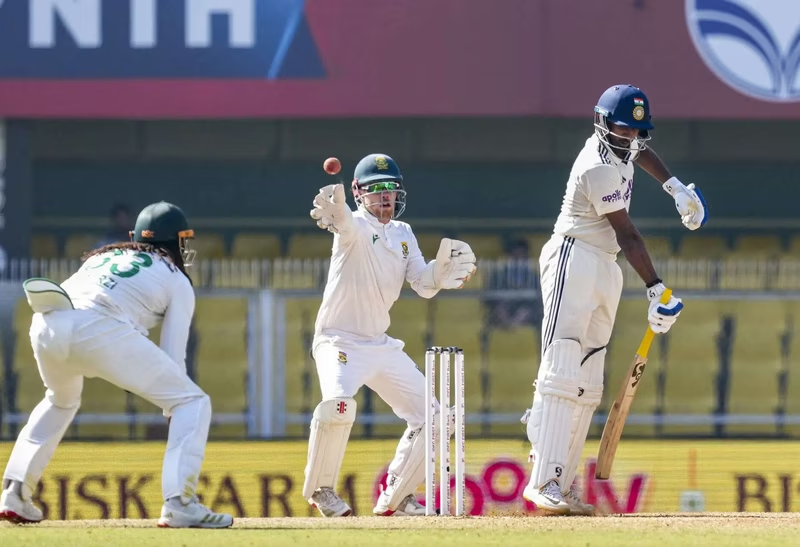
The recent India Test cricket decline is not a blip; it’s a seismic shift. A humiliating 2-0 series loss to South Africa in November 2025, which included a record 408-run defeat, marked a historic low [[5], [9]]. This wasn’t just another loss—it was India’s third home series defeat in a little over a year, a scenario unthinkable in the previous decade .
Table of Contents
- The Home Fortress Has Fallen
- India Test Cricket Decline at the Roots
- The Coaching and Selection Dilemma
- A Glimmer of Hope: The Test Twenty Experiment
- Conclusion: Rebuilding the Red-Ball Foundation
The Home Fortress Has Fallen
India’s home record was the stuff of legend. Between 2013 and 2024, they lost just four home Tests out of 54—a staggering statistic that underlined their dominance . The team went 4,331 days without losing a home series . That era of invincibility is now over.
The recent slide is alarming. Successive home losses to New Zealand and now South Africa have exposed a team that is fragile and unprepared for the unique demands of red-ball cricket . The 408-run loss to South Africa in 2025 stands as their worst-ever defeat by runs in Test history . This isn’t just a matter of poor form on a given day; it points to a deeper structural weakness in their preparation and skillset.
India Test Cricket Decline at the Roots
The crisis isn’t confined to the senior team. The rot begins at the grassroots. For years now, the entire Indian cricket ecosystem—from academies to junior selectors—has been laser-focused on T20 and ODI success. The result? A generation of players who are white-ball specialists but lack the temperament, technique, and skills to thrive in the longer format.
Youngsters are incentivized to hit big and score quickly. The patience, discipline, and nuanced shot selection required for Test cricket are being de-prioritized, if not forgotten entirely . This systemic neglect of red-ball skills is now manifesting in the senior team, where players struggle to build long innings or handle a probing spell of seam or spin bowling.
As former captain Sourav Ganguly has warned, red-ball cricket remains the ultimate test for any player, and its importance cannot be overstated . Yet, the current pathway seems to be steering talent away from this crucible.
The Coaching and Selection Dilemma
The appointment of Gautam Gambhir as the all-format head coach has come under intense scrutiny. While the white-ball teams have flourished under his leadership, the Test side’s performance has been described as “below expectations” . This stark contrast has reignited the debate on whether India needs separate coaches for red-ball and white-ball cricket [[20], [22]].
The selection policy also bears a significant share of the blame. The focus on IPL performance often overshadows a player’s first-class record. A player who can smash a quickfire 50 in a T20 match is often favored over one who has consistently scored centuries in the Ranji Trophy. This approach, as Dilip Vengsarkar has questioned, fails to understand the “completely different challenge” that red-ball cricket presents .
A Glimmer of Hope: The Test Twenty Experiment
In a fascinating turn of events, the cricketing world is about to witness an experiment that might just bridge this gap. The new “Test Twenty” format, set to launch its inaugural Junior Test Twenty Championship (JTTC) in 2026, is designed to blend “the patience of Test cricket with the pace of T20s” [[14], [17]].
This 80-over format, where each team bats twice, is a direct attempt to create a competitive, broadcast-friendly environment that still teaches the core values of red-ball cricket: building an innings, understanding game situations, and developing resilience .
If this new format is embraced by the Indian system and integrated into its development pathway, it could be a game-changer. It offers a potential solution to the current paradox: how to produce players who can thrive in the high-octane world of T20 leagues while still possessing the skills to wear the Test cap with pride.
Conclusion: Rebuilding the Red-Ball Foundation
The India Test cricket decline is a wake-up call for the BCCI and the entire cricketing community. The legacy built by generations of greats is not a birthright; it’s a responsibility that must be actively nurtured. Ignoring the foundations of the game for the sake of immediate white-ball glory is a short-sighted strategy with long-term consequences.
Rebuilding this legacy will require a multi-pronged approach: a dedicated red-ball coaching structure, a selection policy that values first-class performance, and a grassroots system that teaches the art of Test cricket. The upcoming Test Twenty format might offer a promising new path. Until then, the onus is on Indian cricket to decide if it truly values its Test heritage or is content to watch it erode into history.
For more on India’s team strategy, check out our analysis on the [INTERNAL_LINK:bcci-selection-policy].
Sources
- India’s Test decline under Gambhir: Results that have… (Times of India)
- India’s Test crisis deepens as South Africa humble hosts 2–0 (ESPNcricinfo)
- IND vs SA: India records its worst loss in Test history – Sportstar
- ‘Red ball cricket is a completely different challenge…’ (Cricbuzz)
- BCCI To Appoint Different White & Red-Ball Coaches If… (Hindustan Times)
- Dilip Vengsarkar questions Shreyas Iyer’s first class cricket… (Times Now)
- Sourav Ganguly on the Importance of Red-Ball Cricket… (NDTV Sports)
- Test Twenty cricket format: The future of modern cricket (Khel Now)
- Cricket enters a new era with launch of Test Twenty (Sportstar)
- Cricket Welcomes Its Fourth Format – Test Twenty (The Hindu)