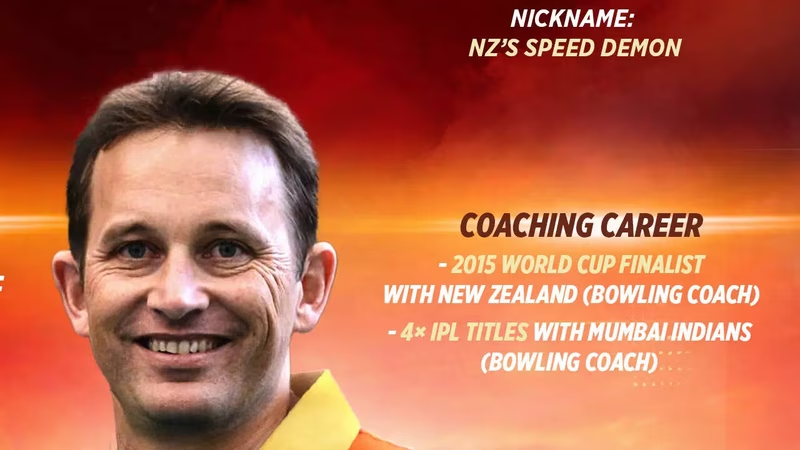
The roar of the crowd, the flash of a 150kph delivery, the instant gratification of a T20 wicket—it’s a seductive world for a young fast bowler. But beneath the glitz of leagues like the ILT20 lies a critical question: how do you nurture that raw pace without burning the talent out before it can truly flourish? Enter Shane Bond, the former New Zealand speedster turned master coach, who now shapes the next generation of quicks as the bowling coach for the Gulf Giants in the ILT20.
Bond, whose own career was famously derailed by injury, has a unique perspective. In a recent conversation, he laid bare his philosophy, offering a crucial counter-narrative to the “all gas, no brakes” approach that often dominates the T20 circuit. His core message? **Fast bowler management** isn’t just important—it’s the absolute bedrock of a sustainable, successful career.
Table of Contents
- The ILT20: A Platform, Not a Panacea
- Why “Fast Bowler Management” is Non-Negotiable
- The Unshakeable Foundation of First-Class Cricket
- The Hidden Dangers of Rushing Young Quicks
- Coaching in a Cultural Melting Pot
- Key Takeaways for the Future of Fast Bowling
- Sources
The ILT20: A Platform, Not a Panacea
Bond is a believer in the ILT20’s potential. He sees it as a “vital platform” for UAE talent, offering unprecedented exposure to high-level competition and a diverse range of international stars and coaching minds . This melting pot of styles and cultures is a fantastic learning environment. However, he’s quick to add a caveat: the league is just one piece of a much larger puzzle.
For a young bowler, the ILT20 can be an incredible launchpad, but it shouldn’t be their entire cricketing diet. The format’s intensity and the pressure to perform from ball one can create a distorted view of what bowling is truly about. It’s a place to showcase skills, not necessarily to build them from the ground up.
Why “Fast Bowler Management” is Non-Negotiable
This is where Bond’s experience as a player who lost years to injury becomes his greatest coaching asset. He knows firsthand the perils of an unmanaged workload. The rise of T20 leagues has indeed complicated the careers of fast bowlers, primarily due to the relentless nature of their schedules and the physical demands they place on the body .
“How you manage tearaway quick bowlers is really important,” he states, a line that serves as both a mantra and a warning. Modern **fast bowler management** isn’t just about counting overs. As one study notes, it’s about “building resilience” and creating a “consistent environment” that allows for long-term skill acquisition, not just short-term heroics . The rapid shift between the low, explosive workload of a T20 match and the sustained, grueling demands of a four-day game can be a significant injury risk if not handled with extreme care .
The Unshakeable Foundation of First-Class Cricket
In an age obsessed with T20, Bond’s most powerful message might be his staunch defense of first-class cricket. He believes it remains “essential” for a fast bowler’s development . Why?
First-class cricket teaches patience and strategy. It’s where a bowler learns to build pressure over long spells, to move the ball both ways for extended periods, and to out-think a batter over several sessions. It’s the ultimate proving ground for their physical and mental endurance. On this front, experts agree that first-class cricket is “key for growing cricket players” and serves as the primary pathway “to international cricket” . Without this foundation, a bowler is just a one-trick pony, reliant on pace alone, which is a recipe for a short and injury-plagued career.
The Hidden Dangers of Rushing Young Quicks
Bond is particularly wary of the trend to rush young, raw pace talents into the high-stakes world of T20 leagues before they are physically or technically ready. He points to the “risks of rushing young quicks,” a cautionary tale that has played out with numerous prodigies across the globe .
When a young bowler is thrown into the deep end, the expectation is to deliver wickets with every over. This pressure can lead to poor mechanics as they try to extract even more pace, drastically increasing their injury risk. They miss out on the crucial developmental phase where they would learn control, variations, and how to manage their own bodies in longer formats. As Bond’s own career illustrates, the gift of extreme pace is a double-edged sword that must be sheathed in a robust technical and physical framework.
Coaching in a Cultural Melting Pot
His role with the Gulf Giants presents its own unique set of challenges. Coaching in the ILT20 means navigating a squad full of players from vastly different cricketing cultures, each with their own ingrained methods and beliefs . For Bond, this requires more than just technical expertise; it demands exceptional communication skills and deep empathy.
He must find a way to blend his own philosophy on **fast bowler management** with the player’s existing skillset and mindset, a delicate balancing act that is as much about psychology as it is about physics. It’s a challenge he seems to relish, viewing it as an opportunity to create a unique, hybrid bowling unit that can thrive in the unpredictable environment of a T20 league.
Key Takeaways for the Future of Fast Bowling
Shane Bond’s insights cut through the noise of the modern T20 circus. His message is clear and consistent: patience, structure, and a respect for the traditional pathways of the game are more important than ever. The ILT20 and other leagues are fantastic opportunities, but they are not shortcuts.
For young fast bowlers, the path to longevity is paved with first-class overs and guided by a meticulous, individualized management plan. For franchises and coaches, the goal should be to develop complete bowlers, not just T20 specialists. As the demand for pace continues to grow, Bond’s voice of reason is a crucial reminder that true speed is a marathon, not a sprint.
Sources
Shane Bond exclusive: ‘How you manage tearaway quick bowlers is really important’ | ILT20
The Guardian: What is the Role of First-Class Cricket in Player Development?
British Journal of Sports Medicine: Fast bowling match workloads over 5–26 days and risk of injury
Georgetown Cricket: Shane Bond appointed Birmingham Phoenix Head Coach