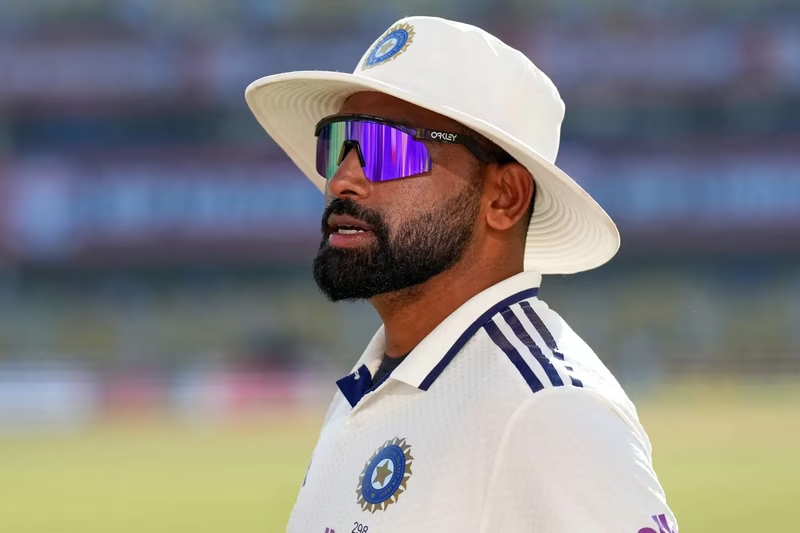
Why Was Mohammed Siraj Dropped From ODIs? A Selection Saga That Defies Logic
In the world of cricket, selections can be as dramatic as the game itself. But sometimes, a decision is so perplexing it leaves even seasoned experts scratching their heads. The recent exclusion of Mohammed Siraj from India’s ODI setup is one such case that has sparked a major controversy.
Following India’s loss to South Africa in the Raipur ODI, former Indian opener Aakash Chopra voiced a question that’s on everyone’s lips: “When did Siraj become a one-format player?” Chopra didn’t mince his words, calling the move “inexplicable” and highlighting the stark contrast between Siraj’s proven ODI pedigree and the inexperience of the young pacers who have replaced him .
Table of Contents
- Aakash Chopra’s Scathing Critique
- Mohammed Siraj’s ODI Record: The Numbers Don’t Lie
- Decoding India’s ODI Selection Logic
- What This Means for Siraj and Team India
- Final Summary
- Sources
Aakash Chopra’s Scathing Critique
Aakash Chopra, known for his sharp and insightful analysis, has been a vocal critic of this sudden shift in India’s bowling strategy. He was particularly stunned to see a player like Harshit Rana, who is still finding his feet in international cricket, being preferred over the established and reliable Siraj .
“Siraj hasn’t done much wrong to miss out! I feel for him,” Chopra remarked, capturing the sentiment of a vast section of fans who have watched Siraj grow from a raw talent into a bowling mainstay across formats . His criticism points to a larger, more worrying trend: a potential abandonment of proven performers in a frantic, and perhaps misguided, push for youth.
Mohammed Siraj ODI: A Record That Speaks Volumes
The selectors’ rationale becomes even more baffling when we look at the cold, hard facts of Siraj’s Mohammed Siraj ODI career. This isn’t a player on the decline; it’s a bowler who has consistently delivered in the 50-over format.
- Wickets: In just 47 ODI matches, Siraj has taken a remarkable 73 wickets .
- Average: He boasts an impressive bowling average of 24.67, which is a benchmark for top-tier ODI bowlers .
- Economy: His economy rate of 5.17 runs per over is a testament to his control and discipline, a crucial asset in the middle overs .
- Strike Rate: He picks up a wicket every 28.5 balls, showing his ability to break partnerships .
These aren’t just numbers; they are the hallmarks of a world-class ODI bowler. To sideline such a performer, especially in a high-stakes series, is a gamble that many, including Chopra, believe is ill-advised.
Decoding India’s ODI Selection Logic
So, what is driving this surprising decision? The official line seems to revolve around a long-term vision, possibly building a new pace attack for future ICC events. With Jasprit Bumrah as the undisputed leader, the selectors appear to be backing a combination of Arshdeep Singh and a host of new faces like Rana .
However, this strategy raises several questions:
- Experience vs. Experiment: In the absence of senior campaigners like Mohammed Shami, who is managing his workload, Siraj was the perfect bridge between Bumrah’s genius and the raw talent of the newcomers . His experience in high-pressure games is invaluable.
- The Risk Factor: While backing youth is essential, completely axing a proven performer for an experiment against a top team like South Africa is a high-risk move. As R. Ashwin pointed out in a separate selection debate, “Why was he picked?” often becomes the question after a loss .
The current selection policy seems to prioritize potential over current, proven form—a philosophy that can be costly in the short term.
What This Means for Siraj and Team India
For Mohammed Siraj, this is a personal and professional setback. After years of hard work to cement his place in the Indian team, being labeled a “red-ball specialist” overnight is a confusing narrative to navigate. It’s a classic case of a player being a victim of their own versatility.
For Team India, the implications are strategic. The lack of a reliable, experienced seamer to support Bumrah in the ODIs was evident in the Raipur loss. The bowling attack looked thin, lacking the control that Siraj has often provided. This move might be an attempt at building for the future, but it risks damaging the present.
As the team navigates its path post the 2023 World Cup, the balance between nurturing new talent and retaining experienced hands like Siraj will be its biggest challenge. For more on India’s evolving team dynamics, see our in-depth analysis on [INTERNAL_LINK:india-pace-bowling-future].
Final Summary
The decision to drop Mohammed Siraj from the ODI team is a contentious one that has drawn sharp criticism from experts like Aakash Chopra. Siraj’s stellar ODI stats—73 wickets at an average of 24.67—make his exclusion seem illogical, especially when compared to the unproven alternatives. While the selectors may have a long-term plan in mind, the immediate impact has been a weakened bowling attack and a justified sense of confusion from fans and former players alike. The question remains: why fix what isn’t broken?