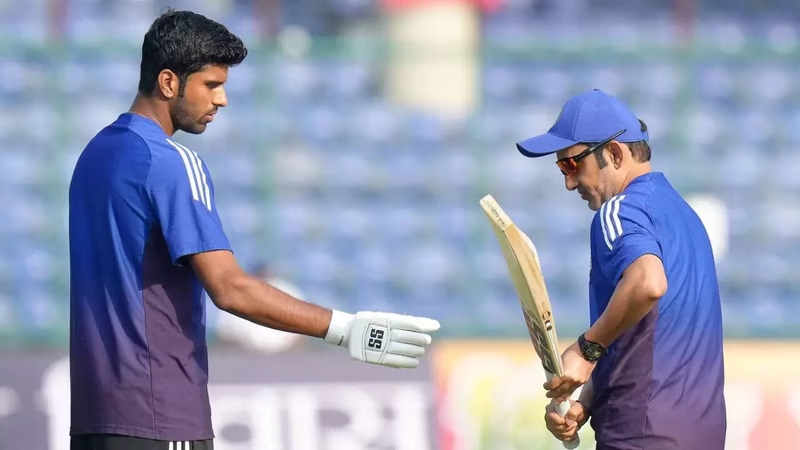
In a statement that’s sent ripples through the cricketing community, newly appointed India head coach Gautam Gambhir has boldly declared that the conventional wisdom around a set batting order is largely “very overrated” in the high-octane world of white-ball cricket.
Speaking after the recently concluded ODI series against South Africa, Gambhir doubled down on his team’s “chop-and-change” approach, revealing a strategic philosophy that values flexibility, player roles, and tactical matchups over rigid positional hierarchies.
Table of Contents
- Gambhir on Flexible Batting Order
- Washington Sundar’s Pivotal Role
- The Dew Factor in South Africa Series
- Looking Ahead to T20Is
- Summary
- Sources
Gambhir on Flexible Batting Order: A New Age Philosophy
For decades, the batting order has been a cornerstone of cricket tactics—a carefully constructed sequence designed to maximize a team’s run-scoring potential. However, Gambhir is challenging this orthodoxy head-on.
“I’ve always believed that in white-ball cricket, batting orders are very overrated, except the opening combination,” Gambhir stated frankly . His logic is rooted in the dynamic nature of modern limited-overs cricket, where the state of the game can shift dramatically within a few overs.
His primary tactical driver for this fluidity is the “right-left combination.” By constantly rotating right-handed and left-handed batters, the field placements for the opposition are forced to change frequently, disrupting the bowler’s rhythm and creating more scoring opportunities . This strategy, he argues, is far more valuable than sticking to a pre-determined batting lineup.
Washington Sundar’s Pivotal Role in the Grand Plan
A key beneficiary—and enabler—of this flexible system is all-rounder Washington Sundar. Gambhir singled out Sundar for his exceptional “team-first attitude” and remarkable adaptability, qualities that are essential in this new framework .
Sundar’s ability to slot into the batting order at number 5, 6, or even 7, depending on the match situation, provides the Indian team with a crucial tactical lever. He can accelerate the innings, anchor it against a new ball, or provide a late flourish, all while being a reliable bowling option.
This adaptability stands in stark contrast to players who are more comfortable in a fixed role. As former cricketer Aakash Chopra noted, the team’s recent batting order experiments have drawn both praise and scrutiny, highlighting the delicate balance between innovation and stability .
The Dew Factor that Defined the ODI Series
While the batting strategy has been a talking point, Gambhir was equally candid about another major factor that influenced the ODI series: dew. The moisture-laden conditions during the evening matches in India significantly hampered the bowlers’ ability to grip the ball .
“Dew makes the ball slippery and tough for bowlers,” a challenge that was evident when South Africa chased down a mammoth 359 in Raipur, a joint-record for the highest chase against India . The dew caused the ball to skid on faster to the bat, nullifying swing and spin, and effectively turning the pitch into a batting paradise in the second innings .
Gambhir acknowledged this as a critical factor in the team’s performance but stopped short of using it as an excuse, instead focusing on how his squad can better adapt to such conditions in the future.
Looking Ahead to T20Is: Less Dew, More Strategy
With the focus now shifting to the upcoming T20 International series against South Africa, Gambhir expects the playing conditions—and therefore his tactical playbook—to evolve. “We expect less influence from dew in the T20Is,” he hinted, suggesting that his team’s bowling attack might find a more balanced contest .
With a shorter format, the importance of his flexible batting order philosophy may become even more pronounced. In T20 cricket, where every ball is a potential game-changer, the ability to send in a power-hitter like Sundar or Suryakumar Yadav based on the specific over and bowler can be a decisive advantage.
This approach aligns with his previous comments on T20 cricket, where he has emphasized “player impact over run accumulation” to build a team capable of winning high-stakes matches like the T20 World Cup .
Summary
Gautam Gambhir is charting a bold new course for Indian white-ball cricket. By dismissing the traditional batting order as “overrated” (outside of the openers), he’s implementing a fluid, situation-based strategy centered on the right-left batting combination. Players like Washington Sundar, with their adaptable skill sets, are central to this plan. While external factors like dew played a significant role in the recent ODI series, Gambhir is focused on refining his tactical approach for the faster-paced T20Is, where his innovative philosophy could yield its greatest rewards.