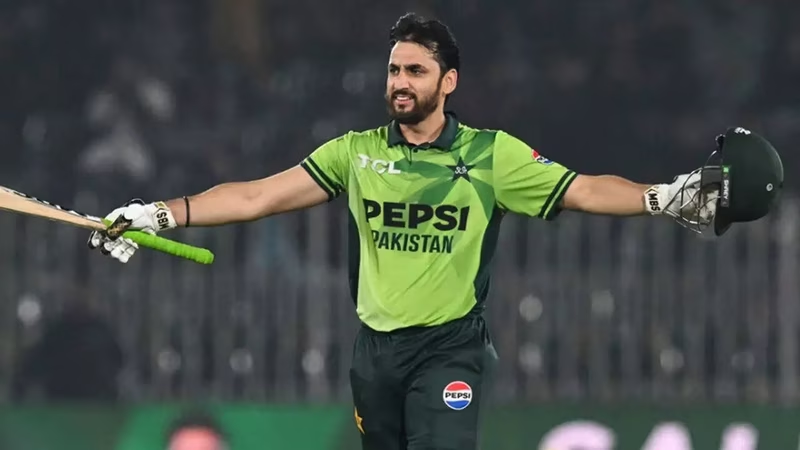
Pakistan’s T20 captain, Salman Ali Agha, has sent a clear message to fans and selectors alike: the team for the Pakistan T20 World Cup 2026 squad is virtually locked in. In a world where last-minute changes are the norm, Agha’s declaration of stability is a bold and calculated move that reveals a deeper strategy focused on role clarity and team cohesion.
With the tournament in Sri Lanka just weeks away and only a handful of official T20 matches remaining on the calendar, the captain is banking on the momentum his young team has built, rather than scrambling for a miracle player. This approach, while seemingly inflexible, might just be the secret weapon Pakistan needs to go all the way.
Table of Contents
- The Stable Squad Strategy: Why Agha is Standing Firm
- How Role Clarity Became the Game-Changer
- The Shadab Khan Wildcard: A Potential Game-Changer
- What’s Left? The Final Chances Before the Big Dance
- Conclusion: A Bold Bet on Consistency
- Sources
The Stable Squad Strategy: Why Agha is Standing Firm
Salman Ali Agha’s recent statements have put to rest speculation about a squad overhaul. “Don’t see major changes in T20 squad before the World Cup,” he firmly stated . This isn’t just a hopeful prediction; it’s a direct reflection of the management’s confidence in the current group. After a period of experimentation, the team has found a combination that works, particularly after their victorious T20I Tri-Series in November 2025 .
This stability is a strategic shift from the past, where Pakistan’s approach to major tournaments often involved frantic last-minute selections. Agha, who has stepped into the leadership role with surprising maturity, understands that constant chopping and changing disrupts team chemistry and erodes player confidence. His stance suggests a long-term vision that prioritizes a settled unit over reactive tweaks.
How Role Clarity Became the Game-Changer
The captain’s confidence stems from a simple yet powerful concept: role clarity. According to Agha, the team’s significant improvement can be directly attributed to every player having a crystal-clear understanding of their specific job within the XI .
No more is the middle-order batsman wondering if he should be an aggressor or an anchor, or the fifth bowler unsure if his primary job is containment or wickets. This clarity has led to more consistent performances and a collective sense of purpose. It transforms a group of talented individuals into a cohesive unit with a shared tactical plan for every match situation.
This approach aligns with modern cricket strategy, where team dynamics and defined responsibilities often trump the raw talent of an 18-man squad. For Pakistan, a team historically known for its mercurial brilliance, this structured thinking is a welcome and necessary evolution.
The Shadab Khan Wildcard: A Potential Game-Changer
While Agha has ruled out “major changes,” he has cleverly left a single, very significant door open: the return of vice-captain Shadab Khan. The star all-rounder has been sidelined for over five months with a shoulder injury but is now making a strong comeback, having already returned to practice matches .
Shadab Khan isn’t just another player; he’s a proven match-winner with the ball, a handy lower-order batter, and a world-class fielder. His potential return would be the one exception to the stability rule, and for good reason. His experience, leadership, and X-factor ability to break a game open make him a unique asset that the current squad may lack. Agha’s comments that Shadab’s return is “not ruled out” are a masterstroke—it manages expectations while acknowledging that if the medical team clears Shadab, he would waltz straight into the playing eleven, not as a replacement but as a vital upgrade.
What’s Left? The Final Chances Before the Big Dance
With the T20 World Cup 2026 kicking off in February , and only six official T20 internationals remaining, the pressure is on for the fringe players. Their final opportunities to impress will likely come in the pre-tournament warm-up games and the last few bilateral fixtures.
These final matches are less about finding a new star and more about fine-tuning the core group’s combinations and ensuring fitness. For everyone outside the established core, time is running out. The message from the captaincy group is clear: the starting XI is set, and any new addition must either be a once-in-a-generation talent (which is rare) or a returning superstar like Shadab.
For fans looking to track Pakistan’s path, their opening fixture is against the Netherlands at the Sinhalese Sports Club (SSC) in Colombo on February 7, 2026 . They’ll then face the USA and their arch-rivals India in a blockbuster Group A clash, making a settled and confident team more crucial than ever.
Conclusion: A Bold Bet on Consistency
Salman Ali Agha’s declaration on the Pakistan T20 World Cup 2026 squad is a fascinating blend of confidence and strategy. By prioritizing a stable core and clear roles, Pakistan is betting that consistency and team cohesion will be their winning formula in Sri Lanka. While the door remains ajar for the exceptional case of Shadab Khan, the overall message is one of a team that has found its identity and is ready to fight for the trophy with a settled unit. It’s a bold approach that could either lead them to glory or leave them wondering ‘what if?’—but at least there will be no confusion about their plan.