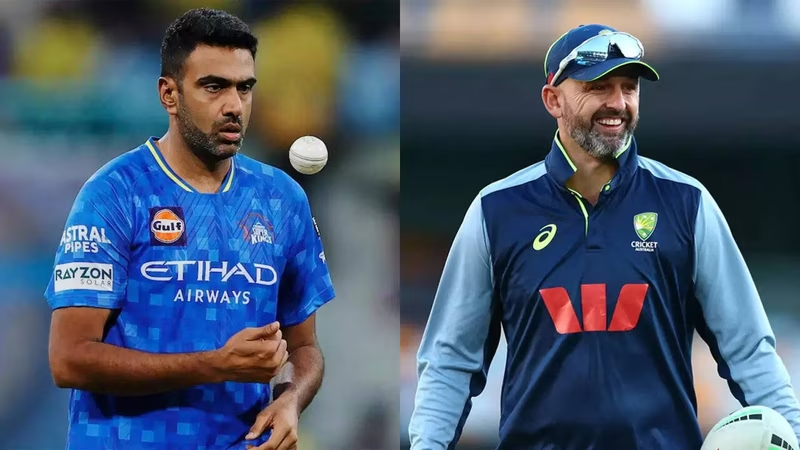
Why Indian Cricketers Can’t Be ‘Filthy’ Like Nathan Lyon: Ashwin’s Candid Take on Cultural Silence
When Australian spinner Nathan Lyon described himself as “absolutely filthy” after being dropped for the second Ashes Test in Brisbane—the first time he’d been omitted from a home Test since 2012—it sparked more than just headlines . It ignited a global conversation about player expression, cultural norms, and the invisible walls that silence athletes in different parts of the cricketing world.
Veteran Indian off-spinner R Ashwin didn’t just notice the contrast—he lived it. In a recent revelation, Ashwin explained why Indian players simply can’t speak with the same raw honesty as their Australian counterparts, even when they feel the exact same emotions .
“We feel the same disappointment, the same frustration,” Ashwin admitted. “But for us, speaking out comes with collateral damage. You get labelled. You’re seen as ‘difficult.’ And that label can stick for your entire career.”
Table of Contents
- The “Filthy” Quote: What Happened?
- Ashwin on Why Indian Players Stay Silent
- How BCCI Policy Reinforces Caution
- Australia vs. India: A Cultural Chasm in Cricket
- Is Change on the Horizon?
- Conclusion: The Cost of Silence
- Sources
The “Filthy” Quote: What Happened?
Nathan Lyon’s omission from the Australian XI for the second Ashes Test in December 2025 was historic—and controversial. At 37, with over 500 Test wickets, Lyon had become a fixture in Australian home Tests. His reaction was refreshingly human: “I felt absolutely filthy,” he told reporters .
There was no sugarcoating. No corporate-speak. Just raw, unfiltered emotion—a rarity in modern elite sport. And notably, no one punished him for it. Cricket Australia didn’t issue a statement. The selectors didn’t call him out. The media praised his honesty.
Ashwin on Why Indian Players Stay Silent
For Ashwin, Lyon’s freedom is a luxury Indian players don’t have. “In Western cultures, expressing your true feelings is seen as authenticity,” Ashwin observed. “In our system, it’s seen as insubordination” .
The fear isn’t unfounded. Indian cricketers operate in a high-stakes ecosystem where:
- Public criticism can lead to exclusion from selection panels
- Media misquotes can spiral into national controversies
- Any perceived “attitude problem” can overshadow years of performance
Ashwin hopes this changes. “I’d love to see a future where an Indian player can say, ‘I’m devastated I was dropped,’ without fear of being branded as selfish or ungrateful,” he said .
BCCI’s Media Policy and the Culture of Control
The Board of Control for Cricket in India (BCCI) has long maintained a tight grip on player conduct—especially off the field. In January 2025, it introduced a 10-point discipline policy aimed at promoting “unity and professionalism” .
While the policy doesn’t explicitly ban honest media commentary, its tone reinforces caution:
- Mandatory participation in domestic cricket
- Restrictions on personal endorsements during tours
- Emphasis on “team-first” messaging in all public appearances
This creates an environment where players self-censor. As one former national selector anonymously noted: “In India, your media management is as important as your batting average.”
Australia vs. India: A Cultural Chasm in Cricket
The difference isn’t just institutional—it’s cultural. Australian cricket thrives on rugged individualism. From Shane Warne’s outspoken critiques to Pat Cummins’ candid pressers, players are expected to have opinions.
In India, the narrative is collectivist: the team is holy, the jersey is sacred, and personal feelings must yield to national interest. This isn’t inherently bad—but it can stifle emotional authenticity.
Historical examples abound:
- Ravindra Jadeja faced backlash for not answering Australian media in English
- Virat Kohli’s clashes with Aussie press over privacy boundaries
- Harbhajan Singh’s career turbulence after media spats
Contrast that with Lyon, who remains a national treasure despite his blunt words. The system protects his right to be human.
Is Change on the Horizon?
Ashwin is optimistic. With a new generation of players—more globally connected and media-savvy—entering the scene, he believes the culture is slowly shifting.
“The younger guys are more confident in their voice,” he noted. “But they still watch what the veterans go through. Until the system rewards honesty instead of punishing it, real change will be slow.”
For now, Indian cricketers continue to internalize their “filthy” feelings—smiling in press conferences while grieving in silence.
Conclusion: The Cost of Silence
The Nathan Lyon–R Ashwin contrast isn’t just about two players—it’s a mirror held up to two cricketing philosophies. One celebrates transparency; the other enforces harmony, even at the cost of authenticity.
For Indian fans, this raises a tough question: Do we want robots in blue jerseys—or real human beings who can say, without fear, “I’m absolutely filthy”?
As Ashwin hopes, maybe one day an Indian player will say it—and be applauded, not admonished.
Sources
- Times of India: “’Absolutely filthy’: Ashwin explains why Indian players can’t speak like Lyon”
- ESPNCricinfo: “Lyon feels ‘filthy’ after rare Test omission”
- Cricbuzz: “BCCI introduces 10-point discipline policy for Team India”
- The Guardian: “Nathan Lyon says he is ‘absolutely FILTHY’ with Aussie selectors”
- Sportskeeda: “BCCI’s 10-point diktat for players to promote ‘discipline and unity’”