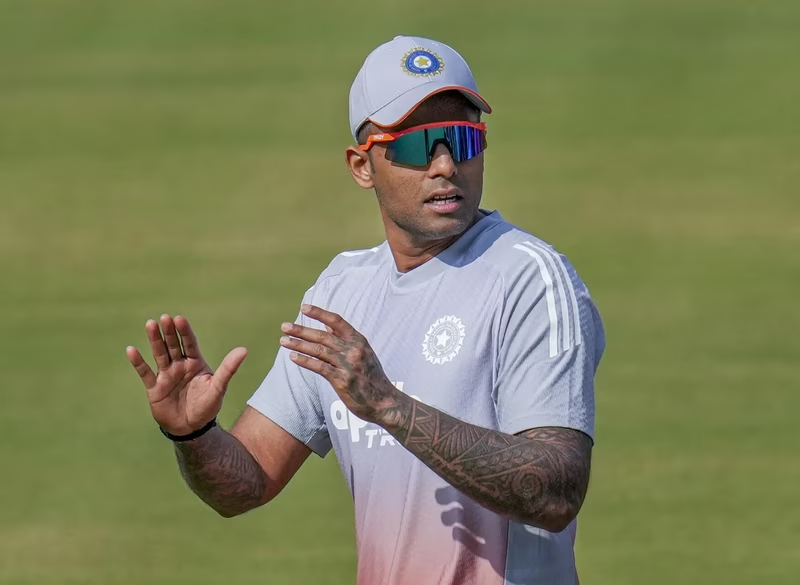
Just days before the first T20I against South Africa, India’s captain has dropped a truth bomb that’s got the cricketing world talking. Struggling for runs himself, Suryakumar Yadav isn’t looking for quick fixes or a complete team overhaul. Instead, he’s preaching a return to fundamentals: a deep, unwavering commitment to domestic cricket as the bedrock of international success. His message is clear, and it’s strategic—this is all about building a bulletproof unit for the 2026 T20 World Cup defense.
Table of Contents
- SKY’s Domestic Cricket Philosophy: More Than Just a Quote
- The 2026 T20 World Cup Blueprint: Stability Over Chaos
- Batting Flexibility: The New India Mantra
- What This Means for Indian Cricket Fans
- Conclusion: A Captain’s Long Game
- Sources
SKY’s Domestic Cricket Philosophy: More Than Just a Quote
When Suryakumar Yadav talks about Suryakumar Yadav domestic cricket, he’s not just paying lip service. He’s making a strategic declaration. For a player whose entire international career is built on the unorthodox flair nurtured in the Indian domestic circuit, his belief is personal and tactical. He’s stressed that even senior players must engage with domestic tournaments to stay “match-ready,” acknowledging its unique “challenges and learning opportunities” .
This stance is a direct counter to a growing trend where established stars skip domestic games, relying on T20 leagues for practice. SKY argues that the longer format of domestic first-class and List A cricket provides a different, invaluable kind of pressure and patience that’s impossible to replicate in the high-octane, short-format leagues . It’s about building a mental and technical resilience that’s crucial when the stakes are highest on the world stage.
The 2026 T20 World Cup Blueprint: Stability Over Chaos
Forget the constant chopping and changing. Suryakumar’s most powerful message is one of continuity. His now-famous line, “We don’t want to change a lot,” is the official team motto for the next 18 months . The preparation for the 2026 T20 World Cup didn’t start yesterday; according to the skipper, it “began right after the 2024 edition” . This series against South Africa is seen as a critical 10-game laboratory to test and cement a core group.
The focus is on building a stable unit that understands each other’s games inside out. This long-term vision prioritizes cohesion over reactionary selections. With key players like Hardik Pandya and Shubman Gill expected to return from fitness breaks, the plan isn’t to disrupt the existing core but to integrate them seamlessly into a well-oiled machine .
Batting Flexibility: The New India Mantra
In a fascinating tactical shift, Suryakumar has emphasized that in his squad, no player from positions three to seven is guaranteed a fixed slot . The only constants are the openers. Everyone else, including the captain himself, must be ready to adapt.
He specifically called out Sanju Samson as a prime example of this required adaptability, stating, “Everyone else has to be very flexible” . This approach is designed to create a dynamic and unpredictable batting lineup that can adjust to any match situation—be it chasing a small total or rebuilding after an early collapse. It’s a system that rewards versatility and puts the team’s needs above individual preferences.
What This Means for Indian Cricket Fans
For fans, this strategy offers a refreshing change of pace. It signals a move away from the anxiety of constant selection debates and towards a period of structured, long-term planning. It means we’re likely to see a more settled team in the lead-up to the World Cup, giving players the confidence to play without the fear of being dropped after a single failure.
It also elevates the importance of the domestic season. Fans should now watch domestic tournaments like the Syed Mushtaq Ali Trophy and the Vijay Hazare Trophy not just for emerging talent, but to gauge the form and readiness of established stars preparing for the global stage. The BCCI’s official website is a great resource to track these domestic fixtures and performances [[INTERNAL_LINK:domestic-cricket-fixtures]].
Furthermore, this plan aligns with the philosophy of other top cricketing nations. As noted by the International Cricket Council (ICC) in their high-performance reviews, a strong domestic structure is the single biggest predictor of sustained international success [[EXTERNAL_LINK:https://www.icc-cricket.com/]].
Conclusion: A Captain’s Long Game
Suryakumar Yadav’s current form might be under scrutiny, but his vision for the team is as sharp as ever. By anchoring India’s 2026 T20 World Cup defense in the discipline of domestic cricket, a commitment to team stability, and a mandate for batting flexibility, he’s playing the long game. He’s not just trying to win the next match against South Africa; he’s meticulously building a champion team for the biggest prize in T20 cricket. It’s a bold, patient strategy that could well be the key to India’s continued dominance.
Sources
- Times of India: We don’t want to change a lot: Suryakumar Yadav
- BCCI & Cricket World: Suryakumar Yadav speaks ahead of 1st T20I against South Africa
- Times of India: on Sanju, Dube & India’s T20 Gameplan for South Africa
- Various Sources: IND v SA 2025: “Important to play domestic cricket,”