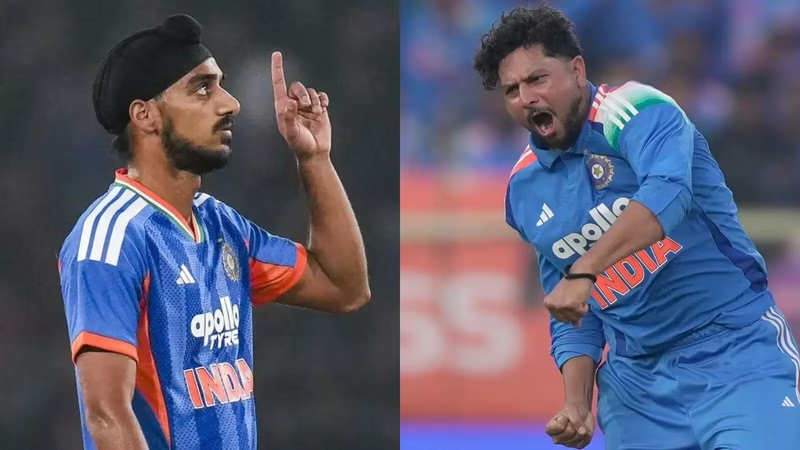
It’s one of the toughest calls in modern Indian cricket. Two match-winners. One spot. And a team philosophy that leaves no room for compromise.
Welcome to the Arsh or Kul conundrum—a selection puzzle that’s shaping India’s T20I future as they gear up for the 2026 T20 World Cup.
Despite both Arshdeep Singh (left-arm pacer) and Kuldeep Yadav (wrist-spinner) boasting stellar stats, consistent performances, and game-changing abilities, the Indian team management has repeatedly signaled they can only accommodate one of them in the final XI. Why? Because in today’s T20 cricket, batting depth isn’t optional—it’s existential.
And with wicketkeeper Jitesh Sharma now firmly preferred over Sanju Samson for his lower-order firepower, the squeeze on specialist bowlers has intensified .
Table of Contents
- The Batting Depth Mandate
- Arsh or Kul: The Statistical Showdown
- Asia Cup 2025: The Tactical Proving Ground
- How Jitesh Sharma Changed the Equation
- Scenarios: When to Pick Arshdeep vs. Kuldeep
- Conclusion: No Room for Two Geniuses
The Batting Depth Mandate
India’s current T20I template is built around a simple, non-negotiable rule: seven genuine batters in the XI.
This includes:
- Two openers (e.g., Yashasvi Jaiswal, Shubman Gill)
- A No. 3 consolidator (e.g., Suryakumar Yadav or Ruturaj Gaikwad)
- Two middle-order power-hitters (e.g., Hardik Pandya, Rinku Singh)
- A wicketkeeper-batter (Jitesh Sharma)
- A bowling all-rounder who can bat (e.g., Axar Patel or Washington Sundar)
That leaves just four spots for pure bowlers. With Jasprit Bumrah and Mohammed Siraj (or Natarajan) locked in as pace options, and one spinner usually required, there’s only one flexible slot left—and that’s where Arsh or Kul battle it out.
Arsh or Kul: The Statistical Showdown
Both players are elite—but in different ways.
| Player | T20I Wickets (Last 18 mos) | Economy Rate | Best Bowling | Key Strength |
|---|---|---|---|---|
| Arshdeep Singh | 38 | 8.2 | 4/9 | Death overs, yorkers, swing with new ball |
| Kuldeep Yadav | 42 | 7.1 | 3/15 | Wicket-taking in middle overs, deceptive googly |
Kuldeep averages under 18 with the ball; Arshdeep has the best death-overs economy among Indian pacers. You’d want both—if you could.
Asia Cup 2025: The Tactical Proving Ground
The UAE-hosted Asia Cup 2025 laid bare India’s selection logic. Despite Arshdeep being in red-hot form, he was left out of four of the five matches . Why?
Because the pitches were spin-friendly. India played two spinners—Kuldeep and Axar—alongside three frontline pacers. To fit that combination, they needed an extra batter, not a fourth pacer. Arshdeep, despite his skill, became the odd man out.
Conversely, on bouncier tracks like in South Africa or Australia, Arshdeep would likely get the nod, and Kuldeep might sit out—especially if Yuzvendra Chahal or Ravi Bishnoi is preferred as the lone spinner.
How Jitesh Sharma Changed the Equation
A year ago, Sanju Samson’s inclusion would’ve tipped the balance toward Kuldeep. Why? Because Samson, while a good batter, doesn’t offer explosive late-order hitting.
But with Jitesh Sharma now the first-choice keeper, the team gains a genuine No. 7 who can clear the boundary with ease. His strike rate of 148 in the death overs allows India to play an extra batter—like Rinku Singh—without sacrificing firepower.
This shift means the “keeper slot” now contributes to batting depth, freeing up the team to prioritize either a death bowler (Arshdeep) or a wicket-taking spinner (Kuldeep)—but never both.
Scenarios: When to Pick Arshdeep vs. Kuldeep
Here’s how India’s think tank likely decides:
- Spin-friendly pitches (India, UAE, Sri Lanka): Kuldeep starts. Arshdeep benched.
- Pace-friendly tracks (South Africa, Australia, England): Arshdeep starts. Kuldeep makes way for a second seamer or all-rounder.
- Balanced conditions (West Indies, USA): Toss and opposition batting lineup decide. If opponent has weak vs spin, Kuldeep plays. If they struggle vs pace, Arshdeep enters.
As [INTERNAL_LINK:t20-pitch-analysis-global-venues] shows, pitch behavior is now the primary driver of India’s bowling composition.
Conclusion: No Room for Two Geniuses
The Arsh or Kul dilemma isn’t about who’s better—it’s about who fits the match context. In a format where balance trumps individual brilliance, even world-class performers must bend to the team’s structural needs.
For fans, it’s frustrating. For selectors, it’s necessary. And for Arshdeep and Kuldeep? It’s a constant reminder that in T20 cricket, talent alone isn’t enough—you have to be the right talent for the day.
As India builds toward the 2026 World Cup, expect this one-spot-two-stars drama to continue—because in the high-stakes world of T20Is, there’s simply no room for two geniuses in one XI.
Sources
- Times of India: Arsh or Kul — Why India can fit only one Deep in T20Is
- ESPNcricinfo Stats: Arshdeep Singh & Kuldeep Yadav T20I Records
- International Cricket Council (ICC): https://www.icc-cricket.com/
- Board of Control for Cricket in India (BCCI): https://www.bcci.tv/