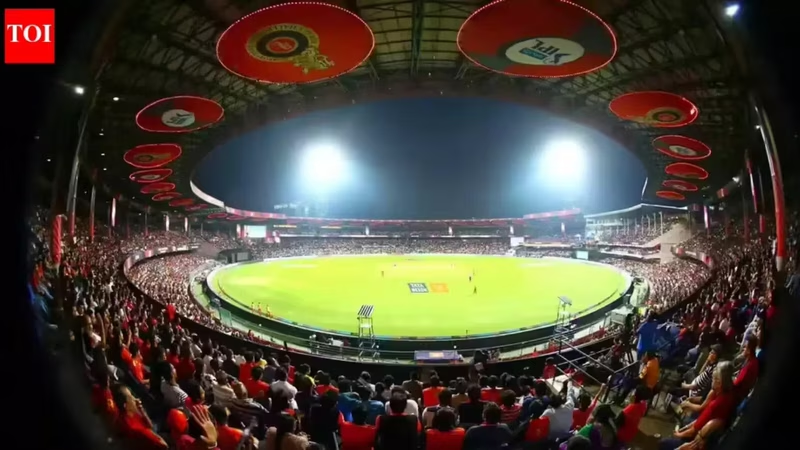
The roar of the crowd. The crack of the bat. The electric buzz of a packed M Chinnaswamy Stadium.
For over a year, those sounds have been replaced by silence—and uneasy memories.
Following the tragic Bengaluru stampede during a high-profile T20 match in late 2024, top-level cricket vanished from one of India’s most iconic venues. No international games. No IPL fixtures. Just empty stands and unanswered questions about safety, infrastructure, and accountability.
But now, a determined new voice is breaking that silence. Chinnaswamy Stadium comeback is no longer a distant dream—it’s a full-fledged campaign led by the Karnataka State Cricket Association’s (KSCA) newly elected president, former India pacer Venkatesh Prasad.
Table of Contents
- The Stampede That Silenced Chinnaswamy
- Chinnaswamy Stadium Comeback: Venkatesh Prasad’s Mission
- Key Hurdles to Resuming Cricket
- Beyond Bengaluru: KSCA’s Statewide Vision
- What Needs to Change for a Safe Return?
- Conclusion: Can Chinnaswamy Rise Again?
The Stampede That Silenced Chinnaswamy
On a rain-affected evening in November 2024, chaos erupted outside Gate No. 3 of the M Chinnaswamy Stadium. Overcrowding, poor crowd management, and a bottleneck at entry points triggered a stampede that left two fans dead and dozens injured .
The fallout was immediate. The BCCI suspended all international and high-stakes domestic matches at the venue. The IPL’s Royal Challengers Bengaluru were forced to shift home games to Hyderabad and Pune in 2025—a massive financial and emotional blow to the city’s cricketing ecosystem.
More than infrastructure, it was trust that was shattered. Fans questioned whether the stadium—built in 1969 and last renovated in 2011—could handle modern crowds and security demands.
Chinnaswamy Stadium Comeback: Venkatesh Prasad’s Mission
Enter Venkatesh Prasad. Elected KSCA president in October 2025, the 1996 World Cup hero hasn’t wasted a moment. Within weeks of taking office, he held high-level talks with Karnataka Chief Minister Siddaramaiah and Deputy CM D.K. Shivakumar to fast-track approvals for stadium upgrades and safety clearances .
“Chinnaswamy isn’t just a stadium—it’s Bengaluru’s cricketing soul,” Prasad declared in a recent press briefing. “Our goal is to bring back international cricket by early 2026, starting with a bilateral series.”
His approach is two-pronged: restore safety and rebuild trust. To that end, the KSCA has commissioned a third-party audit of all entry-exit protocols, emergency response systems, and structural integrity.
Key Hurdles to Resuming Cricket
Despite Prasad’s optimism, the path to a Chinnaswamy Stadium comeback is littered with obstacles:
- Government Clearance: The state Home Department must certify the venue as “stampede-proof,” requiring upgraded barricades, AI-powered crowd monitoring, and dedicated emergency lanes.
- BCCI Approval: The national board remains cautious. A BCCI safety committee inspection is pending, and sources say they want to see “irreversible” changes before greenlighting any matches .
- Public Perception: Winning back fans is as crucial as winning over officials. Many families still associate the venue with trauma.
As [INTERNAL_LINK:stadium-safety-standards-post-accidents] highlights, venues worldwide have faced multi-year bans after crowd disasters—making Chinnaswamy’s potential 2026 return ambitious, if not unprecedented.
Beyond Bengaluru: KSCA’s Statewide Vision
Prasad isn’t just fixated on the capital. During his recent tour, he personally inspected the under-construction stadium in Belagavi, signaling a broader vision: decentralizing Karnataka’s cricket infrastructure.
“We can’t rely on one venue,” he said. “Belagavi, Mysuru, and Davanagere must become secondary hubs for domestic cricket, youth academies, and even T20 franchise feeder tournaments.”
This strategy serves two purposes: it reduces pressure on Chinnaswamy and builds a deeper talent pipeline across the state—addressing long-standing criticism that Karnataka’s cricket success is overly Bengaluru-centric.
What Needs to Change for a Safe Return?
Based on preliminary reports, the KSCA’s proposed upgrades include:
- Smart Ticketing & Entry Gates: RFID-enabled tickets and 12 new automated turnstiles to prevent bottlenecks.
- Dedicated Evacuation Corridors: Clearly marked, unobstructed pathways on all four sides of the stadium.
- Real-Time Crowd Analytics: AI cameras that alert security when density exceeds safe thresholds.
- Community Engagement Drills: Monthly mock drills with BBMP and fire department to train staff and educate fans.
These aren’t cosmetic fixes—they’re systemic overhauls aligned with ICC stadium safety guidelines .
Conclusion: Can Chinnaswamy Rise Again?
The Chinnaswamy Stadium comeback isn’t just about cricket. It’s about healing, accountability, and proving that a city’s passion can coexist with modern safety standards.
Venkatesh Prasad has the credibility, the political access, and the urgency to drive this revival. But success hinges on more than promises—it demands visible, verifiable action.
If the KSCA delivers, 2026 could mark not just a return of cricket, but a renaissance of trust. And for millions of Bengaluru fans, that’s a match worth waiting for.
Sources
- Times of India: KSCA steps up push to restart cricket at Chinnaswamy
- Board of Control for Cricket in India (BCCI): https://www.bcci.tv/
- International Cricket Council (ICC) Venue Safety Standards: https://www.icc-cricket.com/about/governance/venue-standards
- Government of Karnataka – Urban Development Department: https://karnataka.gov.in/