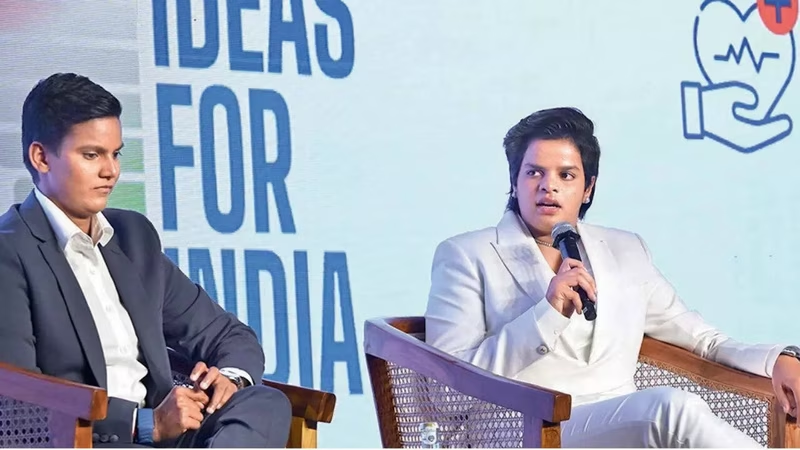
In a stunningly candid revelation that has sent ripples through the cricketing world, World Cup champions Shafali Verma and Deepti Sharma have laid bare a critical gap in Indian women’s cricket. Despite their undeniable flair and world-class talent, they admit the team is still in school when it comes to one crucial attribute: mental toughness .
This admission, coming on the heels of India’s maiden ICC Women’s Cricket World Cup triumph in November 2025, is not a sign of weakness but a powerful declaration of self-awareness and a roadmap for the future. It’s the kind of honesty that separates good teams from legendary ones.
Table of Contents
- The WPL: The Unlikely Classroom for Champions
- The Mental Toughness Deficit: What It Really Means
- Learning From The Legacy of Mithali and Jhulan
- The Test Match Mandate: The Crucible for True Resilience
- What’s Next for Team India?
The WPL: The Unlikely Classroom for Champions
Both Shafali and Deepti point to the Women’s Premier League (WPL) as the single most transformative force in their rapid evolution. It’s not just about the money or the glamour; it’s about the intense, high-pressure environment that simulates international cricket on a weekly basis .
The league has created a unique ecosystem where young Indian talents are forced to share dressing rooms, strategies, and high-stakes moments with some of the best players on the planet. “Before WPL, we were talented, but we were soft,” an insider close to the team confided. The league has been a masterclass in composure under fire, strategic thinking, and the sheer will to win that defines champions .
For Shafali, whose swashbuckling style is now tempered with a newfound calm, the WPL was a crucible. She’s spoken openly about working on “the mental side of her game,” a direct result of the challenges she faced in the tournament . Deepti Sharma, the architect of their World Cup victory and Player of the Tournament, credits the league for sharpening her all-round game to a razor’s edge .
The Mental Toughness Deficit: What It Really Means
When the Indian duo talks about lacking mental toughness, they aren’t referring to a lack of courage. Instead, they’re pinpointing a sophisticated skillset: the ability to manage pressure over long periods, to recover instantly from a mistake, to maintain intense focus during lulls in the game, and to execute complex plans with unwavering belief.
Overseas players, particularly from Australia and England, have honed these skills through a relentless schedule that includes a significant number of Test matches—a format that is the ultimate test of patience, discipline, and psychological fortitude. India’s current calendar, heavily skewed towards T20s and ODIs, simply doesn’t provide the same depth of mental conditioning .
Learning From The Legacy of Mithali and Jhulan
While looking outward for inspiration, Verma and Sharma are also deeply rooted in their own cricketing heritage. They frequently acknowledge the immense debt they owe to legends like Mithali Raj and Jhulan Goswami. These pioneers didn’t just build a team; they built a culture of resilience in an era with far fewer resources and recognition .
Mithali Raj’s legendary concentration and Jhulan’s fiery, never-say-die attitude are now being seen as the foundational pillars of India’s modern mental toughness journey. The current generation is taking that legacy and supercharging it with the global insights they’ve gained from the WPL and international tours .
The Test Match Mandate: The Crucible for True Resilience
Shafali and Deepti’s call for more matches isn’t just a vague wish—it’s a specific, strategic demand for more Test cricket. They understand that the real forge for mental toughness is the five-day format.
The good news? The schedule is starting to shift. The upcoming tour of Australia in 2025-26 includes a Test match, a direct response to the players’ pleas . This is a crucial step. Playing just one or two Tests a year isn’t enough to build the kind of deep-seated resilience that Australia’s women have demonstrated for over a decade. To truly compete at the highest level across all formats, India needs a sustained Test program.
What’s Next for Team India?
The future is incredibly bright. With their historic World Cup win, India’s women have shattered a massive psychological barrier. They now know they can win on the biggest stage. The next phase of their evolution, as articulated by their two biggest stars, is about consistency and depth.
Their roadmap is clear:
- Double down on the WPL: Use it as a year-round training ground for high-pressure scenarios.
- Champion the Test format: Advocate for and excel in the longest form of the game to build iron-clad mental fortitude.
- Blend legacy with innovation: Merge the stoic resilience of Mithali and Jhulan’s era with the aggressive, modern mindset learned from global stars.
This self-critical, forward-looking approach from Verma and Sharma is the most exciting sign of all. It shows a team that’s not content with one trophy, but is on a mission to build a lasting dynasty. The skill was never in doubt. Now, they’re on a focused mission to master the mind.
Conclusion
Shafali Verma and Deepti Sharma’s honesty about the need for greater mental toughness is a powerful statement of intent. It’s a public declaration that the Indian women’s team is in a constant state of learning and growth. The Women’s Premier League has been the catalyst, but the journey is far from over. By demanding more Test cricket and standing on the shoulders of giants like Mithali Raj, they are charting a course for a future where India’s skill is matched by an unbreakable will. For any fan of the game, this is a story worth following.
Sources
- Times of India: “We have more skill, but we’re still learning mental toughness from overseas players”
- ESPNCricinfo: India Women’s tour of England, 2025
- Cricket Australia: India women’s cricket team in Australia in 2025–26
- International Cricket Council (ICC): ICC Women’s Championship