In a moment that blurred the lines between national pride and bureaucratic bewilderment, Assam Chief Minister Himanta Biswa Sarma received a call from none other than Prime Minister Narendra Modi—asking about a young woman named “Simu.” The CM, puzzled and slightly embarrassed, had no idea who she was. That all changed within hours.
Because Simu Das wasn’t just any name. She was the Player of the Match in the final of the inaugural Blind Women’s T20 World Cup—a triumph that crowned India as world champions and catapulted her into the national spotlight .
So, who exactly is Simu Das? And what makes her story one of the most compelling in Indian sport today?
Table of Contents
- The Rise of Simu Das: From Nagaon to World Champion
- Simu Das and the Blind Women’s T20 World Cup 2025
- The PM Modi Call That Stumped Assam CM
- Overcoming Odds: A Life Defined by Resilience
- Recognition and Rewards from the State
- Why Simu Das’s Story Matters for Indian Sport
- Conclusion: A Beacon of Grit and Glory
- Sources
The Rise of Simu Das: From Nagaon to World Champion
Simu Das hails from Nagaon, a district in Assam known more for its historical significance than sporting stardom—especially in adaptive sports. Born completely blind (classified as B1, the most severe visual impairment category in para-cricket), Simu’s early life was marked by hardship .
Reports indicate her father abandoned her and her mother upon learning of her blindness, leaving them to navigate life on their own . Yet, despite limited resources, infrastructural gaps, and societal stigma, Simu found her calling in cricket—a sport notoriously difficult for sighted players, let alone those who play in total darkness .
Simu Das and the Blind Women’s T20 World Cup 2025
The year 2025 will go down in history as the dawn of international women’s blind cricket. The inaugural Blind Women’s T20 World Cup—hosted across multiple venues—saw India dominate from start to finish. And at the heart of their success was Simu Das .
In the final against Nepal, Simu delivered a match-defining all-round performance: an explosive 86 runs with the bat and a crucial wicket with her bowling, earning her the Player of the Match award . She was also among the top performers throughout the tournament, contributing significantly to India’s historic title win .
Her category? B1—meaning she has zero light perception. Players like her rely on sound, tactile cues, and immense spatial awareness to excel .
The PM Modi Call That Stumped Assam CM
Following India’s victory, Prime Minister Narendra Modi personally called to congratulate the team. But his call to Assam CM Himanta Biswa Sarma—asking specifically about “Simu”—left the latter momentarily speechless .
“A call from none other than Prime Minister Narendra Modi had left Assam Chief Minister Himanta Biswa Sarma almost clueless,” one report noted . Within hours, however, the CM had not only identified her but initiated immediate state-level recognition.
Overcoming Odds: A Life Defined by Resilience
Simu Das’s journey reflects a deeper narrative about accessibility, opportunity, and representation in Indian sport:
- She began playing cricket only three years ago, a late start by elite standards .
- She trained without proper gear, often on uneven fields with minimal coaching support .
- Despite being classified as B1 (totally blind), she mastered both batting and bowling—a rare feat even in adaptive cricket .
- Her determination stems from a desire to prove that disability doesn’t define capability .
Recognition and Rewards from the State
Following her World Cup heroics and the PM’s personal acknowledgment, the Government of Assam acted swiftly:
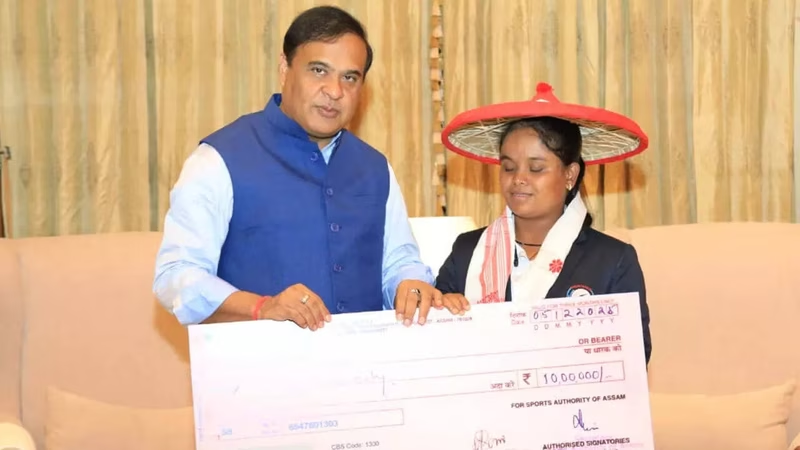
- Chief Minister Himanta Biswa Sarma awarded Simu Das a cash prize of ₹10 lakh .
- She was also promised a government job—a significant step toward long-term security .
- The CM publicly felicitated her, calling her “Assam’s pride” and praising her “journey of grit” .
This recognition isn’t just symbolic; it’s a lifeline for an athlete who overcame abandonment and poverty to represent her country on the world stage .
Why Simu Das’s Story Matters for Indian Sport
Simu Das’s rise highlights critical gaps—and opportunities—in India’s sporting ecosystem:
- Visibility for para-athletes: Women in adaptive sports rarely receive mainstream media coverage. Simu’s story forces a long-overdue conversation [[INTERNAL_LINK:women-in-para-sports]].
- State support vs. grassroots reality: While rewards are welcome, systemic investment in blind cricket infrastructure remains minimal [[INTERNAL_LINK:future-of-blind-cricket-in-india]].
- Role models matter: For millions of visually impaired girls in India, Simu Das is now living proof that sporting excellence is possible .
Organizations like the World Blind Cricket Council have long advocated for greater inclusion—and Simu’s success is a powerful testament to their mission.
Conclusion: A Beacon of Grit and Glory
Simu Das is more than a cricketer. She is a symbol of resilience, a catalyst for change, and a national hero whose name even puzzled a Chief Minister—before it inspired a nation. Her journey from the forgotten lanes of Nagaon to the World Cup podium is a reminder that true talent often shines brightest in the darkest circumstances.
As India celebrates her victory, the real win lies in ensuring that Simu’s story isn’t an exception—but the beginning of a new era for inclusive sport.
Sources
- Indian sports wrap, December 6: India’s blind cricket star Simu Das honoured by Assam CM
- Assam Blind Woman Cricketer Simu Das, Whose Story Left CM Searching
- Assam CM grants government job, Rs 10 lakh to World Cup hero Simu Das
- Assam Chief Minister Felicitates Blind Cricket Champion Simu Das
- India Orange Wins NTT DATA Women’s T20 Cricket Series
- First-ever Women’s T20 World Cup Cricket for the Blind 2025
- Queen of Grit: Simu Das, Blind Cricket World Cup Hero
- Simu Das: Assam’s Blind Cricketer Shines on World Cup Stage
- The remarkable rise of Simu Das, Assam’s blind cricket star
- Exploring the World of Blind Cricket with Simu Das
- Simu: Journey from Darkness to Glory
- Meet Simu Das: India’s Blind Cricket Champion