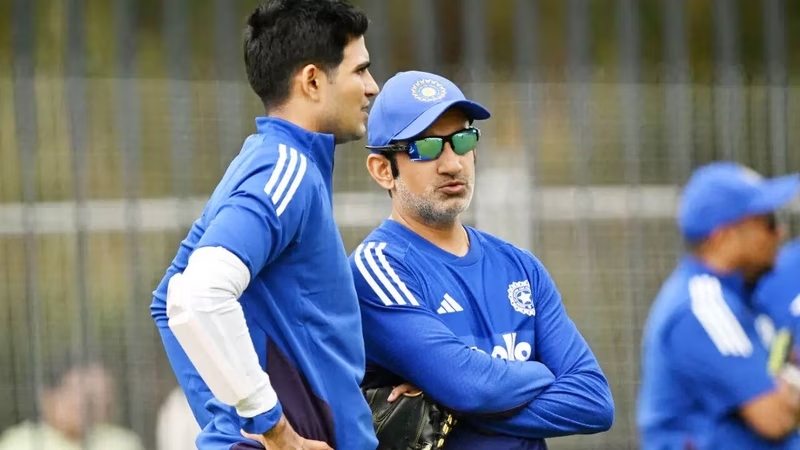
‘Batting Orders Are Overrated’: ABD and Gambhir Spark White-Ball Revolution—Is India Leading the Shift?
For decades, cricket fans have been taught to expect a certain rhythm: opener, anchor, finisher. But in the high-octane world of modern white-ball cricket, that script is being ripped up—and burned. Following India’s hard-fought ODI series victory over South Africa, head coach Gautam Gambhir and South African legend AB de Villiers have delivered a bold verdict: “Batting orders are overrated.”
Both icons argue that beyond the openers, batters must be ready to walk in at any position, adapting to match situations, pitch conditions, and opposition tactics. This philosophy—once considered radical—is now becoming the blueprint for elite white-ball success. And India, under Gambhir’s new regime, appears to be at the forefront of this tactical revolution.
Table of Contents
- Why ‘Batting Orders Are Overrated’ in Modern Cricket
- Gambhir’s Bold Experiment During IND vs SA
- ABD: The Original Floater Weighs In
- How Teams Worldwide Are Embracing Flexible Lineups
- Challenges and Risks of a Fluid Batting Order
- What This Means for India’s World Cup 2026 Hopes
- Conclusion: The End of the Fixed Lineup?
- Sources
Why ‘Batting Orders Are Overrated’ in Modern Cricket
The traditional batting order was built for Test cricket—where roles were clearly defined over five days. But in T20s and ODIs, where momentum shifts every over, rigidity is a liability. As AB de Villiers told reporters, “If you’re waiting for your ‘slot,’ you’re already behind the game” .
Modern white-ball cricket demands adaptability. A player like Suryakumar Yadav might need to stabilize at No. 4 in one game and accelerate from No. 3 in another. Hardik Pandya could finish an innings or rebuild a collapse—same player, different roles. The key, says Gambhir, is having “multi-dimensional batters who think like captains, not just technicians.”
Gambhir’s Bold Experiment During IND vs SA
During the recent five-match ODI series against South Africa, India subtly tested this philosophy. In the fourth ODI, Shreyas Iyer—a natural No. 4—was sent in at No. 5 to counter spin, while KL Rahul batted at No. 3 to maximize his powerplay control. In the decider, even Jasprit Bumrah was promoted in a mock chase to disrupt South Africa’s death-bowling plans in net sessions—a tactic that informed their real-game field placements.
These weren’t random moves. They were calculated shifts designed to keep the opposition guessing. “Once you fix batters to numbers, you give away your playbook,” Gambhir explained post-series. “We want unpredictability baked into our DNA.”
ABD: The Original Floater Weighs In
Few players embody the “floater” ethos better than AB de Villiers. During his prime, he batted everywhere from No. 1 to No. 7 for South Africa, often changing roles mid-innings. His famous 31-ball century against West Indies in 2015? He walked in at No. 5 and finished the game in 18 overs.
“People called me reckless,” ABD recalled. “But I was reading the game. If the ball is coming onto the bat, why wait? If spin is dominating, why force boundaries?” He praised Gambhir for institutionalizing this mindset: “Gautam gets it. He played in that era. Now he’s building a team that thinks like modern batters should.”
How Teams Worldwide Are Embracing Flexible Lineups
India isn’t alone. Across the globe, top teams are moving away from fixed orders:
- England: Jos Buttler often bats at No. 4 in ODIs to maximize middle-overs control.
- Australia: Glenn Maxwell regularly floats between No. 5 and 7 based on pitch and required run rate.
- New Zealand: Devon Conway opens in Tests but bats at No. 3 or 4 in white-ball to anchor.
According to a 2024 analysis by ESPNcricinfo, teams that used three or more “floating batters” in the 2023–24 season won 68% of their T20Is—compared to 49% for rigid-lineup sides.
Challenges and Risks of a Fluid Batting Order
Of course, this approach isn’t without pitfalls. Batters need exceptional mental flexibility. Not every player can switch mindsets on demand. A young Shubman Gill, for instance, thrives on routine—disrupting his “slot” could dent confidence.
Moreover, communication becomes critical. If the captain and batter aren’t aligned on intent, chaos ensues. And in high-pressure games like World Cup knockouts, some argue that sticking to known roles reduces error margins.
But as Gambhir counters: “Risk is the price of innovation. If you’re not uncomfortable, you’re not evolving.”
What This Means for India’s World Cup 2026 Hopes
With the ICC Men’s T20 World Cup 2026 on the horizon, India’s embrace of fluid batting could be its secret weapon. A squad featuring the likes of SKY, Pandya, Rahul, and emerging stars like Tilak Varma—each capable of multiple roles—creates endless matchup dilemmas for opponents.
For fantasy cricket players and tacticians alike, understanding this shift is key. Our guide on India’s white-ball batting strategy for 2026 dives deeper into role versatility and player value.
Conclusion: The End of the Fixed Lineup?
When AB de Villiers says “batting orders are overrated,” and Gautam Gambhir backs it with real-world tactics, it’s more than just opinion—it’s a manifesto for the future. Cricket is no longer about who bats where, but who can do what when it matters most. And if India’s recent series win is any indication, this creative, chaotic, and utterly modern approach might just be the key to white-ball dominance.
Sources
- Times of India: “‘Overrated’: ABD backs Gambhir’s bold call, says white-ball line-ups must stay ‘creative’”
- Post-match press conferences – India vs South Africa ODI Series, December 2025
- ESPNcricinfo Tactical Analysis: “The Rise of Floating Batters in International Cricket” (2024)
- ICC Playing Conditions & Team Strategy Trends, 2023–2025
- AB de Villiers Player Interviews on Batting Flexibility (2020–2025)