Table of Contents
- IPL 2026 Auction: The Budget Reality Check
- How the IPL Auction Purse Actually Works
- Full Breakdown of All 10 Franchises’ Remaining Purse
- Can Teams Really Increase Their IPL 2026 Auction Purse?
- Top Players in the Auction Pool: Who’s Up for Grabs?
- What This Means for Team Strategy
- Conclusion: It’s Not About More Money—It’s About Smarter Spending
- Sources
IPL 2026 Auction: The Budget Reality Check
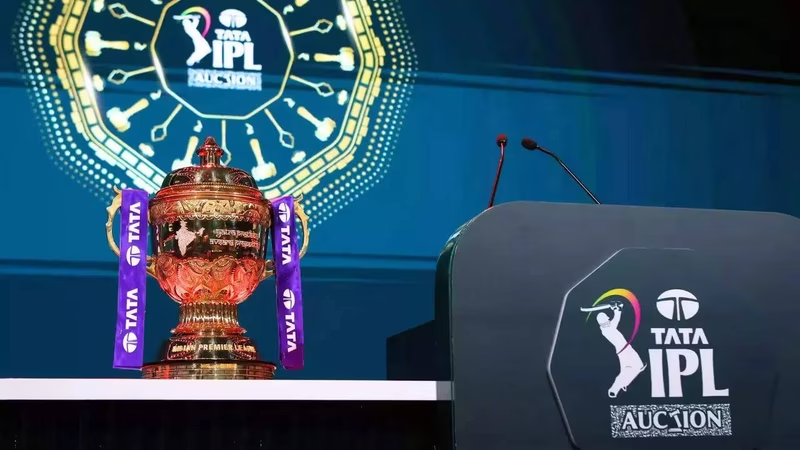
The countdown to the IPL 2026 auction is on—set for December 16 in Abu Dhabi, with 350 players ready to be bid on. But behind the glitz and drama lies a hard financial truth: franchises can’t just wave a magic wand and inflate their bank accounts. Unlike fantasy, real-world IPL economics are tightly regulated.
As teams finalize their squads, a stark disparity has emerged. Kolkata Knight Riders (KKR) hold the largest war chest at a staggering ₹64.3 crore, while five-time champions Mumbai Indians (MI) are clinging to just ₹2.75 crore—the smallest purse in the league. This gap isn’t accidental; it’s the direct result of past spending, player retention choices, and limited methods to free up funds .
How the IPL Auction Purse Actually Works
Every IPL franchise starts with a base purse—₹120 crore for the 2026 cycle. But this isn’t a revolving credit line. The amount a team can spend at auction is what remains after accounting for:
- Retained players (priced at fixed slabs: ₹16Cr, ₹12Cr, ₹8Cr, ₹6Cr)
- Right-to-Match (RTM) card usage
- Players already under contract from previous auctions
Crucially, there’s **no mechanism** for a team to “increase” its purse arbitrarily. The only ways to gain more spending room are through player releases or trades—transactions that must happen **before** the auction date .
Full Breakdown of All 10 Franchises’ Remaining Purse
Based on the latest official data ahead of the Abu Dhabi mega event, here’s where each team stands:
| Team | Remaining Purse (INR Crore) |
|---|---|
| Kolkata Knight Riders | 64.30 |
| Royal Challengers Bengaluru | 57.65 |
| Chennai Super Kings | 43.20 |
| Gujarat Titans | 39.10 |
| Rajasthan Royals | 35.75 |
| Sunrisers Hyderabad | 31.40 |
| Lucknow Super Giants | 29.80 |
| Delhi Capitals | 21.90 |
| Punjab Kings | 16.60 |
| Mumbai Indians | 2.75 |
Source: BCCI & IPL Governing Council data .
Can Teams Really Increase Their IPL 2026 auction Purse?
The short answer: **No—not during or after the auction deadline**. The purse is frozen once the auction begins. However, teams had a window before December 16 to strategically manipulate their budgets through two legal channels:
1. Player Releases
By releasing a player before the auction, a team gets back the full amount of that player’s salary into its purse. For example, if MI had released a ₹10 crore player earlier, they’d now have ₹12.75 crore instead of ₹2.75 crore.
2. Player Trades
Swapping players with another franchise can free up cash. If a team trades a high-salary player for a lower-salary one (or for cash-equivalent value), the difference is added to their auction purse. But **all trades must be completed before the official trade window closes**—which it already has .
So for Mumbai Indians, the damage is done. With just ₹2.75 crore, they can only target low-cost domestic talent or players willing to sign for base price (₹20 lakh). They won’t be in the race for marquee names.
Top Players in the Auction Pool: Who’s Up for Grabs?
Despite budget constraints, the auction pool is stacked. Some of the biggest names include:
- Cameron Green (Australia) – A genuine all-rounder with explosive batting and fast bowling.
- Venkatesh Iyer – The left-handed powerhouse from KKR, now back in the market.
- David Miller – The seasoned South African finisher.
- Mohammad Siraj – India’s premier pace spearhead, unsold last cycle but re-entering.
- Heinrich Klaasen – One of the most destructive T20 batters in the world.
Teams like KKR and RCB, with over ₹50 crore each, will dominate bidding for these stars. MI? They’ll be spectators.
What This Means for Team Strategy
The purse disparity creates a two-tier system:
- Big Spenders (KKR, RCB, CSK): Can rebuild aggressively, target overseas stars, and balance their squads.
- Cash-Strapped (MI, PBKS, DC): Must rely on scouting undervalued talent, promoting academy players, or hoping for post-auction free-agent signings.
This highlights a critical flaw in the IPL’s financial model: poor roster decisions in one cycle can cripple a team for the next. As analyzed by sports economists at the University of Michigan, “salary cap systems only work if teams have tools to correct past mistakes—which the IPL limits severely” .
Conclusion: It’s Not About More Money—It’s About Smarter Spending
The IPL 2026 auction will be a masterclass in financial strategy. While KKR can afford to chase Cameron Green or a world-class pacer, Mumbai Indians must operate like a startup—innovative, lean, and precise. The purse rules are strict, but they’re also fair: every team knew the rules years in advance.
In the end, the auction isn’t won by the richest franchise, but by the smartest one. And for fans, that’s what makes it thrilling.
Sources
- Times of India: IPL 2026 Auction: Can teams increase auction purse?
- IPL Governing Council – Auction Guidelines 2026
- BCCI Official Team Retention & Purse Data
- ESPNcricinfo – Player Availability List for IPL 2026
- University of Michigan – Sport Economics Review on Salary Caps