Table of Contents
- A Historic Honour at the New Chandigarh Stadium
- Yuvraj Singh: From 2011 Hero to Stadium Immortality
- Harmanpreet Kaur: Breaking Barriers, Earning Equal Recognition
- Why This Venue Matters: New Chandigarh’s Rising Stature
- Political Presence & Cultural Statement
- More Than Names: Inspiring Future Generations
- Conclusion: A Blueprint for Inclusive Cricket Legacy
- Sources
A Historic Honour at the New Chandigarh Stadium
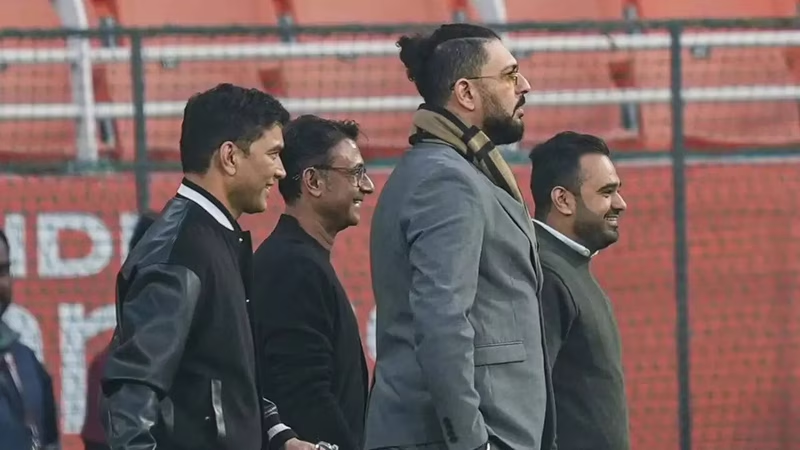
On a landmark Thursday in Punjab, the New Chandigarh Stadium—officially known as the Maharaja Yadavindra Singh International Cricket Stadium—etched two legendary names into its very structure. In a moving ceremony attended by Punjab Chief Minister Bhagwant Mann, stands were formally named after cricket icons **Yuvraj Singh** and **Harmanpreet Kaur** .
This isn’t just another naming event. It’s a rare and powerful gesture that simultaneously honours a 2011 Men’s World Cup hero and the captain who led India to the 2017 Women’s World Cup final—symbolizing a unified vision for Indian cricket that transcends gender, era, and format. For a stadium still establishing its identity on the global stage, this move sends a clear message: legacy is built on inclusivity.
Yuvraj Singh: From 2011 Hero to Stadium Immortality
Born in Chandigarh, Yuvraj Singh is more than a cricketer to Punjab—he’s a symbol of resilience, flair, and triumph. His six sixes in an over against England in the 2007 T20 World Cup, followed by his Player of the Tournament performance in India’s 2011 ODI World Cup win, made him a national icon .
But his legacy extends beyond stats. After battling and overcoming cancer, Yuvraj returned to the game and later devoted himself to nurturing young talent through the YouWeCan foundation. His presence at the stadium wasn’t just ceremonial—he also addressed the Indian men’s team ahead of their 2nd T20I against South Africa, proving his influence remains active .
Having a stand bear his name in his home state is a fitting tribute to a career that inspired millions. As CM Bhagwant Mann noted, “Yuvraj is not just Punjab’s pride—he is India’s inspiration.”
Harmanpreet Kaur: Breaking Barriers, Earning Equal Recognition
Equally significant is the honour bestowed upon **Harmanpreet Kaur**, captain of the Indian women’s cricket team. In 2017, her blistering 171* against Australia in the Women’s World Cup semifinal stunned the world and propelled India to their first-ever final—a watershed moment for women’s sport in the country .
For too long, women’s cricket operated in the shadows of its male counterpart. By naming a stand after Harmanpreet alongside Yuvraj, the New Chandigarh Stadium has made a bold, progressive statement: excellence in women’s cricket deserves the same permanence and prestige as men’s.
Harmanpreet, who hails from Moga in Punjab, represents a new generation of female athletes who demand—and now receive—equal recognition. This honour isn’t just personal; it’s institutional validation of women’s contributions to Indian cricket.
Why This Venue Matters: New Chandigarh Stadium’s Rising Stature
The Maharaja Yadavindra Singh International Cricket Stadium is fast becoming one of India’s most strategically important venues:
- Hosted its first T20I in 2023 (India vs Australia)
- Staged its maiden Test in 2024 (India vs England)
- Now a regular venue for bilateral series and future ICC events
Naming stands after homegrown legends like Yuvraj and Harmanpreet doesn’t just commemorate individuals—it anchors the stadium’s identity in local pride and national achievement. It transforms concrete and steel into a living museum of Punjab’s cricketing soul [[INTERNAL_LINK:new-india-cricket-venues]].
Political Presence & Cultural Statement
The presence of Punjab Chief Minister Bhagwant Mann added official weight to the ceremony. His involvement signals strong state support for both men’s and women’s sports infrastructure—a crucial step in a region where cricket is religion.
Moreover, the dual honour reflects a broader cultural shift. As reported by UNESCO’s 2023 study on gender equality in sport, “Visible recognition of female athletes in public spaces significantly increases girls’ participation in sports” . By elevating Harmanpreet Kaur to the same platform as a male legend, Punjab is setting a national example.
More Than Names: Inspiring Future Generations
For young fans walking into the New Chandigarh Stadium, seeing “Yuvraj Singh Stand” and “Harmanpreet Kaur Stand” isn’t just about history—it’s a roadmap.
- Boys see Yuvraj and dream of six sixes.
- Girls see Harmanpreet and envision themselves lifting World Cups.
- Both learn that excellence, regardless of gender, is immortalized.
This physical tribute ensures that legacy isn’t confined to highlight reels—it’s embedded in the very ground where future stars will play.
Conclusion: A Blueprint for Inclusive Cricket Legacy
The decision to honour Yuvraj Singh and Harmanpreet Kaur at the New Chandigarh Stadium is more than ceremonial—it’s visionary. It bridges generations, unites genders, and roots global ambition in local soil. In a sport often criticized for its slow progress on equality, this move stands out as a benchmark.
As India prepares to co-host the T20 World Cup 2026, venues like this will be in the spotlight. Thanks to this historic gesture, New Chandigarh won’t just host matches—it will tell a story of courage, equality, and unwavering passion for the game.
Sources
- Times of India: Yuvraj, Harmanpreet honoured with stands at New Chandigarh Stadium
- BCCI – Stadium Development Report 2025
- ICC – 2011 World Cup Player of the Tournament: Yuvraj Singh
- ICC – 2017 Women’s World Cup Semifinal Highlights: Harmanpreet Kaur 171*
- UNESCO – Gender Equality in Sport: Global Framework 2023