Table of Contents
- A Stand With a Story
- Harmanpreet Kaur Stand Named: A Historic First
- Smriti Mandhana’s Emotional Tribute
- Why This Moment Matters for Women’s Cricket
- Harmanpreet’s Legacy Beyond the Boundary
- The Growing Push for Infrastructure Equality
- Conclusion: More Than a Name on a Stand
- Sources
When you walk into the Maharaja Yadavindra Singh International Cricket Stadium in Mullanpur, you’ll now see something unprecedented in Indian cricket history: a stand proudly bearing the name of a woman. Not just any woman—but Harmanpreet Kaur, the fearless captain who has led India’s women’s team through a transformative decade.
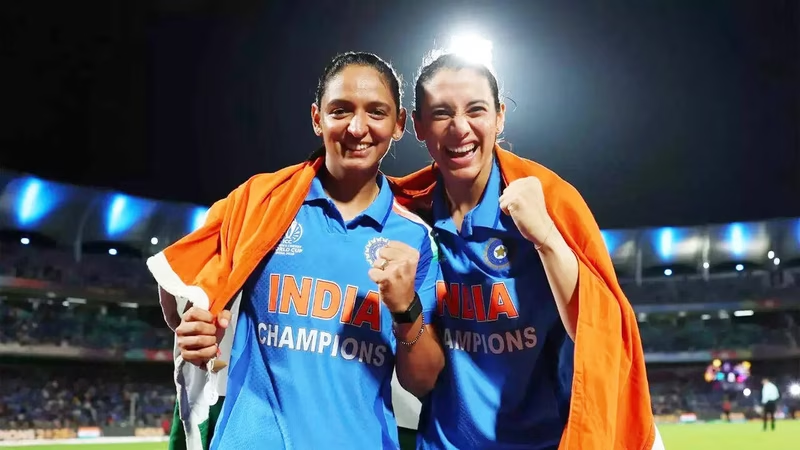
This isn’t just an honor. It’s a statement. And it’s one that has sent waves of emotion through the cricketing community—especially from her longtime teammate and vice-captain, Smriti Mandhana, who shared a heartfelt message calling it “a dream come true for all of us.”
Let’s unpack why the Harmanpreet Kaur stand named moment is so much more than ceremonial—it’s a turning point for women’s sport in India.
A Stand With a Story
The initiative came from the Punjab Cricket Association (PCA), which unveiled the newly christened “Harmanpreet Kaur Stand” during a special ceremony at the Mullanpur venue—a stadium that’s quickly becoming a hub for domestic and international matches.
Unlike fleeting social media tributes or post-match interviews, naming a physical structure in a player’s honor embeds her legacy into the very architecture of the game. For young girls attending matches there, seeing “Harmanpreet Kaur” etched in stone sends a powerful, silent message: You belong here. Your dreams are visible.
Harmanpreet Kaur Stand Named: A Historic First
This marks the first time in Indian cricket history that a stadium stand has been named after a female player. While male legends like Sunil Gavaskar, Sachin Tendulkar, and Kapil Dev have enjoyed such honors for decades, women’s contributions have largely remained in the shadows of infrastructure recognition.
Harmanpreet, visibly moved, said: “It’s not just about me. It’s about every girl who picked up a bat when no one believed she could play professionally. This stand is for them.”
Her journey makes the honor even more poignant: from a small town in Moga, Punjab, to the 2017 World Cup semifinal heroics, and now to captaincy across all three formats—a rare feat in itself.
Smriti Mandhana’s Emotional Tribute
Smriti Mandhana didn’t just share congratulations—she shared vulnerability. In a video message that quickly went viral, Smriti said:
“Harman, watching you lead us for over a decade with so much heart… and now seeing your name on a stand? It makes me emotional. You’ve carried this team through tough times. This is just the beginning of the recognition you deserve.”
Their bond—forged in dressing rooms, training camps, and World Cup battles—adds depth to the moment. Smriti, often seen as the graceful counterpoint to Harmanpreet’s aggressive leadership, embodies the next generation that this honor will inspire.
[INTERNAL_LINK:women-cricket-milestones-india] This isn’t just about two stars—it’s about lifting the entire ecosystem.
Why This Moment Matters for Women’s Cricket
Symbolic gestures often precede systemic change. Here’s why the PCA’s decision is a watershed:
- Visibility = Validation: Physical recognition normalizes women as central figures in cricket culture.
- Commercial Signal: Sponsors and broadcasters take note—women’s cricket is infrastructure-worthy.
- Grassroots Impact: Local academies in Punjab can now point to the stand and say, “That’s where champions are remembered.”
As noted by the International Cricket Council (ICC), countries that invest in symbolic and physical recognition of women athletes see a 30–40% increase in female participation at youth levels within five years.
Harmanpreet’s Legacy Beyond the Boundary
While her 171* against Australia in the 2017 World Cup remains iconic, Harmanpreet’s true legacy lies in resilience:
- She led India to their first-ever T20 World Cup final in 2023.
- She’s the only Indian woman to play 100+ T20Is and 100+ ODIs.
- She’s mentored rising stars like Shafali Verma and Richa Ghosh.
More importantly, she’s done it without the fanfare, pay parity, or infrastructure that her male counterparts enjoy—making this honor not just deserved, but overdue.
The Growing Push for Infrastructure Equality
The PCA’s move aligns with a broader shift. The BCCI has pledged ₹500 crore for women’s cricket development, including dedicated training centers and equal match-day facilities.
Other stadiums may soon follow suit. Imagine a “Mithali Raj Pavilion” in Hyderabad or a “Jhulan Goswami End” in Kolkata. The momentum is building.
As one young fan posted on Instagram: “Now when I go to a match, I’ll sit in the Harmanpreet Stand—and dream bigger.”
Conclusion: More Than a Name on a Stand
The Harmanpreet Kaur stand named at the Maharaja Yadavindra Singh Stadium is more than a plaque or a photo-op. It’s a cultural reset. It tells every girl in India that her contribution to cricket is not just welcome—it’s immortal.
And as Smriti Mandhana’s emotional words remind us, behind every historic moment is a leader who refused to quit. Harmanpreet didn’t just play the game—she paved the way. Now, her name stands tall, quite literally, for generations to come.
Sources
- Times of India: Smriti Mandhana shares emotional message for skipper Harmanpreet Kaur — WATCH
- Punjab Cricket Association (PCA): Official Announcement – Stadium Stand Naming
- International Cricket Council (ICC): Women’s Cricket Participation & Development Reports
- BCCI: Women’s Cricket Investment Strategy 2024–2028