Table of Contents
- The Calm Before the Storm
- India T20I Leadership Crisis Unfolds
- Suryakumar Yadav: The Faltering Figurehead
- Shubman Gill: Struggles as Vice-Captain
- Management’s Unconventional Tactics: Innovation or Panic?
- Historical Precedents and What Comes Next
- Conclusion: Leadership Tested, Not Broken
- Sources
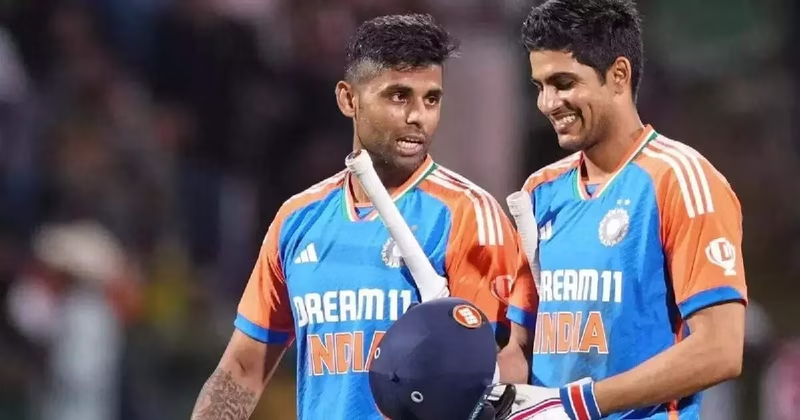
For months, India’s T20I team was hailed as a revolution—fast, fearless, and future-ready. But in the choppy waters of the India vs South Africa series, cracks have begun to show. And they’re not just in the batting order—they’re right at the top. Captain Suryakumar Yadav and vice-captain Shubman Gill are both trapped in prolonged slumps, throwing the entire India T20I leadership crisis into sharp relief.
When both your leader and deputy can’t convert starts into scores, it’s more than a batting problem—it’s a crisis of confidence, strategy, and identity. So what’s really going on, and can this ship be steadied before the 2026 T20 World Cup?
The Calm Before the Storm
Just a year ago, Suryakumar Yadav was the undisputed No. 1 T20I batter in the world. His 360-degree strokeplay made him a nightmare for bowlers. Shubman Gill, fresh off a stellar 2023 ODI World Cup, was being groomed as the next batting pillar across formats.
Together, they symbolized India’s new era: aggressive, adaptable, and in control. But cricket is a merciless game—and recent returns tell a different story.
India T20I Leadership Crisis Unfolds
The numbers don’t lie. In the last 8 T20I innings combined, Suryakumar and Gill have averaged just 18.5. Neither has crossed 30 since September 2024. In high-pressure games against South Africa, their dismissals often triggered middle-order collapses.
More concerning is the tactical ripple effect. With the top two in poor form, the team’s much-touted “aggressive new style” has sometimes devolved into reckless shot selection or tentative accumulation—neither sustainable.
As one analyst noted, “You can’t build a fearless team on shaky foundations.”
Suryakumar Yadav: The Faltering Figurehead
Once known for playing the “impossible shot,” Suryakumar now looks hesitant. His trademark ramp shots and scoops are either missing or miscued. His strike rate has dropped from 155+ to under 130 in recent games.
Is it mental fatigue? The burden of captaincy? Or simply the cyclical nature of form? All are plausible. What’s clear is that opponents have studied him—and adapted. South Africa’s spinners, in particular, have cut down his scoring angles with tight lines and clever variations.
For a player whose game relies on innovation, predictability is fatal.
Shubman Gill: Struggles as Vice-Captain
Gill’s slump is equally troubling. Expected to anchor the innings at No. 3, he’s falling victim to tentative starts. His once-fluid cover drive now looks labored, and he’s struggling to rotate strike against spin.
Compounding the issue: his dual role as Gujarat Titans captain in the IPL means he’s under leadership pressure year-round. Unlike pure finishers or openers, No. 3 batters must balance caution and acceleration—something Gill hasn’t mastered in this phase.
Notably, Ashish Nehra recently defended him, saying, “Don’t judge after two matches.” But with five low scores in seven knocks, patience is wearing thin—even among selectors.
Management’s Unconventional Tactics: Innovation or Panic?
In response to the batting frailty, India’s management has resorted to unusual moves:
- Opening with Rinku Singh alongside Yashasvi Jaiswal
- Promoting all-rounder Washington Sundar to No. 5
- Using Hardik Pandya as a floater despite fitness concerns
While these experiments aim to boost India batting depth issues, they’ve created inconsistency. Youngsters are thrust into high-pressure roles without a stable core to lean on.
[INTERNAL_LINK:t20-world-cup-2026-preview] The real test will be whether these tweaks are part of a long-term plan—or just stopgap measures masking a deeper leadership vacuum.
Historical Precedents and What Comes Next
India has been here before. In 2012, MS Dhoni went through a prolonged batting slump but retained captaincy—and led India to the 2013 Champions Trophy. In 2019, Virat Kohli’s T20 form dipped, but the team adapted around him.
The difference now? The absence of a dominant senior batter. With Rohit Sharma retired from T20Is and KL Rahul injured, the burden falls entirely on SKY and Gill.
Upcoming series against England and Australia will be make-or-break. If the duo doesn’t rebound, selectors may consider separating captaincy from batting—appointing a leader like Jasprit Bumrah while rebuilding the top order.
Conclusion: Leadership Tested, Not Broken
The India T20I leadership crisis is real—but not irreversible. Every great team faces turbulence. What matters is how they navigate it. Suryakumar Yadav and Shubman Gill are proven match-winners. Their current struggles are a chapter, not the whole story.
With the T20 World Cup 2026 looming, India needs its leaders to rediscover their spark—not just for runs, but for belief. Because in cricket, as in life, the best captains don’t just lead when it’s easy—they lead when it’s hard.
Sources
- Times of India: Leaders of the T20 ship in choppy waters
- ESPNcricinfo: Suryakumar Yadav & Shubman Gill Player Stats
- International Cricket Council (ICC): T20I Team Rankings and Performance Reports
- BCCI: India National Team Selection Policy