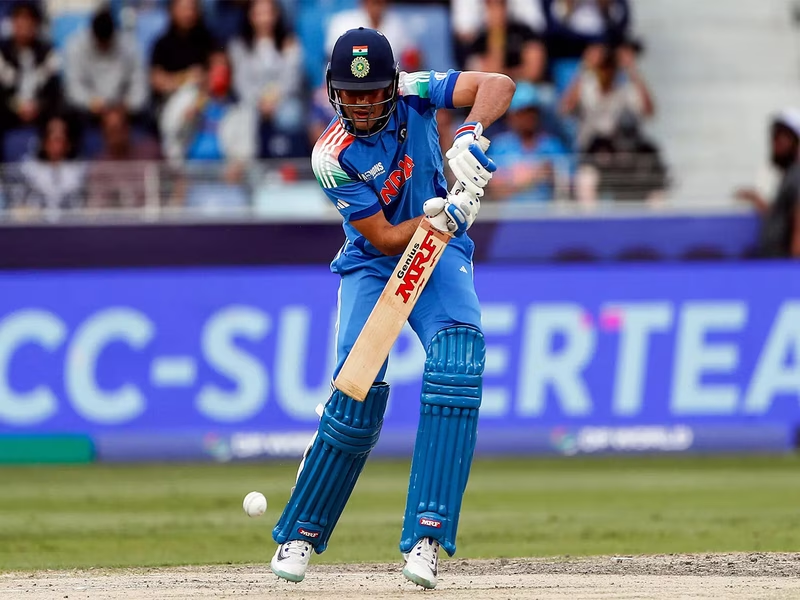
When a former national coach speaks, cricketers—and fans—listen. And Sanjay Bangar, India’s long-serving assistant coach and a master of strategic batting, has just sent a clear, no-nonsense message to one of the team’s most talked-about batters: Shubman Gill.
Following Gill’s underwhelming performances in the ongoing T20I series against South Africa, Bangar has urged the young opener to ditch the pressure to clear the ropes and instead embrace his natural strength: building an innings with classical, high-percentage shots. His advice? “There’s no need for big hits.”
Table of Contents
- Shubman Gill’s Recent T20I Struggles
- Bangar’s Blunt Advice: Focus on Stability, Not Sixes
- The Ideal Role of a T20I Opener in the Indian Context
- Gill’s Past Success: A Blueprint for the Future
- Fan Reactions and Social Media Debate
- What Next for Gill in the Series?
- Conclusion
- Sources
Shubman Gill’s Recent T20I Struggles
The pressure on Shubman Gill has been mounting. Tasked with opening the innings in a format that increasingly demands instant acceleration, Gill has found himself caught between two roles: the elegant accumulator and the explosive modern T20 opener.
In the first two matches of the India vs South Africa T20I series, his returns have been modest. His attempts to play outside his natural game—swinging early for boundaries against quality pace—have led to soft dismissals. This inconsistency at the top has disrupted India’s batting momentum, especially in a series where every run counts .
Bangar’s Blunt Advice: Focus on Stability, Not Sixes
Speaking to the media, Sanjay Bangar didn’t mince words. “There’s no need for him to go for big shots,” he stated firmly. “His job is to see off the new ball, take the shine off, and build a platform for the big hitters to come in and dominate later.”
Bangar, who was instrumental in India’s rise as a world-beating limited-overs side during his coaching tenure, emphasized that Gill’s value lies in his classical technique and ability to rotate the strike under pressure. “He’s a proper batter,” Bangar added. “He doesn’t need to prove he can hit sixes; his role is to anchor.”
This is a significant philosophical intervention, especially in an era where T20 openers are often judged by their strike rate alone.
The Ideal Role of a T20I Opener in the Indian Context
India’s T20I batting lineup is stacked with explosive finishers like Rinku Singh, Shivam Dube, and Suryakumar Yadav. This structure actually *reduces* the burden on openers to provide all the fireworks upfront.
An ideal scenario, as Bangar implies, is:
- Powerplay (Overs 1-6): Focus on preserving wickets, targeting loose deliveries, and rotating strike.
- Middle Overs (7-15): Build partnerships, keep the scoreboard ticking at 8-9 RPO.
- Death Overs (16-20): Leave the carnage to specialists like Hardik Pandya or Dube.
In this framework, Gill’s job isn’t to mimic Jos Buttler or Quinton de Kock—it’s to be the calm before the storm.
Gill’s Past Success: A Blueprint for the Future
Let’s not forget: Shubman Gill has excelled in this anchor role before. His 126* against New Zealand in the 2023 World Cup was a masterclass in controlled aggression. Similarly, in the 2024 white-ball season, his ODI centuries came from building long innings, not from reckless hitting.
His technique—upright stance, crisp cover drives, and excellent judgment outside off-stump—is tailor-made for seeing off quality new-ball bowlers. When he trusts his game, he’s among the world’s best. The issue arises when he tries to be someone he’s not.
Fan Reactions and Social Media Debate
Bangar’s comments have ignited a fierce debate online. One camp argues: “Gill is paid to score quickly in T20s—stop playing Test cricket!” The other counters: “If India’s middle order is so destructive, why risk losing an early wicket?”
This tension reflects a broader confusion in modern T20 cricket: should openers be anchors or launchers? The smartest teams—like England post-2022—use role-based batting, not one-size-fits-all aggression. India might be at a crossroads here, and Gill is right at its center.
What Next for Gill in the Series?
With the India vs South Africa series tied at 1-1, the next match in Dharamsala could be pivotal. Will Gill heed Bangar’s advice and play within his strengths? Or will the pressure to perform in the T20I format push him toward riskier shots?
For a deeper dive into India’s current batting order dynamics, check out our analysis on India’s T20I Batting Lineup in 2024. You can also explore official player stats on the ICC website.
Conclusion
Sanjay Bangar’s message to Shubman Gill isn’t just tactical—it’s philosophical. In a world obsessed with strike rates and six-hitting, Bangar is reminding everyone that cricket is still a game of roles, balance, and context. Gill’s greatest asset isn’t his power; it’s his poise. If he rediscovers that in the upcoming matches, not only will his personal form return, but India’s entire T20I structure could find its missing piece. Sometimes, the most revolutionary thing a batter can do in T20 cricket is… just bat.
Sources
- Times of India: ‘There’s no need for…’: Former India coach sends clear message to Gill
- ICC Player Profile: Shubman Gill – Official ICC Stats
- ESPNcricinfo Series Archive: India vs South Africa T20I Series 2024