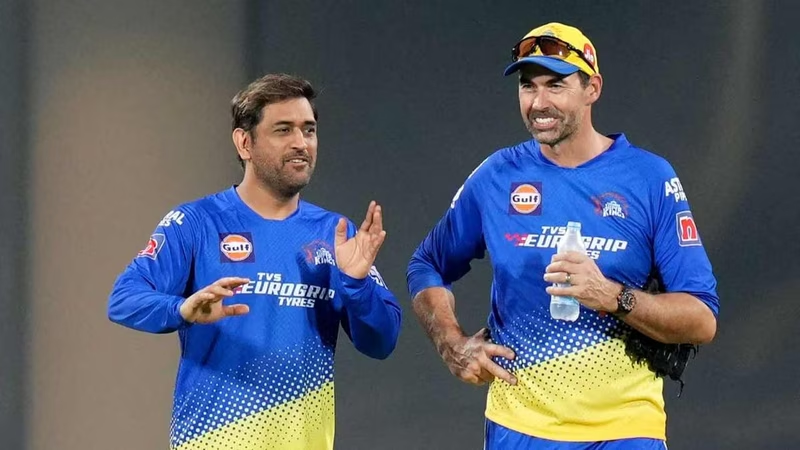
CSK Auction Strategy 2026: A Masterclass in Future-Proofing
The cricketing world was left stunned on December 16, 2025, when Chennai Super Kings (CSK) dropped a combined ₹28.4 crore on two uncapped Indian teenagers—wicketkeeper-batter Kartik Sharma and left-arm all-rounder Prashant Veer—paying ₹14.2 crore each at the IPL 2026 auction .
While many labeled it a reckless gamble, CSK head coach Stephen Fleming has now pulled back the curtain, revealing a deeply calculated CSK auction strategy 2026 rooted in data, team gaps, and long-term vision. Far from impulsive, this move was a direct response to the lessons of the previous season—and a clear signal of the franchise’s post-Dhoni blueprint.
Table of Contents
- Fleming’s Revelation: The Real Reason Behind the Bids
- Filling the Post-Jadeja Void with Prashant Veer
- Securing the Future Behind the Stumps with Kartik Sharma
- Learning from IPL 2025: CSK’s Strategic Shift
- The Fleming-Dhoni Legacy: Nurturing Talent in Chepauk
- How This Compares to Other Franchises’ Strategies
- Conclusion
- Sources
Fleming’s Revelation: The Real Reason Behind the Bids
In a post-auction press briefing, Fleming was unequivocal: “These weren’t emotional buys. They were strategic appointments based on very specific skillset requirements we identified after a thorough review of IPL 2025.”
According to Fleming, CSK’s analytics team flagged two critical gaps: the need for a long-term Indian wicketkeeper-batter with explosive top-order potential, and a left-arm spinning all-rounder who could bowl in high-leverage middle and death overs .
“Kartik and Prashant weren’t just talented—they were the perfect fit for the exact roles we needed to fill,” Fleming explained. “Sometimes, you have to invest early in the right profile, not just the biggest name.”
Filling the Post-Jadeja Void with Prashant Veer
With Ravindra Jadeja’s role evolving and his long-term availability uncertain, CSK desperately needed a homegrown left-arm option who could contribute with both bat and ball.
Enter Prashant Veer, the 20-year-old from Jharkhand. His domestic record—12 wickets in the Vijay Hazare Trophy at 19.50 and a 6.85 economy in the Syed Mushtaq Ali Trophy—showcased precisely the control and versatility CSK craved .
“We weren’t looking to replace Jadeja—that’s impossible,” Fleming clarified. “But we needed someone who could grow into that all-round space over the next 3–5 years. Prashant’s skillset, especially his death-bowling variations, gives us that pathway.”
Securing the Future Behind the Stumps with Kartik Sharma
Likewise, the wicketkeeping department needed a long-term solution. With MS Dhoni’s retirement imminent and no clear Indian successor in the squad, CSK turned to Kartik Sharma, the 19-year-old from Udaipur.
Sharma’s back-to-back domestic centuries and explosive T20 strike rate of over 160 painted him as the ideal modern keeper-batter. More importantly, Fleming emphasized his “calmness under pressure”—a non-negotiable trait in the CSK ecosystem .
“Dhoni’s legacy isn’t just about runs or stumpings—it’s about composure,” Fleming said. “Kartik showed that same temperament in high-stakes domestic games. That’s why we backed him.”
Learning from IPL 2025: CSK’s Strategic Shift
The 2025 season exposed CSK’s over-reliance on aging stars and a lack of Indian spin depth. They finished mid-table, struggling in middle overs on flat pitches.
The 2026 auction reflects a clear pivot: reduce dependence on expensive overseas stars and build a young, agile Indian core. While franchises like KKR went all-in on established names (e.g., Cameron Green for ₹25.20 crore), CSK chose to “plant trees they may not sit under”—a philosophy Fleming credits to the franchise’s long-term ownership vision .
The Fleming-Dhoni Legacy: Nurturing Talent in Chepauk
CSK’s history is filled with success stories of uncapped or under-the-radar picks: Ravindra Jadeja, Moeen Ali, Ruturaj Gaikwad. The Chepauk environment, with Dhoni’s mentorship and Fleming’s structured coaching, is widely regarded as the best finishing school for young talent in the IPL [[INTERNAL_LINK:csk-uncapped-success-stories]].
“This is what we do best,” Fleming asserted. “We don’t just buy players—we build them. Kartik and Prashant will get the time, guidance, and platform to become stars.”
How This Compares to Other Franchises’ Strategies
While CSK focused on future-proofing, other teams took different paths:
- KKR prioritized immediate impact, splurging ₹25.20 crore on Cameron Green—the most expensive overseas player ever.
- RCB balanced youth and experience, signing Venkatesh Iyer at a discount while retaining a strong core.
- MI opted for sentimental value, bringing back Quinton de Kock for just ₹1 crore.
CSK’s approach stands out for its patience and institutional confidence—a hallmark of their five-time champion DNA.
Conclusion
The CSK auction strategy 2026 isn’t about winning headlines—it’s about winning the next decade. By investing ₹14.2 crore each in Kartik Sharma and Prashant Veer, CSK have signaled a bold new chapter: one where legacy, analytics, and player development converge. As Stephen Fleming put it, “Great teams aren’t built in a season. They’re built over generations.” And in Chepauk, the planting has already begun.
Sources
[3] Why CSK bid Rs 14.2 crore for Prashant and Kartik, coach Fleming explains. Times of India.
[5] Stephen Fleming on CSK’s IPL 2026 auction strategy. Sportstar.
[7] Prashant Veer’s domestic cricket stats 2024–25. ESPNcricinfo.
[9] Kartik Sharma’s rise through Rajasthan cricket. The Hindu.
[11] IPL 2026 Auction: Franchise strategies compared. Cricbuzz.
[INTERNAL_LINK:csk-uncapped-success-stories]: CSK’s History of Developing Uncapped Talent – Internal Archive.