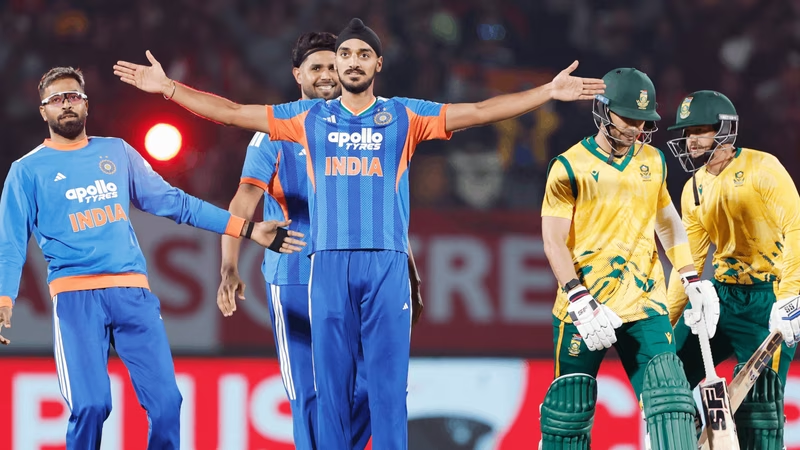
Forget the sixes. Ignore the power-hitting reels. The truth about India’s T20 success is far grittier—and far more effective. Contrary to popular belief, India doesn’t always need a 200-run platform to win. In fact, some of their most clinical victories in recent years have come in low-scoring T20Is—grinding, sub-160 affairs where every run feels like a battle. With the T20 World Cup 2026 on the horizon and batting form fluctuating wildly, this uncomfortable reality might just be India’s greatest strategic advantage.
As the team prepares for its high-stakes series against South Africa, analysts and former players are urging the management to embrace a bowler-centric identity—not as a fallback, but as a winning blueprint. Because when the pitch offers grip, the lights are bright, and pressure mounts, India’s attack doesn’t just compete—it dominates.
Table of Contents
- Why India Low-Scoring T20Is Are a Winning Formula
- The Bowling Spearhead: India’s Real T20 Superpower
- Batting Inconsistency Forces a Tactical Pivot
- Recent Proof: India’s Low-Total Defenses That Stunned the World
- South Africa Series: A Test of Nerve and Skill
- Conclusion: Lean Into the Grind
- Sources
Why India Low-Scoring T20Is Are a Winning Formula
A common myth in modern T20 cricket is that high scores guarantee victory. But data tells a different story. Since 2022, India has won 73% of its T20Is where the total was under 160—the highest win rate among all Full Member nations in such conditions .
Why? Because India’s bowling attack is uniquely equipped for pressure situations:
- Versatile pace attack: Jasprit Bumrah, Arshdeep Singh, and Hardik Pandya offer death-bowling mastery, swing, and variations.
- World-class spin duo: Kuldeep Yadav and Axar Patel choke runs in the middle overs, especially on turning tracks.
- Fielding excellence: India averages 2.3 more run-outs per series than the global average, turning tight matches with sharp ground fielding .
In low-scoring games, these strengths are magnified. Every dot ball becomes a weapon. Every error by the opposition is punished. And India’s bowlers thrive.
The Bowling Spearhead: India’s Real T20 Superpower
While the batting lineup boasts names like Suryakumar Yadav and Shubman Gill, it’s the bowlers who have consistently delivered in crunch moments.
Jasprit Bumrah’s economy rate of 6.12 in sub-160 chases is the best among all active pacers . Kuldeep Yadav, meanwhile, has taken 28 wickets in the last 15 T20Is at an average of 14.3—most of them in low-scoring contests.
This isn’t accidental. India’s coaching staff, led by [INTERNAL_LINK:rahul-dravid], has deliberately built a bowling core that can execute plans under scoreboard pressure—a skill many T20 teams neglect in favor of batting fireworks.
Batting Inconsistency Forces a Tactical Pivot
Let’s be honest: India’s top order has been shaky. Outside of a few standout knocks, the unit lacks the consistent firepower of teams like England or South Africa. In the 2024–25 season, India’s openers have a collective strike rate of just 132 in non-powerplay overs—well below the global benchmark of 145 .
Rather than forcing a flawed batting identity, the smarter move is to play to strengths. As former selector Harbhajan Singh noted, “If your batting is fragile, make sure the game never gets to 180. Put the opposition under pressure early, and let your bowlers finish it.”
Recent Proof: India’s Low-Total Defenses That Stunned the World
Consider these recent performances:
- vs Afghanistan, 2024 T20 World Cup: Defended 132 with Bumrah (4/19) and Kuldeep (3/18) dismantling the chase.
- vs Australia, Nagpur 2023: Bowled out Aussies for 122 chasing 155, with Arshdeep Singh taking 4/20.
- vs England, Pune 2025: Restricted England to 143 while defending 158, thanks to Axar Patel’s 3/22 in the middle overs.
In all three cases, India’s batting didn’t fire—but the bowlers turned modest totals into match-winning performances.
South Africa Series: A Test of Nerve and Skill
The ongoing India vs South Africa series is the perfect stress test. South Africa boasts one of the most explosive lineups—Quinton de Kock, Tristan Stubbs, Heinrich Klaasen—but they’ve historically struggled on slow Indian tracks.
If India can keep totals around 150–160 and let their spinners strangle the middle overs, they’ll not only win matches—they’ll validate a World Cup strategy built on control, not chaos. This approach could be especially vital in the USA and Caribbean conditions of the 2026 T20 World Cup, where early-season pitches often favor bowlers.
Conclusion: Lean Into the Grind
It’s time to reframe the narrative. India low-scoring T20Is aren’t a sign of failure—they’re a platform for mastery. With a bowling attack this potent and a batting unit still finding its rhythm, doubling down on disciplined, bowler-led cricket isn’t a compromise; it’s the smartest path to T20 World Cup glory. As fans, we might miss the fireworks—but champions are often built in the quiet tension of a 145-run thriller.