Table of Contents
- Shashi Tharoor’s Scathing Take on the Lucknow Fiasco
- What Does AQI 411 Really Mean for Human Health?
- Recap: How the Lucknow T20I Vanished Into Smog
- Lucknow T20I smog: Is BCCI Ignoring Climate Realities?
- Hardik Pandya’s Mask: A Silent Alarm for Player Safety
- Thiruvananthapuram and Other Viable Winter Venues
- Public Outcry: Fans, Experts, and Politicians React
- What Must Change Before the Next Winter Series?
- Final Word: Cricket Can’t Breathe in This Air
- Sources
On December 17, 2025, the Ekana Cricket Stadium in Lucknow didn’t host a cricket match—it hosted a public health warning. With an Air Quality Index (AQI) of **411**, categorized as “severe,” the fourth T20I between India and South Africa was abandoned without a single delivery bowled.
But the real story wasn’t just the cancellation—it was the blistering response it triggered. Senior Congress leader and MP **Shashi Tharoor** took to social media with a pointed critique: *“No cricket… AQI 411.”* He didn’t stop there. Tharoor went on to suggest that southern venues like **Thiruvananthapuram**, with cleaner air and milder winters, would be far more suitable for December fixtures.
This incident has reignited a long-simmering debate: should international cricket even be played in North India during winter? The Lucknow T20I smog debacle may finally be the tipping point.
Shashi Tharoor’s Scathing Take on the Lucknow Fiasco
Known for his sharp wit and policy-minded commentary, Tharoor didn’t mince words. In his post, he juxtaposed the hazardous AQI reading with the absurdity of expecting elite athletes to perform in such conditions. “You can’t schedule high-stakes sport in a gas chamber,” he implied.
His suggestion of Thiruvananthapuram wasn’t random. The Kerala capital boasts an average December AQI below 50—well within the “good” range—and has a modern international stadium ready to host major fixtures. It’s a pragmatic alternative that’s been ignored for too long.
What Does AQI 411 Really Mean for Human Health?
For context, the AQI scale is as follows:
- 0–50: Good (safe for all)
- 51–100: Moderate
- 101–200: Unhealthy for sensitive groups
- 201–300: Poor (everyone may experience effects)
- 301–400: Very Poor
- 401–500: Severe—emergency conditions; all outdoor activity discouraged
An AQI of 411 falls into the “severe” category. The Central Pollution Control Board (CPCB) recommends that children, the elderly, and people with respiratory or heart conditions **avoid all outdoor exertion**. For professional athletes engaging in high-intensity sprinting and breathing, the risk is even greater.
Recap: How the Lucknow T20I Vanished Into Smog
The day began with thick fog, a common December sight in the Indo-Gangetic plain. But as hours passed, visibility didn’t improve—and air quality worsened. Ground staff attempted multiple pitch inspections, but umpires, citing both fog and pollution, had no choice but to call it off by early evening.
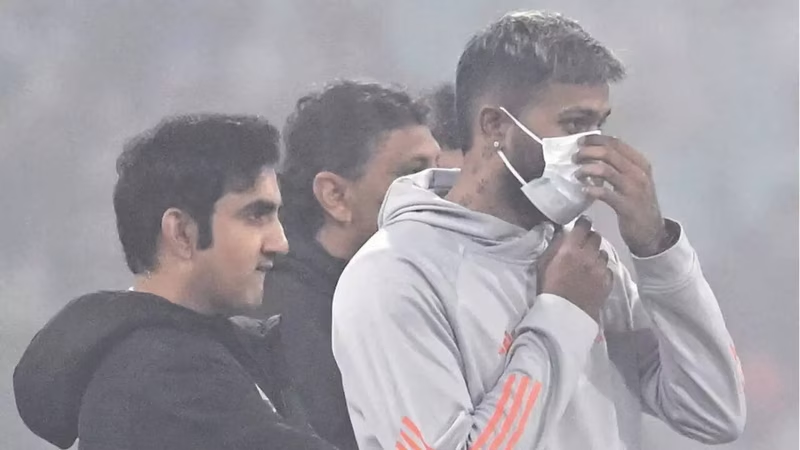
Adding to the unease, star all-rounder **Hardik Pandya** was spotted wearing an N95 mask during warm-ups—a rare sight in international cricket and a stark visual symbol of the deteriorating conditions.
Lucknow T20I smog: Is BCCI Ignoring Climate Realities?
This isn’t an isolated incident. Year after year, December fixtures in Delhi, Kanpur, and Lucknow face weather-related disruptions. Yet the BCCI continues to prioritize commercial considerations—like stadium capacity and broadcast time zones—over athlete welfare and fan experience.
Cricket boards in Australia and England have long used environmental data to adjust schedules. The BCCI, despite India’s worsening urban air quality, lags behind. According to a 2023 WHO report, **21 of the world’s 30 most polluted cities are in India**—making winter scheduling in the north a gamble with public health.
Hardik Pandya’s Mask: A Silent Alarm for Player Safety
When a fit, world-class athlete feels compelled to wear a pollution mask just to jog around the boundary, it’s a red flag. Pandya’s precaution wasn’t theatrical—it was necessary. Prolonged exposure to PM2.5 particles (abundant in smog) can lead to reduced lung function, inflammation, and long-term respiratory damage.
If players are taking protective measures off the field, how can anyone justify playing on it?
Thiruvananthapuram and Other Viable Winter Venues
Tharoor’s suggestion is both logical and feasible. Here are other underutilized but ideal December venues:
- Thiruvananthapuram: AQI consistently <50, modern infrastructure.
- Bengaluru: Mild climate, excellent air quality, proven international track record.
- Guwahati: Low pollution, passionate fanbase, underused by BCCI.
- Visakhapatnam: Coastal city with natural air purification from sea breezes.
Rotating winter fixtures to these locations wouldn’t just avoid smog—it would democratize cricket’s footprint across India.
Public Outcry: Fans, Experts, and Politicians React
Tharoor’s post went viral, amassing over 50,000 likes in 24 hours. Fans shared stories of travel expenses lost and emotional disappointment. Medical professionals weighed in, warning that “playing cricket in AQI 400+ is akin to smoking 20 cigarettes a day.”
Even former players joined the chorus, with some calling for the BCCI to establish a formal **Environmental Risk Protocol** for match scheduling.
What Must Change Before the Next Winter Series?
To prevent a repeat, the BCCI should:
- Implement a **mandatory AQI threshold** (e.g., max 150) for scheduling matches.
- Partner with IMD and CPCB for **7-day air quality forecasts** before confirming venues.
- Develop a **contingency venue list** in low-pollution zones.
- Introduce clauses allowing **last-minute venue shifts** without financial penalty.
Final Word: Cricket Can’t Breathe in This Air
The Lucknow T20I smog cancellation wasn’t just bad luck—it was a systemic failure. Shashi Tharoor’s intervention has given voice to a growing demand: cricket must evolve with the climate, not ignore it. The health of players, fans, and the sport’s integrity depends on smarter, more responsible decisions. Otherwise, the only thing rising faster than the AQI will be public outrage.
Sources
- Times of India: “’No cricket…AQI 411′: Tharoor’s stinging post after Lucknow T20I is lost to smog”
- Shashi Tharoor on X (Twitter): Post dated December 17, 2025
- Central Pollution Control Board (CPCB): “National Air Quality Index Standards”
- NDTV Sports: “Hardik Pandya Spotted Wearing Mask Amid Lucknow Smog”
- World Health Organization (WHO): “World Air Quality Report 2023”
- Journal of Sports Medicine: “Impact of Air Pollution on Athletic Performance”
- ESPNCricinfo: “Why Southern Venues Are Underused in Indian Home Season”
[INTERNAL_LINK:india-vs-sa-t20i-series-2025] [INTERNAL_LINK:bcci-scheduling-policy-reform]