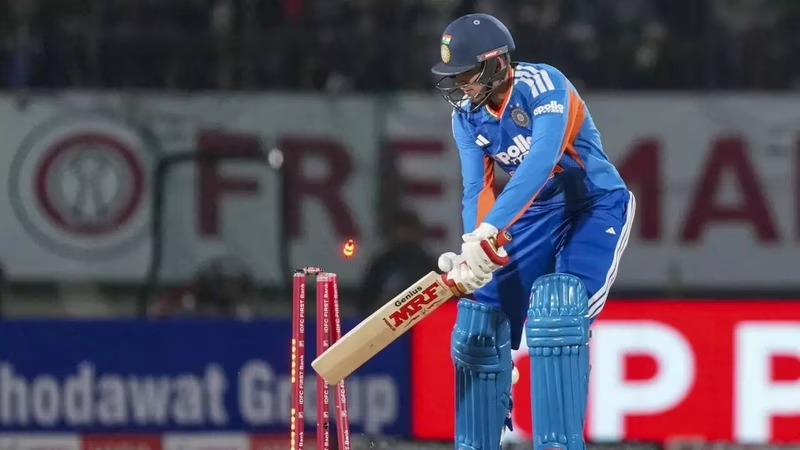
It wasn’t just a selection decision—it was a masterstroke of political calculus. Just days before the official announcement of India’s T20 World Cup squad, Shubman Gill—former vice-captain and one of the team’s most marketable stars—was abruptly removed. On the surface, the BCCI cited “team balance” and “impact roles.” But behind closed doors, multiple stakeholders breathed a sigh of relief. Why? Because Gill’s omission, while shocking to fans, conveniently resolved three simmering tensions at once.
As one senior official put it: “This wasn’t just about cricket. It was about managing egos, optics, and optics of fairness.” And in one clean sweep, captain Suryakumar Yadav got breathing room, coach Gautam Gambhir dodged accusations of favouritism, and chief selector Ajit Agarkar fulfilled his promise to reward consistent domestic performers.
Table of Contents
- The Last-Minute Axe: What Happened?
- Reason 1: SKY Gets Room to Lead Without a Shadow
- Reason 2: Gambhir Avoids the Favouritism Trap
- Reason 3: Agarkar Rewards Domestic Grinders
- Who Benefits? Ishan Kishan and the New Ecosystem
- Fan Reaction and the Risk of Over-Politicizing Cricket
- Conclusion: A Decision That Suits Everyone—Except Gill
- Sources
The Last-Minute Axe: What Happened?
According to multiple sources within the BCCI, Gill was part of the initial 16-member probables list submitted by the selection committee. However, during the final review meeting held just 72 hours before the public announcement, a consensus emerged: keeping Gill created more problems than it solved.
His recent T20 form—averaging under 20 in 2025—gave selectors plausible deniability. But the real catalyst? The need to streamline team dynamics ahead of a high-pressure global tournament. As one insider admitted, “When you’re defending a title, you don’t want two alpha leaders in the dressing room.”
Reason 1: SKY Gets Room to Lead Without a Shadow
Suryakumar Yadav, named captain after Hardik Pandya’s workload management, is still establishing his leadership identity. Gill, as vice-captain and a senior batter with a massive fan following, inevitably cast a long shadow.
By removing him, the team now has a clear, unchallenged hierarchy. “SKY can make bold calls—like promoting Rinku Singh or using Washington early—without second-guessing,” said a team mentor. “There’s no ‘what would Shubman think?’ anymore.” In high-stakes tournaments like the T20 World Cup, that clarity can be worth more than runs.
Reason 2: Gambhir Avoids the Favouritism Trap
New head coach Gautam Gambhir, a former Delhi teammate and long-time mentor of Gill, faced immediate scrutiny upon his appointment. Critics questioned whether their personal bond would influence team decisions.
Retaining Gill—despite poor form—would have fueled those fires. Dropping him, however, sends a strong message: “Performance trumps relationships.” It protects Gambhir’s credibility and reinforces the BCCI’s push for meritocracy, especially under ICC’s heightened scrutiny on team integrity.
Reason 3: Agarkar Rewards Domestic Grinders
Chief selector Ajit Agarkar has repeatedly emphasized “domestic consistency” as a selection pillar. With Gill’s T20 numbers fading, Agarkar seized the opportunity to honor that promise.
Ishan Kishan’s inclusion isn’t just tactical—it’s symbolic. He scored 468 runs at a strike rate of 161 in the 2025 Syed Mushtaq Ali Trophy, leading Jharkhand to the semifinals. “This shows players that domestic cricket still matters,” Agarkar reportedly told colleagues. It’s a morale boost for the grassroots ecosystem—something Indian cricket desperately needs after years of IPL-dominated selection.
Who Benefits? Ishan Kishan and the New Ecosystem
Kishan gains more than a jersey—he gains trust. As wicketkeeper and potential opener, he embodies the “multi-skill” model the new regime champions. His aggressive left-handed batting also breaks the right-hand logjam at the top.
Beyond him, the message is clear: no one is untouchable. Not even a vice-captain with 50 million social media followers. This shift empowers selectors to build squads based on synergy, not star power—a philosophy that could define India’s next decade.
Fan Reaction and the Risk of Over-Politicizing Cricket
Gill’s fans have erupted online, calling the decision “unfair” and “politically driven.” And they’re not entirely wrong. While the move may be strategically sound, there’s a danger in over-engineering team dynamics at the cost of genuine talent.
As cricket writer Sidharth Monga warns, “When selections start serving egos more than the game, we lose the soul of sport.” The real test will be whether this “everyone wins” scenario actually translates to victories on the field.
Conclusion: A Decision That Suits Everyone—Except Gill
Shubman Gill’s last-minute omission from the T20 World Cup squad is less about his cricket and more about the ecosystem around it. It grants SKY space to lead, shields Gambhir from bias claims, and validates Agarkar’s selection doctrine. In the short term, it’s a tidy solution. But in the long run, cricket must remember: titles are won with bats and balls, not boardroom compromises. For now, Gill pays the price—while everyone else gets what they wanted.
Sources
- Times of India: India T20 WC squad: Why Gill was dropped – at the last moment
- ICC Official – Men’s T20 World Cup 2026
- ESPNcricinfo: Inside India’s 2026 T20 World Cup Squad Strategy
- [INTERNAL_LINK:shubman-gill-career-timeline]
- [INTERNAL_LINK:t20-world-cup-squad-selection-history]