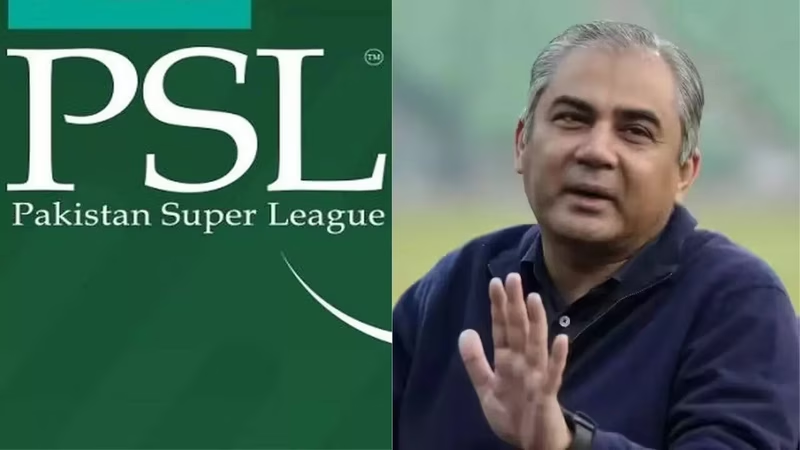
The Pakistan Super League’s dream of a bold two-team expansion is running into harsh reality. In a move that signals deep trouble behind the scenes, the Pakistan Cricket Board (PCB) has once again pushed back the deadline for PSL franchise bids—this time by two more days, just ahead of the scheduled January 6 auction. This marks the second postponement in as many weeks, and insiders say the reason is alarming: serious investors simply aren’t biting.
Once hailed as a golden opportunity to globalize Pakistan’s premier T20 property, the expansion now feels like a fire sale. With lukewarm interest, subpar technical proposals, and the sudden vacuum left by the exit of Multan Sultans’ former owner, the PSL’s growth story is at a crossroads. Is this a temporary setback—or a symptom of deeper structural issues?
Table of Contents
- PSL Franchise Bids: The Deadline Drama
- Why Investors Are Hesitating
- Multan Sultans: Ownership Crisis Deepens
- PCB’s Expansion Plan Under Scrutiny
- How Other Leagues Avoid This Mistake
- What Happens If Bids Fail?
- Conclusion: Can PSL Recover?
- Sources
PSL Franchise Bids: The Deadline Drama
The PCB first opened expressions of interest for two new PSL franchises in late 2024, targeting cities like Faisalabad and Sialkot to broaden the league’s national footprint. The initial bid deadline was set for early January 2025, with an auction scheduled for January 6.
But as the date loomed, only a handful of serious bids emerged—and many failed to meet basic technical criteria, such as financial guarantees, ownership structure clarity, and broadcast revenue projections . Faced with a potential embarrassment, the PCB quietly extended the deadline. Now, with January 6 just days away, they’ve done it again—officially “to allow more time for due diligence” .
Translation? They’re still begging for credible bidders.
Why Investors Are Hesitating
At first glance, buying a PSL team seems like a smart play. The league enjoys massive TV ratings in Pakistan, global streaming deals, and star power. But savvy investors see red flags:
- Political instability: Frequent changes in PCB leadership deter long-term capital.
- Unclear revenue model: Teams get minimal share of central broadcast deals compared to IPL or SA20.
- Security concerns: Despite improved conditions, international player availability remains volatile.
- Poor governance history: Past bidding controversies (e.g., Quetta Gladiators ownership dispute) linger in memory .
“You’re being asked to invest $30–40 million for a franchise that returns maybe 5% annually—if you’re lucky,” said one Dubai-based sports investor who declined to bid. “Without a clearer path to profitability, it’s too risky.”
Multan Sultans: Ownership Crisis Deepens
Adding to the chaos is the sudden departure of Ali Tareen, son of former PCB chairman Javed Miandad’s political ally Jahangir Tareen, who sold his stake in the Multan Sultans. The franchise, one of PSL’s most successful on-field, now lacks a permanent owner .
Rumors swirl that the PCB may temporarily take over the team—or even put it up for sale alongside the new franchises. This uncertainty has spooked potential bidders, who worry about league instability and brand devaluation.
PCB’s Expansion Plan Under Scrutiny
Critics argue the PCB rushed expansion without fixing foundational issues. Unlike the IPL—which spent years optimizing its six-team model before adding two more—the PSL is expanding from six to eight teams despite unresolved financial and operational gaps.
“You don’t add more plates to a spinning act if the existing ones are wobbling,” quipped a former league consultant. “Fix revenue sharing, stabilize ownership, and then grow.”
Instead, the PCB appears to be using expansion as a band-aid—to inflate the league’s valuation ahead of a potential media rights renegotiation in 2026.
How Other Leagues Avoid This Mistake
Compare PSL’s struggle to the SA20 or ILT20, where franchise rights sold out in days. Why? Clear terms, strong central revenue guarantees, and political insulation from cricket boards.
The IPL’s success wasn’t accidental. The BCCI guaranteed franchises 40% of broadcast revenue from day one and capped player salary bills to ensure profitability . The PSL offers no such assurances.
What Happens If Bids Fail?
If credible bids don’t materialize by January 6, the PCB has three unappealing options:
- Cancel expansion: Save face but admit strategic overreach.
- Lower the price: Risk devaluing the entire league brand.
- Assign franchises to state entities: E.g., Pakistan Army or WAPDA—but this kills commercial appeal.
None are ideal. All signal a loss of confidence in the PSL’s marketability.
Conclusion: Can PSL Recover?
The repeated delays in PSL franchise bids aren’t just logistical—they’re a referendum on the league’s commercial health. While passionate fans will keep watching, global investors demand transparency, stability, and profit potential. Until the PCB addresses those, the PSL’s expansion dream may remain just that: a dream. For now, the world watches to see if Pakistan’s crown jewel of cricket can polish its business model—or risk fading in a crowded global T20 marketplace.
Sources
Pakistan Cricket Board begs for bids; PSL deadline pushed again – Times of India
PSL Ownership Disputes: A History of Turbulence – ESPNcricinfo
Multan Sultans Ownership in Limbo – The News International
How IPL Built Billion-Dollar Franchises – Forbes