Table of Contents
- The Ashes DRS Debacle That Sparked a Revolt
- DRS Technology Standardisation: Starc Says ‘Enough Is Enough’
- Why Current DRS Systems Are a Global Mess
- The Real Cost of Inconsistent Tech
- What a Centralised ICC Model Could Look Like
- Player Trust Is Eroding—and That’s Dangerous
- Conclusion
- Sources
The Ashes DRS Debacle That Sparked a Revolt
The 2025 Ashes series was meant to be a celebration of cricket’s oldest rivalry. Instead, it became a showcase for the sport’s most frustrating flaw: the inconsistent, often unreliable Decision Review System (DRS). Multiple controversial calls—stemming from what players claim were miscalibrated tracking systems—left batters, bowlers, and fans questioning the integrity of on-field decisions.
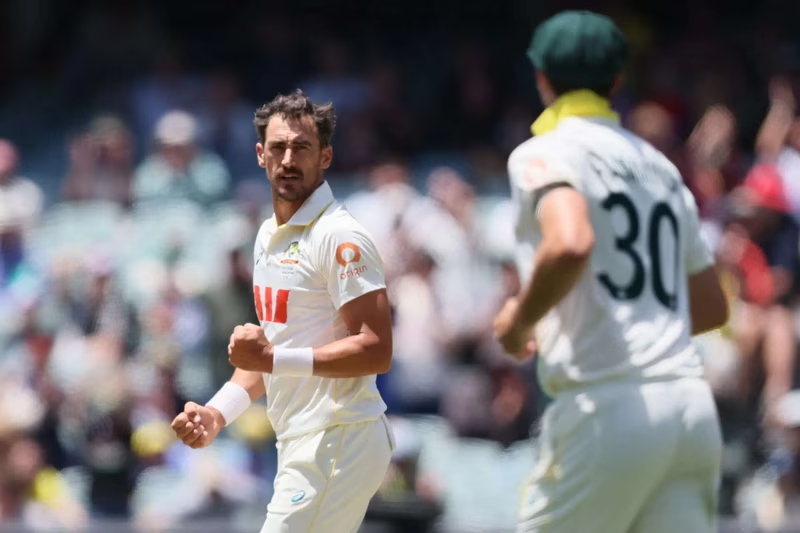
Australia’s spearhead, Mitchell Starc, has now broken ranks with a blunt and urgent plea: “Why don’t we use the same technology?” In a candid outburst, the veteran fast bowler called on the International Cricket Council (ICC) to take full ownership of DRS infrastructure, arguing that the current patchwork system is damaging the game’s credibility .
DRS Technology Standardisation: Starc Says ‘Enough Is Enough’
Starc’s frustration isn’t about one bad call—it’s about systemic failure. “Every series uses different tech, different calibrations, different tolerances,” he explained. “One week, the margin for error is 2mm; the next, it’s 5mm. How is that fair to players who’ve trained their entire lives to hit a spot?”
His core demand is simple yet radical: the ICC must fund, own, and deploy a single, universal DRS technology standardisation protocol for all international matches. No more local broadcasters dictating the quality of ball-tracking. No more last-minute software adjustments. Just one reliable system, used everywhere—from Lord’s to Galle, from Perth to Port of Spain.
Why Current DRS Systems Are a Global Mess
Today, DRS implementation is outsourced to host broadcasters or local boards, leading to alarming inconsistencies:
- Variable Hawk-Eye calibration: Systems in England and Australia use different baseline settings, affecting LBW predictions.
- Audio sensitivity differences: Snicko thresholds vary, causing edges to be “heard” in one series but not another.
- Umpire interpretation gaps: Even with the same tech, on-field umpires apply “Umpire’s Call” with subjective leniency.
This fragmentation means a dismissal that’s upheld in India might be overturned in South Africa—not because the ball behaved differently, but because the technology did. For elite athletes operating at millimeter precision, this is unacceptable.
The Real Cost of Inconsistent Tech
The stakes aren’t just about fairness—they’re about legacy. In high-pressure contests like the Ashes, a single incorrect DRS call can swing a match, a series, or even a player’s career trajectory. Starc pointed to a specific incident where Australia lost a crucial wicket due to a system that “showed the ball missing leg stump by 0.8mm”—a margin smaller than the calibration error margin permitted in some jurisdictions.
Beyond results, inconsistent DRS erodes fan trust. Viewers see contradictory graphics and wonder: “Which one is real?” This confusion fuels cynicism, especially in an era where sports integrity is under constant scrutiny.
What a Centralised ICC Model Could Look Like
Starc’s vision isn’t theoretical—it’s practical. A centralised ICC DRS model would involve:
- ICC-owned hardware: Standard Hawk-Eye and Real Time Snicko units deployed globally.
- Neutral tech teams: ICC-certified engineers managing setup and calibration for every series.
- Transparent protocols: Publicly documented tolerance thresholds and review procedures.
- Regular audits: Independent verification of system accuracy before each Test.
This approach mirrors Formula 1’s standardized timing and safety systems—where consistency isn’t optional, it’s essential. The cost? Significant, but negligible compared to the ICC’s annual revenue. As the ICC’s governance framework states, “ensuring the integrity of the game” is its core mandate .
Player Trust Is Eroding—and That’s Dangerous
Perhaps the most alarming aspect is the psychological toll on players. When athletes can’t trust the system meant to support fairness, frustration turns into disillusionment. Starc isn’t alone—players like Virat Kohli, Joe Root, and Kagiso Rabada have all voiced concerns about DRS reliability in recent years.
If the guardians of the game fail to act, the DRS—once hailed as a revolutionary tool for justice—could become a symbol of chaos. For more on technology’s role in modern cricket, see our deep dive on [INTERNAL_LINK:future-of-cricket-technology-and-fair-play].
Conclusion
Mitchell Starc’s call for DRS technology standardisation is more than a complaint—it’s a wake-up call. In a sport where milliseconds and millimeters define greatness, the technology meant to uphold fairness must itself be fair, consistent, and trustworthy. The ICC now faces a critical choice: continue with a fragmented, error-prone system, or step up as the true custodian of cricket’s integrity. The players—and the fans—are watching.
Sources
[1] Times of India. (2025). ‘Why don’t we use same tech?’: Starc urges ICC to step in as DRS trust crumbles. Retrieved from https://timesofindia.indiatimes.com/sports/cricket/ashes/why-dont-we-use-the-same-technology-mitchell-starc-urges-icc-to-step-in-as-ashes-drs-trust-crumbles/articleshow/126117111.cms
[2] International Cricket Council (ICC). (2025). About ICC: Governance and Integrity. Retrieved from https://www.icc-cricket.com/about/governance
[3] ESPNcricinfo. (2025). DRS Controversies in the 2025 Ashes Series. Retrieved from https://www.espncricinfo.com/story/ashes-2025-drs-errors-analysis