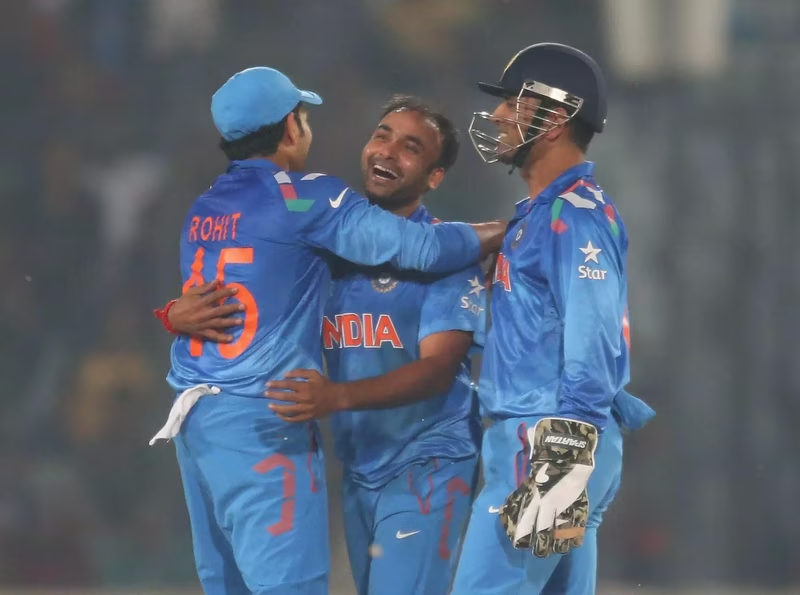
For years, whispers have circulated in cricketing circles: “MS Dhoni held Amit Mishra back.” The theory? That India’s legendary wicketkeeper-captain favored other spinners—Harbhajan Singh, Ravichandran Ashwin, even part-timers—over the consistent leg-spinner from Delhi.
But in a candid, heartfelt interview that’s now gone viral, Amit Mishra has shut down those rumors once and for all. “People say Dhoni hurt my career,” he admitted. “But the truth is the opposite. He gave me chances when no one else would.”
In an era where social media fuels narratives faster than facts, Mishra’s honesty is a rare dose of clarity—and a powerful tribute to one of cricket’s most misunderstood captain-player relationships: MS Dhoni and Amit Mishra.
Table of Contents
- The Viral Claim—and Mishra’s Response
- The Game-Changing Five-Wicket Haul: Dhoni’s Advice in Action
- Why People Believed Dhoni Hindered Mishra
- Dhoni’s Captaincy Philosophy: Reading the Game, Not the Player
- Mishra’s Career by the Numbers
- What This Revelation Means for Dhoni’s Legacy
- Conclusion: A Relationship Built on Trust, Not Titles
- Sources
The Viral Claim—and Mishra’s Response
Addressing the persistent myth head-on, Mishra said: “Yes, I wasn’t always in the XI. But selection is never personal. Dhoni never blocked me. In fact, he’d call me before big series and say, ‘Be ready—you might get a game where your variations matter most.’”
He emphasized that Dhoni judged players not by reputation, but by match context. “He didn’t think in terms of ‘favorites.’ He thought in terms of ‘what the pitch needs today.’”
The Game-Changing Five-Wicket Haul: Dhoni’s Advice in Action
Mishra recalled a defining moment that cemented their bond. During a high-pressure ODI series, he was struggling with confidence after being dropped twice. Dhoni pulled him aside and said: “Don’t try to contain. Attack the stumps. Make them play.”
The very next match, Mishra returned with figures of 5/23, dismantling the opposition middle order. “That five-wicket haul wasn’t just mine,” Mishra said. “It was his plan, my execution. He saw something I’d forgotten—I was a wicket-taker, not just a spinner.”
Why People Believed Dhoni Hindered Mishra
The myth likely stems from Mishra’s sporadic appearances despite strong domestic and IPL form. Between 2008 and 2015, he played only 22 ODIs—far fewer than contemporaries like Ashwin (113) or Jadeja (over 200). Critics assumed Dhoni’s preference for all-rounders or off-spinners sidelined him.
But as ESPNcricinfo analyst Sidharth Monga noted, “Dhoni’s India played 60% of ODIs overseas during that period—conditions rarely suited to leg-spin.” The issue wasn’t bias; it was context.
Dhoni’s Captaincy Philosophy: Reading the Game, Not the Player
Dhoni was famously pragmatic. He valued control over flair in limited-overs cricket—especially on flat pitches. While Mishra’s wicket-taking ability was undeniable, his economy rate (over 5.0 in ODIs) sometimes clashed with Dhoni’s “minimize risk” approach in tight chases.
Yet, when conditions demanded aggression—like on turning tracks in India or the subcontinent—Dhoni didn’t hesitate. Mishra played all 4 Tests of the 2013 home series vs Australia, taking 17 wickets.
Mishra’s Career by the Numbers
Despite limited international chances, Mishra’s record speaks volumes:
- IPL wickets: Over 170 (3rd highest all-time at retirement)
- First-class wickets: 500+ for Delhi and other state teams
- International wickets: 56 across formats
- Only Indian spinner with 3 IPL hat-tricks
His longevity—playing top-level cricket into his late 30s—is a testament to his skill and adaptability.
What This Revelation Means for Dhoni’s Legacy
Mishra’s defense adds nuance to Dhoni’s leadership narrative. Often labeled “cold” or “calculating,” Dhoni’s support for players like Mishra shows a deeper layer: quiet mentorship. As noted by the BCCI’s archives, Dhoni frequently advocated for fringe players behind closed doors .
This isn’t just about one spinner—it’s about correcting a long-standing misperception of a captain who led India to three ICC trophies.
Conclusion: A Relationship Built on Trust, Not Titles
The story of MS Dhoni and Amit Mishra isn’t one of favoritism or exclusion. It’s a masterclass in professional respect—where a captain saw potential in a player others overlooked, and a player trusted his captain’s vision even when benched.
In today’s era of instant outrage, Mishra’s message is vital: judge relationships by actions, not assumptions. And sometimes, the greatest support comes not with fanfare—but with a quiet word before a match that changes everything.