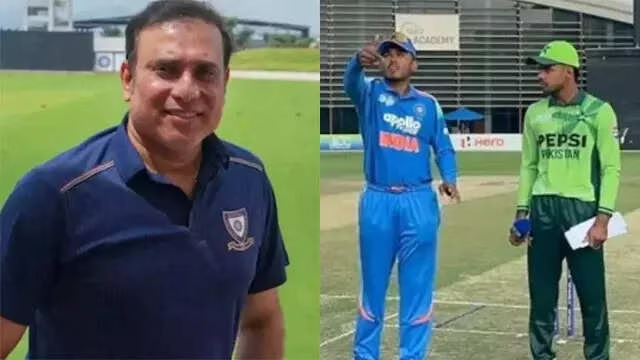
India’s early exit from the 2025 U19 Asia Cup wasn’t just a loss on the scoreboard—it triggered alarm bells at the highest levels of Indian cricket. Now, the Board of Control for Cricket in India (BCCI) has launched a sweeping internal audit of its Centre of Excellence (CoE) and broader developmental ecosystem. The core question? Is India’s famed talent pipeline starting to crack?
This move—dubbed the BCCI CoE review—comes amid growing concerns over inconsistent youth performances, communication gaps between selectors, coaching staff, and team management, and a perceived stagnation in skill development compared to rivals like Afghanistan and Bangladesh .
Table of Contents
- What Went Wrong in the U19 Asia Cup?
- BCCI CoE Review: Key Areas Under Scrutiny
- The CoE Structure: What It Is and How It Works
- Communication Breakdown Between Selectors and Coaches
- Global Comparisons: How Other Nations Develop Youth
- What Changes Can We Expect?
- Conclusion: Rebuilding India’s Cricket Future
- Sources
What Went Wrong in the U19 Asia Cup?
India’s U19 team, once synonymous with dominance in age-group tournaments, failed to reach the final of the 2025 U19 Asia Cup—a stark contrast to their record five U19 World Cup titles . Analysts pointed to glaring issues:
- Poor shot selection under pressure
- Lack of adaptable game plans against spin-heavy attacks
- Fragile middle-order collapsing repeatedly
- Inconsistent bowling execution in crucial overs
More concerning than the loss was the pattern—a lack of innovation, tactical rigidity, and limited exposure to diverse playing conditions. These aren’t just team-level failures; they reflect deeper systemic issues in how young players are groomed.
BCCI CoE Review: Key Areas Under Scrutiny
The BCCI CoE review is now zeroing in on three critical pillars:
- Coaching methodology: Are drills outdated? Is there enough focus on decision-making under pressure?
- Talent identification: Is the scouting network reaching grassroots academies in Tier-2 and Tier-3 cities?
- Integration between CoE, selectors, and national age-group staff: Are messages aligned on player development goals?
A senior BCCI official told TOI, “There’s been a disconnect. The CoE trains players one way, selectors pick based on stats, and team management expects instant T20 fluency. That misalignment is hurting us.”
The CoE Structure: What It Is and How It Works
Established in 2022 at the National Cricket Academy (NCA) in Bengaluru, the BCCI’s Centre of Excellence was designed to be a finishing school for elite U19 and emerging players. It offers:
- High-performance training blocks (4–6 weeks)
- Video analysis and biomechanics labs
- Mental conditioning and nutrition programs
- Exposure matches against A teams and foreign touring sides
Yet, insiders say only a fraction of U19 squad members actually undergo full CoE stints. Many are fast-tracked to IPL or domestic cricket without adequate technical refinement .
Communication Breakdown Between Selectors and Coaches
One of the biggest red flags is the lack of feedback loops between the CoE coaching staff and the junior selection committee.
For instance, a player might be praised at the CoE for building resilience in red-ball formats—but the U19 selectors prioritize white-ball strike rates. This contradiction leaves players confused about their role and development path.
Compare this to Australia’s system: Cricket Australia holds monthly sync-ups between state coaches, NTC (National Talent Centre) staff, and selectors to track each prospect’s progress holistically .
Global Comparisons: How Other Nations Develop Youth
While India relies heavily on tournament performances, other nations have built structured, year-round development ecosystems:
- Afghanistan: Runs regional academies with ex-internationals mentoring U16–U19 players daily.
- Bangladesh: Mandates all U19 players complete a 3-month residential CoE module before selection.
- England: The ECB’s “Player Pathway” integrates county, academy, and national age-group staff with shared KPIs .
India’s approach remains fragmented—academies, state associations, NCA, and IPL teams often operate in silos.
What Changes Can We Expect?
Based on internal discussions, the BCCI is likely to implement:
- A centralized digital dashboard tracking every U19 player’s fitness, technique, and mental metrics
- Quarterly strategy workshops involving CoE coaches, selectors, and U19 team management
- More multi-format exposure camps simulating high-pressure tournament conditions
- Partnerships with overseas academies for international immersion programs
For aspiring cricketers following [INTERNAL_LINK:how-to-get-into-bcci-academy], understanding this evolving framework will be crucial.
Conclusion: Rebuilding India’s Cricket Future
The BCCI CoE review isn’t just bureaucratic housekeeping—it’s a necessary reset. India can no longer rely on raw talent alone. With global youth cricket becoming more sophisticated, a coordinated, data-driven, and communication-rich development model is the only way forward.
The U19 Asia Cup stumble may end up being the wake-up call Indian cricket needed. Now, the real test begins: turning insight into action.