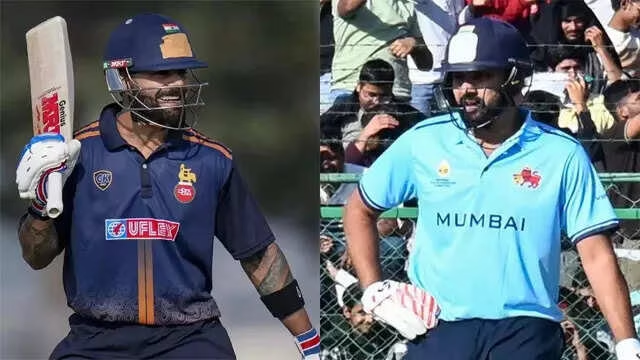
The groans from cricket fans across India are almost audible. Virat Kohli is smashing centuries for Delhi. Rohit Sharma is back in the blue of Mumbai. And yet, millions are left in the dark, unable to watch a single ball of their heroes in the Vijay Hazare Trophy. The frustration is real, and it’s boiling over on social media with calls of ‘Shame on BCCI!’ .
Now, one of the game’s most respected voices, R Ashwin, has stepped into the fray—not to defend the status quo, but to shed light on the intricate machinery behind the scenes that fans simply don’t see.
Table of Contents
- Ashwin Acknowledges the Fan Fury
- The Real Reason the Vijay Hazare Trophy Isn’t Fully Televised
- The Logistical Nightmare of Domestic Cricket
- A Systemic Issue, Not a Lack of Care
- What Does the Future Hold for Domestic Cricket Broadcasts?
- Conclusion
- Sources
Ashwin Acknowledges the Fan Fury
Speaking candidly on his popular YouTube channel, Ashwin didn’t mince words. “Fans are asking ‘what the hell?'” he admitted, directly quoting the anger he’s witnessed online [[12], [15]]. He completely gets it. Why wouldn’t you want to see your favorite stars in action, especially in a format as dynamic as the 50-over game?
“I get fans’ frustration, but…” is the crucial preface to his entire explanation. It’s a statement that bridges the gap between public emotion and administrative reality. He’s not dismissing their feelings; he’s asking them to look beyond the surface.
The Real Reason the Vijay Hazare Trophy Isn’t Fully Televised
The common assumption is that the BCCI simply doesn’t care about domestic cricket or that it’s a deliberate snub to fans. Ashwin’s insight, however, points to a far more complex issue: logistics and infrastructure.
“You cannot televise all matches,” Ashwin stated plainly . This isn’t a matter of preference; it’s a matter of hard, physical limitations. The Vijay Hazare Trophy features a massive field of 38 teams, all playing across multiple venues in a condensed schedule from December 24, 2025, to January 18, 2026 .
The BCCI simply does not have the broadcasting infrastructure—cameras, production crews, satellite trucks, and transmission facilities—to cover every single game simultaneously across the country [[24], [25]]. Unlike a marquee T20 league with a single city or a few venues, the VHT is a sprawling, nationwide tournament.
The Logistical Nightmare of Domestic Cricket
Imagine the scale: On any given match day, there could be 15-20 games happening at once in different corners of India. Mobilizing a full broadcast setup for each one is not just prohibitively expensive, it’s practically impossible with the current setup.
Furthermore, Ashwin hinted at a pre-existing broadcast schedule. “Broadcasting schedules are set far in advance,” he explained . This means that the decision on which matches get the TV treatment isn’t a last-minute whim based on who is playing, but a logistical plan locked in weeks or even months before the tournament begins.
While select matches, often the knockouts or games in specific neutral venues, are broadcast on Star Sports Khel and streamed on JioCinema, the bulk of the group-stage action remains under the radar [[8], [14]]. This leaves fans of teams featuring giants like Kohli and Sharma completely out of luck if their match isn’t on the pre-approved list.
A Systemic Issue, Not a Lack of Care
It’s important to frame this correctly. This isn’t about the BCCI being indifferent to its fans or its domestic stars. It’s a systemic challenge that has plagued Indian domestic cricket for years. The broadcast quality and availability for domestic fixtures have long been a point of criticism .
The system is built to prioritize international cricket and a few high-profile T20 leagues, which command the bulk of the broadcasting revenue and infrastructure. The domestic circuit, the very bedrock that produces future international stars, is often left to fend for itself with limited resources.
Ashwin’s comments are a call for understanding the complexity of the issue, not an excuse. He’s highlighting that the solution isn’t as simple as ‘just turn on the cameras.’ It requires a fundamental investment in the domestic broadcast ecosystem—a centralized, well-funded production unit dedicated to covering these tournaments comprehensively.
What Does the Future Hold for Domestic Cricket Broadcasts?
The growing fan outrage is a clear signal that the status quo is no longer acceptable. In today’s digital age, where fans have an insatiable appetite for cricket content, the lack of access to domestic matches feels like a relic from a bygone era.
One potential path forward is a dedicated streaming platform or channel for all domestic cricket. This wouldn’t require the massive infrastructure of a full TV broadcast for every game but could utilize more affordable, high-quality streaming setups. The BCCI has shown it can do this for its own platform, and fans are clearly willing to engage.
For now, fans of the Vijay Hazare Trophy will have to rely on scorecards, match highlights, and hope their team’s crucial games make the cut for the limited broadcast window. You can stay updated on all the action through our comprehensive Vijay Hazare Trophy hub.
For a global perspective on how other nations handle domestic broadcasts, the ICC’s official website often features reports on various domestic structures worldwide.
Conclusion
Ravichandran Ashwin’s explanation for the limited TV coverage of the Vijay Hazare Trophy is a much-needed dose of reality. While fan frustration is entirely justified, the problem is rooted in logistical and infrastructural constraints, not a lack of desire to broadcast the games. The presence of superstars like Kohli and Sharma has magnified a long-standing issue, creating a perfect storm of public demand and systemic inability to meet it. The path to a better future for domestic cricket in India must include a serious conversation about investing in its visibility and accessibility for the fans who are its lifeblood.
Sources
- Ashwin, R. (2025). Interview on Vijay Hazare Trophy Broadcast Issues. Ravichandran Ashwin Official YouTube Channel [[12], [15], [20]].
- Times of India. (2025). ‘I get fans’ frustration, but…’: Ashwin explains why VHT matches weren’t televised. Retrieved from https://timesofindia.indiatimes.com/sports/cricket/news/i-get-fans-frustration-but-ashwin-explains-why-vijay-hazare-trophy-matches-werent-televised/articleshow/126171241.cms
- Various. (2025). Vijay Hazare Trophy 2025-26 Broadcast and Tournament Details [[4], [8], [14], [17], [24], [25]].