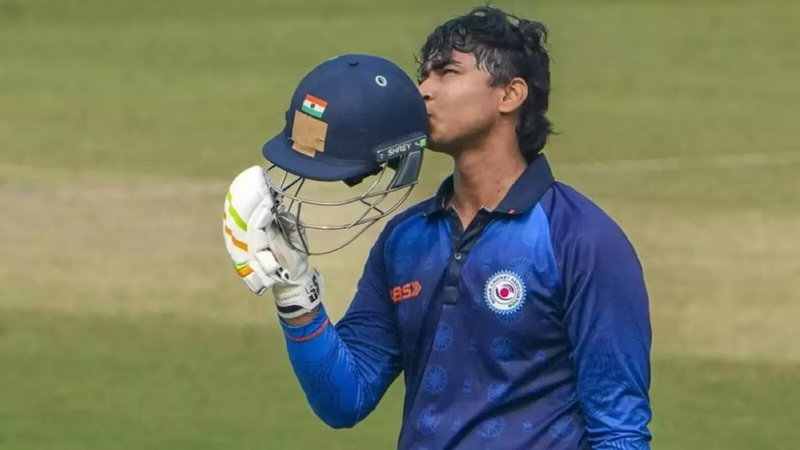
Vaibhav Suryavanshi’s Record 190: A Triumph That Reveals a Troubling Truth
When 14-year-old Vaibhav Suryavanshi smashed a blistering 190 off just 84 balls—including the fastest 150 in List A history—for Bihar against Mizoram in the 2025 Vijay Hazare Trophy, the cricket world rightly erupted in awe . At first glance, it was a moment of pure sporting magic: a teenage prodigy rewriting the record books with audacious strokes and fearless intent.
But beneath the fireworks lies a far more complex—and concerning—narrative. This extraordinary innings, and others like it in the same tournament, expose a growing domestic cricket imbalance that threatens the integrity and developmental value of India’s premier domestic competitions.
Table of Contents
- The Record-Breaking Innings
- Domestic Cricket Imbalance: What’s Really Happening?
- The Northeastern Challenge
- Why Competitive Balance Matters
- Potential Solutions for a Healthier Ecosystem
- Conclusion: Celebrate Genius, But Fix the System
- Sources
The Record-Breaking Innings
Suryavanshi’s assault wasn’t just about runs—it was a statistical anomaly. His 190 featured 12 fours and 15 sixes, helping Bihar post a mammoth 574/6, one of the highest totals in List A cricket history. He reached his century in 55 balls and his 150 in a mere 69 deliveries, eclipsing previous benchmarks set by seasoned professionals .
What’s even more striking? He wasn’t alone. Multiple centuries were scored in that single match, and similar lopsided scorelines have appeared across the tournament, particularly in fixtures involving newly inducted northeastern states.
The Domestic Cricket Imbalance: A Systemic Flaw
The domestic cricket imbalance isn’t a new issue, but Suryavanshi’s innings has acted as a stark spotlight. The problem stems from the uneven development of cricket infrastructure, coaching, and talent pools across India’s vast geography. Traditional powerhouses like Karnataka, Mumbai, and Tamil Nadu have decades of institutional support, while newer teams—many only integrated into the national structure since 2018—lack comparable resources.
This gap creates contests that feel more like training sessions than competitive fixtures. When a team posts 574, it’s not just dominance—it’s an indicator that the opposition isn’t on the same playing field, literally or figuratively.
The Northeastern Challenge
The Board of Control for Cricket in India (BCCI)’s decision to include teams from the northeastern states was a commendable move aimed at expanding cricket’s footprint . However, integration without a robust, long-term support system has left these teams vulnerable.
Many northeastern squads lack:
- Access to high-quality turf wickets and training facilities
- Experienced local coaches and strength-conditioning programs
- Competitive age-group tournaments to build depth
- Scouting networks to identify and nurture talent early
As a result, their players, while talented and enthusiastic, are often thrown into India’s toughest domestic arena without the foundation needed to compete at that level.
Why Competitive Balance Matters
Some might argue that big scores and one-sided wins are simply part of sport. But in a development context, they’re counterproductive. Here’s why:
- False Metrics: A batter scoring 190 against an underprepared attack doesn’t prove they can handle high-quality spin or pace—the true test at the international level.
- Stunted Growth: Bowlers from stronger teams don’t learn to build pressure or execute plans; they just bowl to a script. Meanwhile, bowlers from weaker teams lose confidence.
- Talent Misallocation: Selectors may misjudge players based on inflated stats, overlooking grittier performers in tighter contests.
As ESPNcricinfo has previously noted, “A domestic system that doesn’t challenge its best players is a system that fails its national team” .
Potential Solutions for a Healthier Ecosystem
The BCCI has the opportunity—and responsibility—to course-correct. Here are actionable steps:
- Two-Tier System: Introduce a promotion-relegation structure, giving newer teams time to develop in a lower division before facing elite opposition.
- Targeted Investment: Allocate specific funding for infrastructure, coaching, and grassroots programs in northeastern states [[INTERNAL_LINK:northeast-cricket-development]].
- Shared Resources: Facilitate player loans or coaching exchanges between established and emerging teams.
- Modified Formats: Consider regional qualifying groups before national stages to ensure only the most competitive teams advance.
Conclusion: Celebrate Genius, But Fix the System
Vaibhav Suryavanshi is a once-in-a-generation talent, and his 190 is a moment worth celebrating. But applause alone isn’t enough. His innings has inadvertently exposed a critical flaw in India’s cricketing pipeline: a domestic cricket imbalance that, if left unaddressed, could undermine the very system meant to produce future stars. The BCCI must act not just to protect records, but to protect the future of Indian cricket itself.
Sources
- Times of India: “Applaud, yes — but heed the bigger picture: Suryavanshi’s ton exposes domestic cricket’s imbalance”
- BCCI Official Website: “Inclusion of Northeastern Teams in Domestic Cricket”
- ESPNcricinfo: “The state of India’s domestic cricket: A critical analysis”