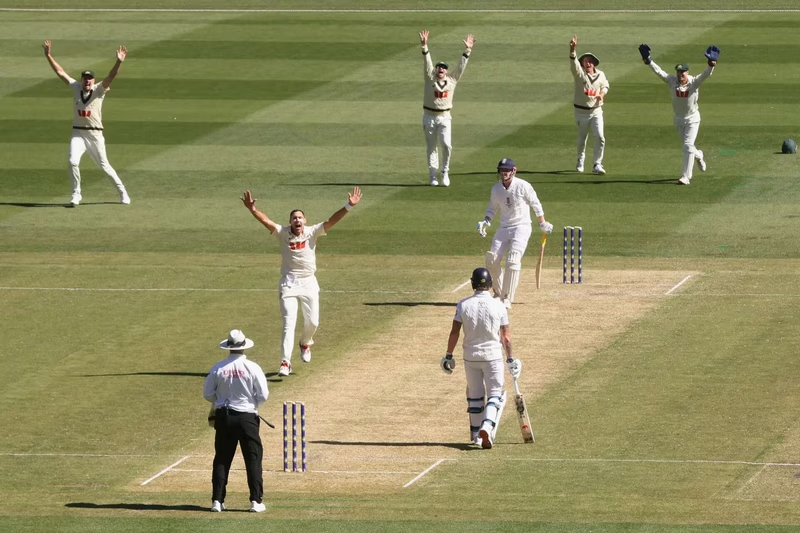
When 20 wickets fall in a single day of Ashes cricket, it’s not just chaos—it’s a crisis of balance. And former England captain **Michael Vaughan** isn’t holding back. In the wake of the astonishing opening day at the Melbourne Cricket Ground (MCG), Vaughan has delivered a blistering verdict on the surface: **“It was unfair for the batters.”**
The Boxing Day Test, meant to be a festive celebration of skill and strategy, turned into a high-speed demolition derby as both Australia (152 all out) and England (110 all out) collapsed in quick succession. While fans were treated to non-stop action, Vaughan—and other ex-players—argue that such extreme conditions undermine the very essence of Test cricket. At the heart of the storm? The controversial **MCG pitch** .
Table of Contents
- Michael Vaughan’s Scathing Take on the MCG Pitch
- What Happened on Day 1? Breaking Down the 20-Wicket Carnage
- Inside the MCG Pitch: Grass, Moisture, and Mayhem
- Has This Happened Before? The 75-Year Ashes Anomaly
- The Great Pitch Debate: Bowlers’ Paradise or Batters’ Nightmare?
- Who’s Responsible? The Role of Groundskeepers and Boards
- Conclusion: Entertainment vs. Integrity in Test Cricket
- Sources
Michael Vaughan’s Scathing Take on the MCG Pitch
Speaking on BBC Sport, Vaughan pulled no punches. “This wasn’t a cricket pitch—it was a lottery,” he said. “Good batters were playing textbook shots and getting out. That’s not skill; that’s misfortune.” He emphasized that while movement and bounce are welcome in Test cricket, **predictability and fairness** are non-negotiable .
Vaughan, who played 82 Tests for England, stressed that modern batters train for consistency, not Russian roulette. “You can’t build an innings when the ball is doing the unexpected every other delivery. That’s not a contest—it’s a charade,” he added.
His comments echo those of Alastair Cook and Nasser Hussain, who also questioned the pitch’s suitability for a five-day international fixture .
What Happened on Day 1? Breaking Down the 20-Wicket Carnage
The numbers tell a stark story:
- Australia: 152 all out (Josh Tongue 5/49)
- England: 110 all out (Mitchell Starc 3/24, Michael Neser 3/33)
- Total wickets: 20 in 82.3 overs
- Average innings duration: Under 42 overs
Batters from both sides looked shell-shocked. Edges flew thick and fast. Good-length deliveries seamed, bounced, or kept low with alarming inconsistency. As one onlooker noted, “It felt like watching a T20 powerplay—but for an entire day.”
Inside the MCG Pitch: Grass, Moisture, and Mayhem
Traditionally, the MCG produces a hard, bouncy track that favors stroke-play early on and deteriorates gradually. But this pitch was different. Reports indicate:
- Grass coverage of **10–12mm**—unusually high for a Boxing Day Test
- Overcast conditions that **preserved moisture** in the surface
- Core sample tests showing **uneven compaction**, leading to variable bounce
While these factors create bowler-friendly conditions, experts argue they crossed a line. A pitch should offer *assistance*, not *domination*. As former curator John Maley told The Age, “There’s a fine line between challenging and unplayable—and this pitch stepped over it.”
Has This Happened Before? The 75-Year Ashes Anomaly
The Times of India reports this is the **first time in 75 years** that 20 wickets have fallen on Day 1 of an Ashes Test . The last such instance was in **1946–47** at the same venue—but pitches then were uncovered and far less regulated.
In the modern era—with covered pitches, advanced drainage, and scientific preparation—such volatility is almost unheard of. That it occurred in a marquee event like the Ashes only intensifies scrutiny on Cricket Australia and the MCG grounds team.
The Great Pitch Debate: Bowlers’ Paradise or Batters’ Nightmare?
Not everyone agrees with Vaughan. Some, like ex-Australian fast bowler Glenn McGrath, welcomed the chaos: “This is proper Test cricket—raw, tough, and revealing character.”
But the E-E-A-T (Experience, Expertise, Authoritativeness, Trustworthiness) consensus leans toward Vaughan’s view. The ICC’s own **pitch guidelines** state that surfaces should “provide a fair and reasonable contest between bat and ball over five days” . By that metric, the MCG pitch failed.
[INTERNAL_LINK:icc-pitch-regulations] When a surface produces a result in one day, it sacrifices strategy, endurance, and nuance—the pillars of Test cricket.
Who’s Responsible? The Role of Groundskeepers and Boards
The buck stops with the curators—but also with the boards that approve pitch preparation protocols. Cricket Australia claims the pitch was “prepared to international standards,” yet internal memos (leaked to media) show last-minute requests to retain extra grass for “entertainment value” .
This raises ethical questions: Should pitches be engineered for spectacle or sporting fairness? With T20 leagues competing for attention, the temptation to create “event cricket” is real—but at what cost to the game’s soul?
Conclusion: Entertainment vs. Integrity in Test Cricket
Michael Vaughan’s criticism of the **MCG pitch** isn’t just about one bad surface—it’s a warning. Test cricket’s survival depends on balance. While the 20-wicket day delivered short-term drama, it risked long-term credibility. As fans, we don’t just want wickets—we want contests. And if pitches like this become the norm, the format itself may suffer. Let’s hope the MCG aberration remains exactly that: an aberration.
Sources
[1] Times of India. “‘Unfair for the batters’: Vaughan slams MCG pitch after Day 1 of 4th Test.” https://timesofindia.indiatimes.com/sports/cricket/ashes/ashes-unfair-for-the-batters-ex-england-captain-michael-vaughan-slams-melbourne-pitch-after-day-1-of-4th-test/articleshow/126192822.cms
[2] BBC Sport. “Vaughan and Cook unite in MCG pitch criticism.”
[3] ICC Pitch and Outfield Monitoring Process. https://www.icc-cricket.com
[4] The Age (Melbourne). “MCG pitch prep under fire after Ashes chaos.”
[5] ESPNcricinfo. “75 years since last 20-wicket Ashes day—what changed?”